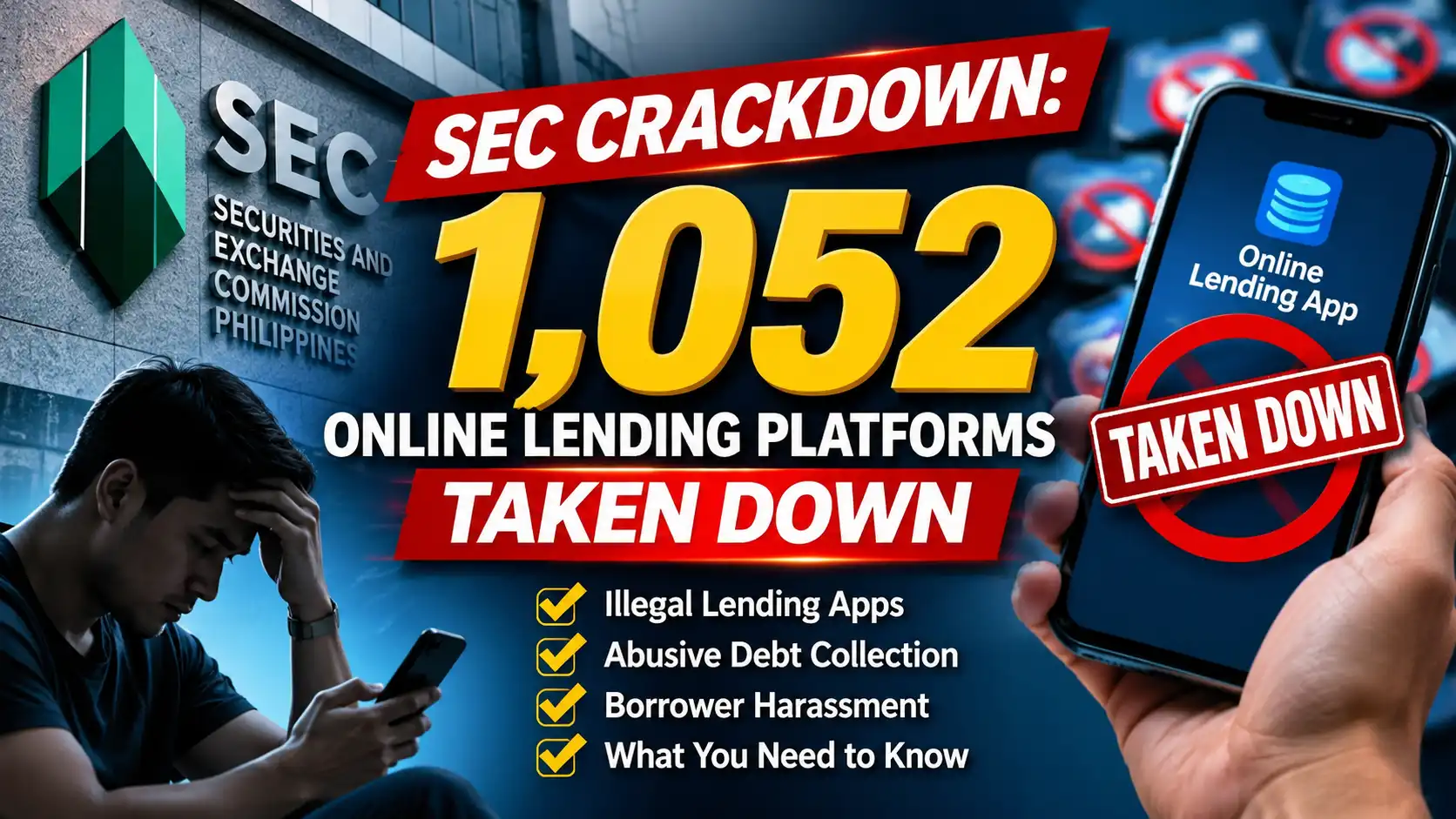
The Philippine Securities and Exchange Commission (SEC) has intensified its crackdown on online lending platforms amid growing concerns over abusive debt collection, harassment, unauthorized lending operations and violations of borrowers’ privacy.
During a House Committee on Banks and Financial Intermediaries hearing on November 23, 2026, the SEC reported that 1,052 online lending platforms, mobile application listings, social media accounts and websites had been taken down as of October 30, 2026.
The disclosure comes as lawmakers examine stronger regulations to protect Filipino borrowers from predatory lending companies, excessive interest charges, threatening collection practices and the misuse of personal information.
For millions of Filipinos who rely on digital lending services to cover emergency expenses, medical bills and everyday financial needs, the crackdown raises several important questions.
Which lending apps are affected? Are borrowers still required to repay their loans? What legal protections are available to victims of harassment? And can the government hold technology companies accountable for allowing unauthorized lenders to operate?
SEC Online Lending Crackdown: Breakdown of the 1,052 Takedowns
The SEC’s reported figures cover multiple digital platforms, not just mobile lending applications.
Online lending platform takedowns — October 30, 2026
SEC Online Lending Crackdown 2026
Reported takedowns as of October 30, 2026
Total platform takedowns
Source: Reported SEC testimony during the November 23, 2026 House Committee on Banks and Financial Intermediaries hearing.
Figures attributed to SEC testimony at the November 23 congressional hearing.
| Platform | Takedowns | Percentage |
|---|---|---|
| 492 | 46.77% | |
| Apple App Store | 196 | 18.63% |
| TikTok | 163 | 15.49% |
| Google Play Store | 115 | 10.93% |
| Websites | 86 | 8.17% |
| Total | 1,052 | 100% |
What Did the SEC Take Down?
Source: Reported SEC takedown figures as of October 30, 2026.
An important distinction is that only 311 of the reported takedowns involved mobile app-store listings. The remaining 741 involved social media pages, accounts and websites.
The figures do not necessarily represent 1,052 separate lending companies, since a single operator may maintain several applications, websites and social media accounts.
The distinction matters because several viral social media posts have described all 1,052 removals as lending apps banned specifically for harassment. The reported SEC figures cover a broader range of enforcement actions.
Why the SEC Is Cracking Down on Online Lending Platforms
Online lending applications, commonly referred to as OLAs in the Philippines, have become increasingly popular because they offer fast access to cash with relatively simple application requirements.
Unlike traditional bank loans, many digital lenders advertise immediate approval, minimal documentation and direct disbursement through electronic wallets or bank accounts.
While legitimate digital lending services provide financial access to underserved Filipinos, unauthorized operators have exploited the same technology to engage in questionable business practices.
Abusive debt collection and harassment
One of the biggest complaints against online lending companies involves aggressive collection tactics.
Borrowers have reported receiving repeated calls, threatening messages, insults and warnings that their personal information will be posted publicly.
Some collection agents allegedly contact borrowers’ relatives, friends, employers and coworkers to pressure them into paying.
These practices can cause emotional distress, damage professional reputations and create unnecessary conflict within families.
Having an overdue loan does not give a collection agency unlimited authority to threaten or humiliate a borrower.
Unauthorized access to personal information
Some lending applications request access to sensitive information stored on mobile phones.
This may include contact lists, photographs, location information and other personal data.
When such information is collected excessively or used to intimidate borrowers, the lender may violate Philippine data privacy regulations.
The National Privacy Commission (NPC) has previously warned lending companies against unnecessary access to borrowers’ contacts and the misuse of personal information during debt collection.
Excessive interest rates and hidden charges
Another concern is the lack of transparency surrounding the actual cost of borrowing.
Some borrowers discover that the amount deposited into their accounts is significantly lower than the approved loan amount because of processing fees and other deductions.
Despite receiving less money, borrowers may still be required to repay the full principal together with interest and additional charges.
Short repayment periods can further increase the financial pressure, forcing some borrowers to take out additional loans to settle existing obligations.
This creates a cycle of debt that can be difficult to escape.
Unauthorized lending operations
Not every application available through a major app store is authorized to operate as a lending business in the Philippines.
Some operators may use misleading company names, imitate legitimate financial institutions or falsely claim to be registered with the SEC.
An application being available on Google Play or the Apple App Store does not automatically establish that its operator has the necessary authority to lend money.
Philippine Lawmakers Push for Stronger Online Lending Regulations
The November 23 congressional hearing highlighted the need for stronger coordination between government regulators, technology companies and law enforcement agencies.
One proposal discussed involves requiring major application distribution platforms to verify whether lending companies have the necessary regulatory authorization before allowing their apps to become available to Filipino consumers.
Such a requirement could help prevent unauthorized lending operators from reaching potential borrowers in the first place.
However, enforcement presents several challenges. Lending operators can change application names, create new social media accounts, move to alternative websites or distribute Android installation files outside official app stores.
Removing an application is therefore only one part of a much larger regulatory problem.
A more effective approach would involve identifying the people and companies behind unauthorized lending operations, investigating financial transactions and holding operators accountable for violations.
Proposed House Bills Against Abusive Online Lending
The official House of Representatives committee agenda for November 23, 2026 confirms that lawmakers are considering several measures to strengthen borrower protection and regulate digital lending operations.
| House Bill | Proposed measure |
|---|---|
| HB 2662 | Prohibition of unfair debt collection practices |
| HB 4016 | Penalties for abusive online lending collection |
| HB 9738 | Verified identification system for debt collectors |
| HB 10269 | Prohibition of threatening and coercive collection practices |
| HB 10366 | Establishment of a compensation board for victims |
| HB 10887 | Stronger protection against predatory online lending |
| HB 241 | Nationwide limits on lending interest rates |
| HB 5283 | Stronger regulatory framework for digital lending |
These proposals could significantly change how online lending businesses operate in the Philippines if enacted into law.
Compensation for victims of online lending harassment
One of the more significant proposals is House Bill 10366, introduced by Representative Chel Diokno.
The measure seeks to establish a Victim Compensation Board for Online Lending Abuses and introduce stronger protections against deceptive and abusive lending practices.
A compensation mechanism could provide another avenue for victims seeking financial redress for harm caused by abusive lenders.
However, the proposed compensation board does not yet exist under this bill. The measure still needs to undergo the legislative process before it can become law.
A nationwide interest rate cap
House Bill 241, also referred to as the proposed Goodbye 5-6 Act, seeks to address loan sharking through nationwide interest rate limits and stronger borrower protection.
Although certain categories of loans are already subject to regulatory interest and fee limits, the proposal seeks broader protections against predatory lending.
The challenge for lawmakers is to balance consumer protection with access to legitimate credit, particularly for Filipinos who cannot easily qualify for traditional bank loans.
SEC List of Illegal and Unauthorized Online Lending Apps in 2026
Following the announcement, many borrowers have been searching for a complete list of the 1,052 online lending platforms removed by the SEC.
As of November 24, 2026, a consolidated public list identifying every removed application, account and website has not been located.
However, the SEC maintains an official database of advisories against unauthorized businesses, fraudulent lending platforms and operators impersonating legitimate financial institutions.
Recent advisories include the following:
| Online lending platform or name | Advisory date | Nature of warning |
|---|---|---|
| TekCash | November 12, 2026 | Unauthorized use of corporate identity |
| Peso Flow | November 4, 2026 | Unauthorized use of corporate identity |
| Pocket Cash – Digital Loan | October 29, 2026 | Fraudulent platform using an existing name |
These advisories can be accessed through the official SEC advisories page.
Borrowers should understand that an advisory involving an impersonator does not necessarily mean that the legitimate company whose identity was stolen is operating illegally.
These examples are also not a confirmed subset of the 1,052 reported takedowns.
How to Check if an Online Lending App Is Legitimate in the Philippines
Before borrowing money through an online lending application, consumers should verify the company behind the platform.
1. Check the SEC list of recorded online lending platforms
The SEC maintains a publicly accessible list of financing and lending companies and their recorded online lending platforms.
The list includes corporate names, SEC registration numbers, platform names and regulatory disclosure information.
Official verification: SEC List of Recorded Online Lending Platforms
2. Verify the company’s authority to lend
SEC corporate registration alone does not automatically authorize a company to conduct lending operations.
Lending companies generally need the appropriate Certificate of Authority to operate.
Consumers dealing with banks and other BSP-supervised financial institutions should also verify their regulatory status through the Bangko Sentral ng Pilipinas.
3. Review the actual borrowing costs
Before accepting a loan, calculate how much money will actually be deposited into your account and how much you will be required to repay.
Consider this hypothetical example:
| Loan details | Amount |
|---|---|
| Approved loan | ₱10,000 |
| Processing fees deducted | ₱2,000 |
| Actual amount received | ₱8,000 |
| Total repayment | ₱11,500 |
| Actual borrowing cost | ₱3,500 |
| Cost relative to amount received | 43.75% |
A loan advertised as having a relatively low interest rate can become extremely expensive once processing charges and other deductions are included.
This example illustrates why borrowers should consider the total cost of credit rather than relying solely on advertised interest rates.
4. Review application permissions
Be cautious when a lending application requests unnecessary access to contacts, photographs, messages, social media accounts or other personal information.
Read the privacy policy before granting permissions. Avoid downloading lending applications from suspicious links, unsolicited text messages or unofficial installation websites.
5. Check recent SEC advisories
A lending application may have changed its name, been impersonated by scammers or become the subject of an enforcement action.
Checking recent government advisories can help identify potential risks before providing personal information or transferring money.
What Philippine Law Says About Online Lending Harassment
The Philippines already has laws and regulations that address unfair lending practices, consumer protection and the misuse of personal information.
SEC Memorandum Circular No. 18, Series of 2019
Issued on August 23, 2019, this regulation prohibits unfair debt collection practices by financing and lending companies.
Prohibited conduct includes certain forms of intimidation, harassment, deceptive representations and unauthorized disclosure of borrowers’ information.
The rules also address the conduct of third-party collection agents working on behalf of lending companies.
Read the official document: SEC Memorandum Circular No. 18, Series of 2019.
Republic Act No. 9474 — Lending Company Regulation Act of 2007
The Lending Company Regulation Act provides the legal framework for regulating lending companies in the Philippines.
It establishes requirements for operating lending businesses and gives regulators authority over covered lending companies.
Republic Act No. 10173 — Data Privacy Act of 2012
The Data Privacy Act protects individuals against unlawful processing and misuse of personal information.
Lending companies that improperly collect, disclose or use personal information may face regulatory action and other legal consequences.
Borrowers can seek assistance from the National Privacy Commission when their personal information has been misused.
Republic Act No. 11765 — Financial Products and Services Consumer Protection Act
This law strengthens consumer protection in the financial services industry.
It recognizes important consumer rights, including fair treatment, transparency, protection of consumer assets and data, and access to complaint-handling mechanisms.
The law provides an additional regulatory framework for addressing misconduct by covered financial service providers.
Can Online Lending Apps Contact Your Family, Friends or Employer?
Debt collectors do not have unrestricted authority to contact everyone in a borrower’s phone directory.
Using personal contacts to publicly embarrass, intimidate or pressure a borrower into paying may violate applicable debt collection and data privacy regulations.
There is an important distinction between contacting a person who is legally responsible for a debt, such as a guarantor or co-maker, and harassing unrelated third parties.
Borrowers who experience unauthorized disclosure of their loan information should preserve the evidence and consider filing complaints with the appropriate government agencies.
Can You Be Arrested for Not Paying an Online Lending App?
An ordinary failure to repay a loan is generally a civil matter.
Article III, Section 20 of the 1987 Philippine Constitution states that no person shall be imprisoned for debt or non-payment of a poll tax.
A collection agent cannot simply order a borrower’s arrest because a loan payment is overdue.
However, separate criminal offenses involving fraud, falsification or other unlawful conduct may have different legal consequences.
A borrower may also face legitimate civil collection proceedings.
Consumers should distinguish genuine legal documents from fabricated arrest warrants, fake court notices and threatening text messages designed to pressure borrowers into immediate payment.
Do You Still Have to Pay if Your Online Lending App Is Banned?
The removal of an online lending application does not automatically cancel an otherwise enforceable loan.
Borrowers may still have contractual obligations even if the application is no longer available on Google Play or the Apple App Store.
However, borrowers may have grounds to dispute certain charges or practices, including unauthorized loans, unlawful fees, inaccurate balances and potentially excessive interest.
If your lending application has been removed:
- Preserve copies of your loan agreement and transaction history.
- Request a detailed statement of your outstanding balance.
- Verify the legal identity and regulatory status of the lender.
- Confirm legitimate payment channels before transferring money.
- Document any threats, harassment or suspicious collection demands.
- Consult the appropriate regulator or a qualified lawyer when the obligation is disputed.
Do not assume that an app-store takedown automatically eliminates your debt. At the same time, do not send payments to unverified personal accounts simply because someone threatens legal action.
How to Report Online Lending Harassment in the Philippines
Borrowers experiencing harassment, threats, fraudulent collection activities or unauthorized disclosure of personal information can seek help from several government agencies.
| Government agency | Types of complaints | Official website |
|---|---|---|
| Securities and Exchange Commission | Unauthorized lending and abusive collection | SEC iMessage |
| National Privacy Commission | Misuse of contacts and personal data | privacy.gov.ph |
| Bangko Sentral ng Pilipinas | BSP-supervised financial institutions | bsp.gov.ph |
| Cybercrime Investigation and Coordinating Center | Online threats, scams and cybercrime | cicc.gov.ph |
| Department of Justice | Cybercrime-related legal concerns | doj.gov.ph |
Evidence to prepare when filing a complaint
A properly documented complaint can help regulators investigate the lending company and identify the individuals responsible.
Useful evidence includes screenshots of threatening messages, call logs, collection agent phone numbers, application names, loan agreements, payment receipts, social media posts and messages sent to relatives or coworkers.
Prepare a written timeline describing when the loan was obtained, when the harassment began and how the collection agents contacted you.
Keep original copies of all available evidence, even if the lending application has already been removed.
Why Removing Lending Apps Is Not Enough
Illustration of how unauthorized lending operations can continue despite platform removals.
The removal of 1,052 online platforms represents a significant enforcement effort, but it does not necessarily eliminate the businesses behind them.
An unauthorized lender can potentially reappear under a different application name, establish new social media accounts or create another website.
This is why stronger enforcement should extend beyond removing digital platforms.
Potential long-term solutions include mandatory verification before app publication, better coordination between government agencies, transparent disclosure of borrowing costs, stronger penalties, accessible complaint systems and effective enforcement against the people responsible for illegal lending operations.
Financial education is equally important. Consumers need to understand the actual cost of short-term borrowing and how to recognize predatory lending practices before entering into a loan agreement.
The Online Lending Abuse Cycle
Illustrative cycle of unauthorized online lending operations. The sequence does not represent every lending company.
What the SEC Crackdown Means for the Philippine Economy
Online lending is not inherently harmful. Responsible digital lending can improve financial inclusion by providing access to credit for individuals and small businesses that are underserved by traditional financial institutions.
The problem arises when financial technology is used to exploit people facing economic difficulties.
Borrowers trapped in expensive short-term debt may have less money available for food, housing, transportation, education and healthcare.
Repeated borrowing can also weaken household financial stability and reduce consumer purchasing power.
Stronger regulation could help restore confidence in legitimate financial technology companies while discouraging operators that rely on deceptive lending and aggressive collection practices.
The objective should not be to eliminate digital lending altogether. It should be to make borrowing safer, more transparent and more affordable.
Frequently Asked Questions
Is it true that the SEC banned 1,052 online lending apps?
The SEC reported 1,052 online lending-related takedowns as of October 30, 2026. However, the total includes mobile app listings, Facebook pages, TikTok accounts and websites, not just standalone lending applications.
Are all online lending apps illegal in the Philippines?
No. Many online lending platforms operate legally under authorized lending companies, financing companies or other regulated financial institutions.
Borrowers should verify the company and its lending authority before applying.
Where can I find the SEC list of banned lending apps?
You can check the official SEC advisories page for enforcement actions and warnings. A complete consolidated public list of all 1,052 takedowns has not been located as of November 24, 2026.
Can an online lending company post my picture on Facebook?
Using a borrower’s photograph or personal information to shame or intimidate them may violate applicable data privacy and debt collection regulations.
Victims can report such conduct to the SEC and National Privacy Commission.
Can I sue an online lending company for harassment?
Depending on the circumstances and available evidence, victims may pursue administrative complaints, civil remedies or other appropriate legal actions.
A qualified lawyer can help determine whether compensation or other remedies may be available.
Can I block abusive collection agents?
Borrowers can take reasonable steps to protect themselves from abusive communications. Preserve evidence before blocking numbers and maintain a legitimate communication channel for addressing valid financial obligations.
Blocking a collection agent does not automatically cancel a debt.
Is the government creating a compensation fund for online lending victims?
House Bill 10366 proposes a Victim Compensation Board for Online Lending Abuses. As of November 24, 2026, this remains a legislative proposal and does not establish an existing entitlement to compensation.
The Bottom Line
The SEC’s removal of 1,052 online lending-related platforms highlights the scale of the Philippines’ continuing battle against unauthorized digital lending and abusive debt collection.
The November 23 congressional hearing also exposes an important weakness in the current regulatory system: authorities can coordinate the removal of problematic applications, but preventing unauthorized operators from reaching consumers remains a challenge.
Stronger laws, better enforcement, greater accountability from technology companies and improved financial education could help address these problems.
For borrowers, the message is clear. Verify lenders before borrowing, understand the actual cost of loans, protect your personal information and document abusive collection practices.
Financial difficulties should never become an excuse for harassment, intimidation or public humiliation.
The next test for the government is whether these enforcement actions and proposed laws will lead to lasting improvements in consumer protection rather than another temporary removal of applications that eventually reappear under different names.
Sources and official government documents
Last updated: November 24, 2026
- ABS-CBN News: Lawmakers explore app-store restrictions on unauthorized lending platforms — November 23, 2026.
- NewsWatch Plus: House lawmakers eye stricter app screening after 1,052 online lending platform takedowns — November 24, 2026.
- House of Representatives: Official Committee Meeting Agenda — November 23, 2026.
- SEC Memorandum Circular No. 18, Series of 2019.
- SEC List of Recorded Online Lending Platforms — October 20, 2026.
- SEC Official Public Advisories.
- National Privacy Commission.
Disclaimer: This article is for general information and does not constitute legal or financial advice.