
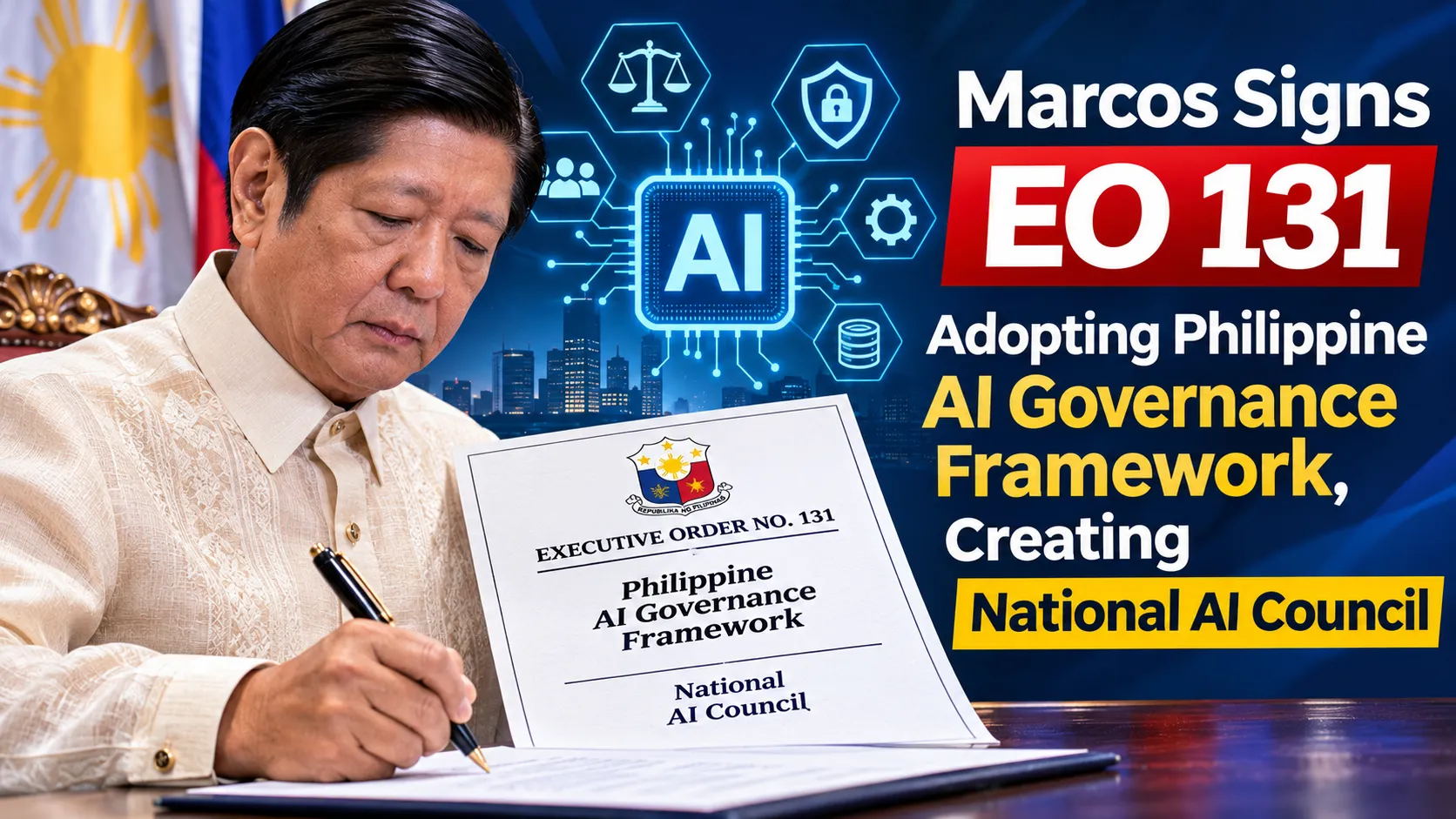
President Ferdinand Marcos Jr. signed Executive Order No. 131 on November 12, 2026, formally adopting the Philippines’ Artificial Intelligence Governance Framework and creating a National Artificial Intelligence Council, a new cross-agency body meant to coordinate the country’s AI policy and rollout.
The order matters beyond the technology sector. By putting AI under a national governance framework, the administration is signaling that artificial intelligence will affect public services, skills training, data policy, digital infrastructure and future government spending decisions. The official listing of the issuance appears on the Official Gazette’s executive orders page, while details on the framework’s implementation were reported by GMA News.
What changed under EO 131
Based on the available official and media reports, EO 131 does two main things: it adopts an AI Governance Framework as a national strategic guide, and it creates the National Artificial Intelligence Council, or NAIC, to help coordinate implementation across government.
That shift is significant because AI policy in the Philippines has often been discussed in pieces — as a matter of innovation, digitalization or industry promotion. EO 131 appears to consolidate those conversations into a formal government-wide structure.
GMA News reported that the council will organize technical working groups covering institutions, data and research development, capabilities, infrastructure and demand generation. Those categories suggest the government is looking not only at rules for AI use, but also at the practical conditions needed to build an AI ecosystem.
Why this matters to Filipinos
For most people, EO 131 will not immediately change daily life. There is no indication from the reviewed sources that the order instantly creates new public services, direct cash support or mandatory rules for ordinary users. But the long-term effects could be wide-ranging.
For workers and students, an AI policy framework could influence future training programs, digital-skills initiatives and education planning. For businesses and startups, it may shape the investment climate, partnerships with government and expectations around responsible AI use.
For taxpayers, the most important question is whether the new framework leads to measurable benefits rather than expensive, poorly coordinated projects. AI systems can require major investments in computing, connectivity, power, water and technical expertise. That means implementation is not just a tech story; it is also a public spending and accountability story.
Infrastructure and funding questions are central
One of the more consequential details reported by GMA News is that the infrastructure component of the framework is meant to align with the Philippines AI Infrastructure Masterplan 2026–2033. The report said this includes digital infrastructure rollout as well as resource needs tied to AI systems, including energy and water planning.
That detail is important because it shows AI policy is being treated as an infrastructure issue, not only a software or regulation issue. If the country intends to scale AI use in government and the economy, agencies will likely have to deal with capacity constraints, procurement choices and operating costs.
On funding, GMA News reported that initial implementation money will come from existing appropriations of member agencies and other funds identified by the Department of Budget and Management, subject to regular budgeting and auditing rules. Future requirements are expected to be included in annual budget proposals.
That means the Marcos administration has laid out a starting mechanism for implementation, but the available reports do not yet provide a full cost estimate. It is still unclear how much additional spending will be needed, which agencies will take the lead in procurement, and how government will measure whether the framework actually improves services, productivity or jobs.
Part of a broader digital-governance push
EO 131 does not appear to be an isolated move. Earlier in 2026, the Presidential Communications Office said Marcos had ordered the updating and modernization of the government’s data classification structure through Executive Order No. 119. In the PCO’s framing, that move was connected to digital transformation and the handling of government data, as seen in its release on modernizing the government data classification structure.
The administration has also publicly argued that new technologies should deliver concrete benefits to Filipinos. In another PCO release, Marcos was quoted as saying government must ensure emerging technologies serve the public, not just exist as policy buzzwords, according to the PCO statement on ensuring new technologies serve Filipinos.
Taken together, those earlier moves provide context for EO 131. The government appears to be building a wider policy architecture around data, digital transformation and now AI governance.
What remains unclear
Even with the signing of EO 131, several important details remain unresolved in the material reviewed.
The full operational structure and exact membership list of the National Artificial Intelligence Council were not fully available from the supplied sources.
No independently verified overall cost estimate for nationwide implementation was available in the reviewed material.
The sources do not yet spell out specific deadlines, performance targets or key performance indicators for agencies.
It is still unclear how the framework will address difficult issues such as automated decision-making, labor displacement, liability, procurement standards, data access and sector-specific regulation.
Those uncertainties matter because AI governance is not just about promoting innovation. It is also about setting guardrails, assigning responsibility and making sure public money is used effectively.
What happens next
The next phase will likely depend on how quickly the new council is organized and whether agencies begin publishing implementing details. The creation of technical working groups suggests the government intends to move from broad policy statements to more specific planning.
For the public, the key signs to watch are practical ones: which agencies are named to lead, whether budget proposals expand, what standards are issued for government AI use, and whether any measurable public-service improvements are promised.
For now, the clearest verified development is that the Philippines has taken a formal national step on AI governance. Whether EO 131 becomes a meaningful accountability framework or simply another coordinating body will depend on the decisions that follow.
FAQ
What is EO 131?
EO 131 is an executive order signed by President Ferdinand Marcos Jr. on November 12, 2026 adopting the Philippines’ AI Governance Framework and creating the National Artificial Intelligence Council.
When was EO 131 signed?
The Official Gazette listing indicates it was signed on November 12, 2026. Media reports with additional details were published on November 14, 2026.
Will EO 131 immediately affect ordinary Filipinos?
Not directly for most people in the short term. Its immediate effect is on policy coordination inside government. Any wider impact on jobs, education, regulation or public services will depend on implementation.
Why should taxpayers pay attention?
Because AI policy can lead to future spending on infrastructure, data systems, training and procurement. Oversight will matter as the framework moves from announcement to execution.
Sources
- Executive Orders | Official Gazette of the Republic of the Philippines
- Marcos signs EO adopting AI framework, creates national council | GMA News Online
- PBBM orders update, modernization of gov’t data classification structure – Presidential Communications Office
- PBBM: Gov’t must ensure new technologies serve Filipinos – Presidential Communications Office