
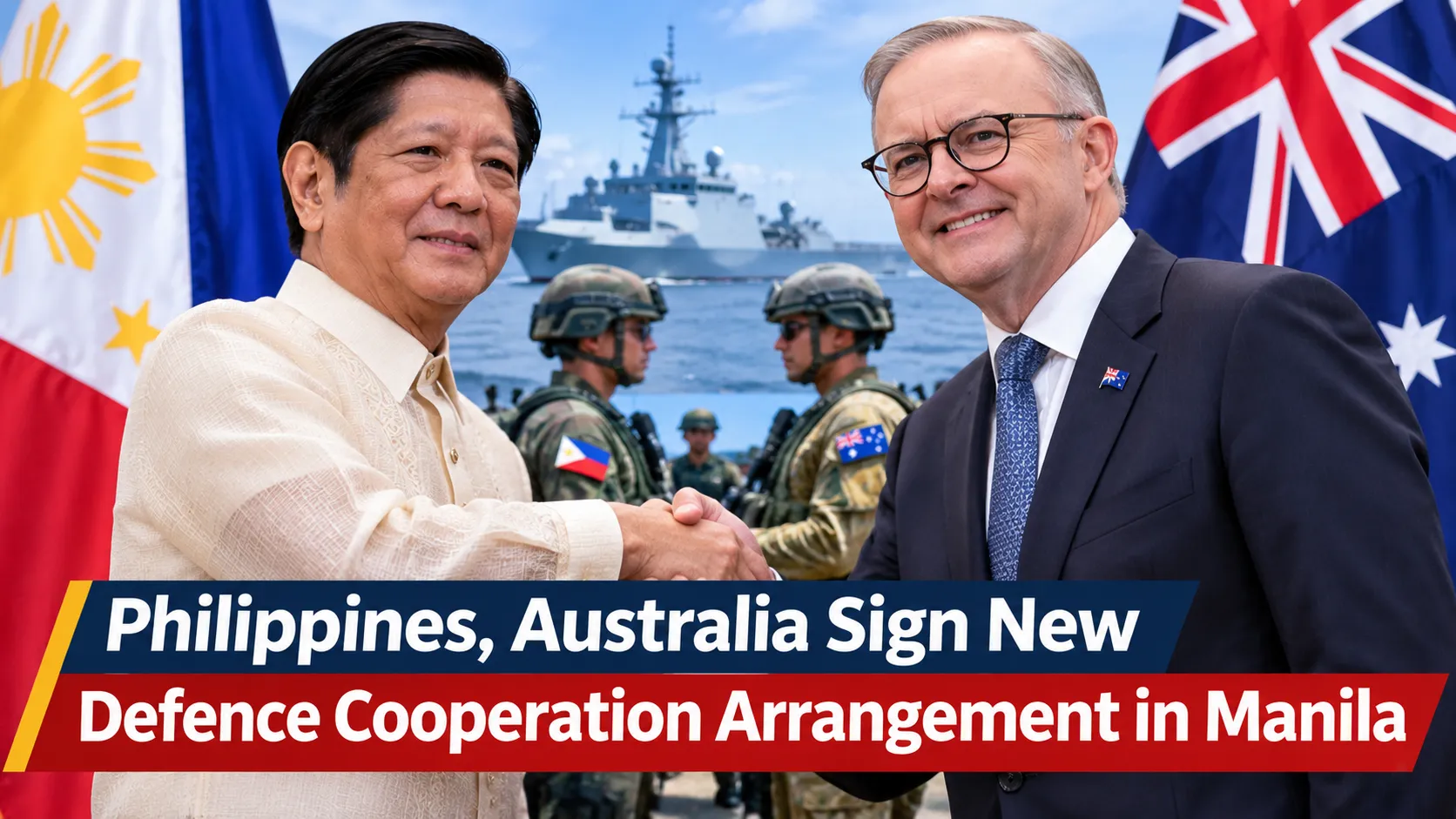
The Philippines and Australia signed a new defence cooperation arrangement in Manila on November 15, 2026, broadening military coordination in areas that include maritime awareness, training, cyber defence, logistics and disaster response.
The signing is significant because both governments are presenting it as a practical upgrade to an older framework, not just a symbolic diplomatic gesture. In an official Australian defence release, Canberra said the arrangement provides a “contemporary framework” for cooperation and covers priority areas such as maritime awareness, information-sharing, strategic dialogue, planning, interoperability, secure communications, logistics, force protection, disaster response and defence infrastructure development. The release is available here.
What changed in Manila
The new arrangement updates longstanding Philippines-Australia defence ties that Australian officials say have previously rested on a 1995 memorandum of understanding and the 2012 Status of Visiting Forces Agreement, or SOVFA. An earlier joint statement by the two countries’ defence ministers in August 2026 had already signaled that both sides were working on a replacement for the 1995 framework.
That matters because the latest deal appears aimed at making existing cooperation easier to carry out. Reuters reported, via a republished story on Investing.com, that Philippine Defence Secretary Gilberto Teodoro Jr. said the arrangement would reduce bureaucratic friction in implementing the SOVFA and support closer land, air, maritime and disaster-response cooperation. Reuters’ report can be read here.
Based on the publicly available summaries, this is best described as a defence cooperation arrangement or implementing framework. It is not presented in the reviewed materials as a new mutual-defence treaty.
Why the South China Sea is central to the story
The agreement comes as the Philippines continues to deepen security ties with partners amid repeated maritime tensions in the South China Sea, including incidents involving Filipino vessels and personnel.
In a joint leaders’ statement issued on November 16, 2026, the Philippines and Australia linked their expanded security cooperation to support for international law and regional stability. The statement expressed concern over coercive and dangerous actions against Filipino nationals and vessels, and reaffirmed the July 12, 2016 arbitral award as final and binding on the parties to that arbitration. The leaders’ statement is available here.
For Filipino readers, that language is important. It shows Manila and Canberra are not treating the arrangement as a narrow administrative update. They are also placing it within the wider dispute over maritime rights, navigation and security in waters the Philippines refers to as the West Philippine Sea.
Reuters also reported China’s opposing position: Beijing rejects the 2016 arbitral ruling, says its actions in the South China Sea are lawful, and opposes joint military activity by the Philippines and its partners on the grounds that such actions raise tensions.
What areas of cooperation are covered
The official Australian release identifies a wide scope for future cooperation. These include:
- Maritime awareness and information-sharing
- Strategic dialogue and planning
- Training and interoperability
- Cyber defence and secure communications
- Logistics and sustainment
- Force protection
- Disaster response
- Defence infrastructure development
Several of those areas have direct public-interest implications beyond traditional military planning. Better maritime awareness could support monitoring of disputed waters and sea lanes. Disaster-response cooperation matters in a country regularly hit by typhoons and other emergencies. Secure communications and cyber coordination could also become increasingly relevant as defence and government systems face growing digital risks.
Why this matters to ordinary Filipinos
For most households, a defence agreement can feel remote. But the practical effects can be closer to home.
If the arrangement speeds up coordination under existing visiting-forces rules, it could help the Philippines and Australia carry out more regular exercises, planning and maritime-security activities. That may improve readiness in patrol coordination, humanitarian assistance and emergency response.
It could also complement other recent security partnerships involving the Philippines. For example, The Daily Caffeine recently reported on Japan’s security grant for Philippine coastal radar and drones, another sign that Manila is building security capacity through multiple partnerships.
At the same time, the immediate real-world impact is still unclear. The reviewed materials do not include the full public text of the arrangement, a confirmed Philippine implementation budget, or a detailed project timeline.
What remains unclear
Several key questions remain unanswered based on the sources provided:
| Issue | What is known | What is still unclear |
|---|---|---|
| Legal form | The deal is described as a defence cooperation arrangement/framework. | Whether any further domestic process or publication of full legal text will follow. |
| Funding | The Reuters report mentions Australian support for maritime domain awareness, equipment, training and drone-related help. | No single consolidated public budget figure for the arrangement itself was confirmed in the reviewed materials. |
| Timeline | The pact was signed on November 15, 2026. | No full implementation schedule or list of first projects was publicly detailed in the materials reviewed. |
| Immediate deliverables | Priority areas were identified by officials. | It is not yet clear which activities will start first or when. |
Background: a relationship being modernized
Australian officials have said 2026 marks the 80th anniversary of diplomatic relations between the two countries. The August 7, 2026 defence ministers’ statement showed that the new arrangement had been in preparation for months and was intended to supersede and modernize the 1995 defence cooperation MOU.
That background suggests the Manila signing is part of a longer shift: from a narrower, older defence framework toward broader cooperation that includes cyber resilience, communications security, infrastructure and more integrated planning.
What to watch next
The most important follow-up is implementation. Filipinos should watch for any official announcements on:
- new joint exercises or expanded training cycles;
- maritime surveillance or drone support;
- defence infrastructure projects;
- cyber and secure-communications initiatives; and
- new guidelines that make SOVFA-related activities easier to execute.
Another question is whether Philippine officials will release more detail on costs, timelines and measurable outputs. For an arrangement framed as practical and operational, those details will determine how much changes beyond the diplomatic language.
FAQ
What exactly was signed?
A new Philippines-Australia defence cooperation arrangement was signed in Manila on November 15, 2026.
Is this a new military alliance?
Based on the reviewed sources, no. It is described as an expanded cooperation framework, not a new mutual-defence treaty.
Why is the South China Sea part of the story?
Because the leaders’ statement tied the partnership to maritime security, concern over actions against Filipino vessels and support for the 2016 arbitral ruling.
What could change first?
The clearest possibilities are smoother implementation of existing defence activities, more training and interoperability work, and closer maritime and disaster-response coordination.
The Manila signing gives the Philippines and Australia a broader and more up-to-date structure for defence cooperation. But the real test will come in the next announcements: what projects begin first, how fast they move, and whether the arrangement delivers visible gains in maritime security and disaster preparedness.
Sources
- Enhancing defence cooperation and maritime security in Southeast Asia | Defence Ministers
- Philippines, Australia sign defence pact with eye on China By Reuters
- Kasandigan: Philippines-Australia Leaders’ Statement on Expanded Security and Defense Cooperation | Prime Minister of Australia
- Joint Statement from Australia-Philippines Defence Ministers’ Meeting | Defence Ministers