
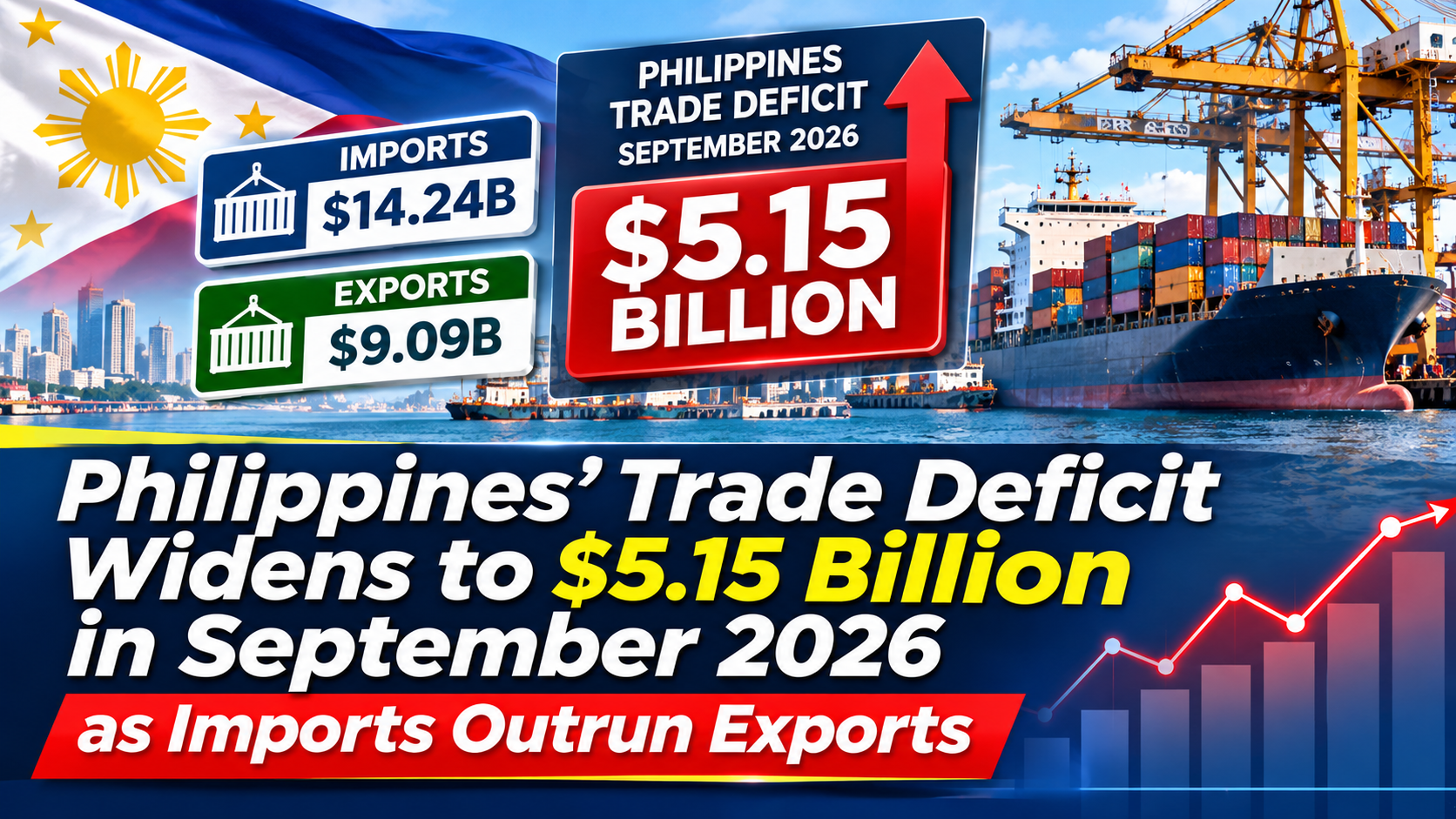
The Philippines’ preliminary goods trade deficit widened to $5.15 billion in September 2026, according to the latest merchandise trade release from the Philippine Statistics Authority, adding to signs of strain in the country’s external trade position as imports continued to run ahead of exports.
The September figure matters beyond economics dashboards. For households and businesses, a wider trade gap can translate into added pressure on the peso and higher costs for imported fuel, food inputs, medicines, gadgets, machinery, and raw materials over time. It does not automatically mean a crisis or an immediate jump in prices, but it is one of the indicators policymakers watch closely when inflation is already a public concern.
What changed in the September 2026 trade data
The key update is the size of the gap: the Philippines posted a $5.15-billion trade deficit for September 2026 in preliminary data tied to the PSA’s monthly international merchandise trade report. The official release is available on the PSA’s September 2026 merchandise trade page.
A trade deficit means the country imported more goods than it exported during the month. In this case, the deficit widened as imports outpaced exports, continuing a pattern that has kept the Philippines in negative goods trade territory for much of 2026.
Separate external indicators published by the Bangko Sentral ng Pilipinas show the country also carried a large cumulative trade deficit from January to September 2026, suggesting the September reading was not an isolated one-month swing. The broader external backdrop appears in the BSP’s selected external indicators report.
Why the trade deficit matters to Filipinos
Trade balances can feel abstract, but their effects are practical.
The Philippines depends heavily on imports for energy, industrial inputs, capital equipment, and many consumer goods. When imports grow faster than exports for a sustained period, more foreign currency is needed to pay for those purchases. That can put pressure on the peso, especially when combined with other factors such as oil prices, global dollar demand, capital flows, and interest-rate expectations.
If the peso weakens, imported products and imported components may become more expensive in peso terms. Over time, that can affect:
- fuel and transport costs,
- electricity and power-related expenses,
- prices of imported food and food inputs,
- medicine and medical supplies,
- gadgets, appliances, and vehicles, and
- business costs for manufacturers and retailers.
That said, the link is not automatic or immediate. A wider trade deficit is a warning signal, not proof that price increases will follow right away. Inflation and exchange-rate movements depend on multiple forces, not trade data alone.
Part of a bigger 2026 economic picture
The September trade gap lands at a sensitive time for the economy. Recent official data has already pointed to slower growth and elevated inflation, both of which shape how consumers and investors interpret new trade numbers.
For readers following the broader economy, this development fits alongside recent indicators such as weaker output growth and faster price increases. Those trends help explain why external trade data matters: it is another window into how much pressure the economy is absorbing from abroad.
A trade deficit by itself does not mean the economy is failing. Fast-growing economies often import heavily, especially if firms are buying machinery, equipment, or industrial supplies. But when the imbalance remains large, it raises questions about competitiveness, foreign exchange demand, and how resilient the country is to external shocks.
What the data does and does not show
The available evidence supports several firm conclusions.
- The data month is September 2026.
- The Philippines posted a $5.15-billion preliminary trade deficit for that month.
- The broader 2026 pattern remained one of a deep goods trade imbalance, based on BSP external indicators.
But some important details are still unclear from the research supplied here.
The available PSA summary does not fully show which commodity groups drove the September move most strongly. That means it would be premature to make specific claims about whether fuel, electronics, food, machinery, or another category was the main reason the deficit widened, unless those details are verified in the full statistical tables.
There is also no specific policy response in the supplied evidence tied directly to the September figure. So while the data may influence economic discussions inside government, it would be overstating the evidence to say officials have already announced a new response because of this one report.
How officials and markets may read the number
For economic managers, a larger monthly trade gap is relevant because it can feed into wider assessments of inflation risks, external financing needs, and exchange-rate stability. For businesses, it can be a signal to watch import costs and currency exposure more closely.
For ordinary Filipinos, the main takeaway is simpler: if the country keeps importing far more than it exports, that can add to the pressures that eventually show up in daily expenses. Whether that happens quickly, slowly, or only mildly depends on what comes next with the peso, oil, food supply chains, and inflation.
In the near term, analysts will likely look for the next rounds of trade, inflation, and currency data to see whether September was part of an intensifying trend or a figure that stabilizes in later months.
FAQ
What is a trade deficit?
A trade deficit means the Philippines imported more goods than it exported during a given period. The PSA’s trade database explains the framework used in its merchandise trade statistics at OpenSTAT.
Does a wider trade deficit mean prices will rise immediately?
Not necessarily. It can add pressure on the peso and on import costs, but actual price movements depend on many factors, including oil prices, exchange rates, supply conditions, and domestic demand.
Is a trade deficit always bad?
No. It can reflect strong domestic demand or business investment. The concern is when the deficit stays large for a long time and increases the economy’s exposure to external shocks.
What should readers watch next?
The next important indicators are upcoming trade releases, peso movements, inflation data, and any official economic guidance from the BSP or national government.
The September 2026 trade data does not tell the whole story of the Philippine economy. But the $5.15-billion deficit is a meaningful sign that imports are still running ahead of exports, keeping pressure on the country’s external position at a time when inflation and living costs remain central public concerns.