
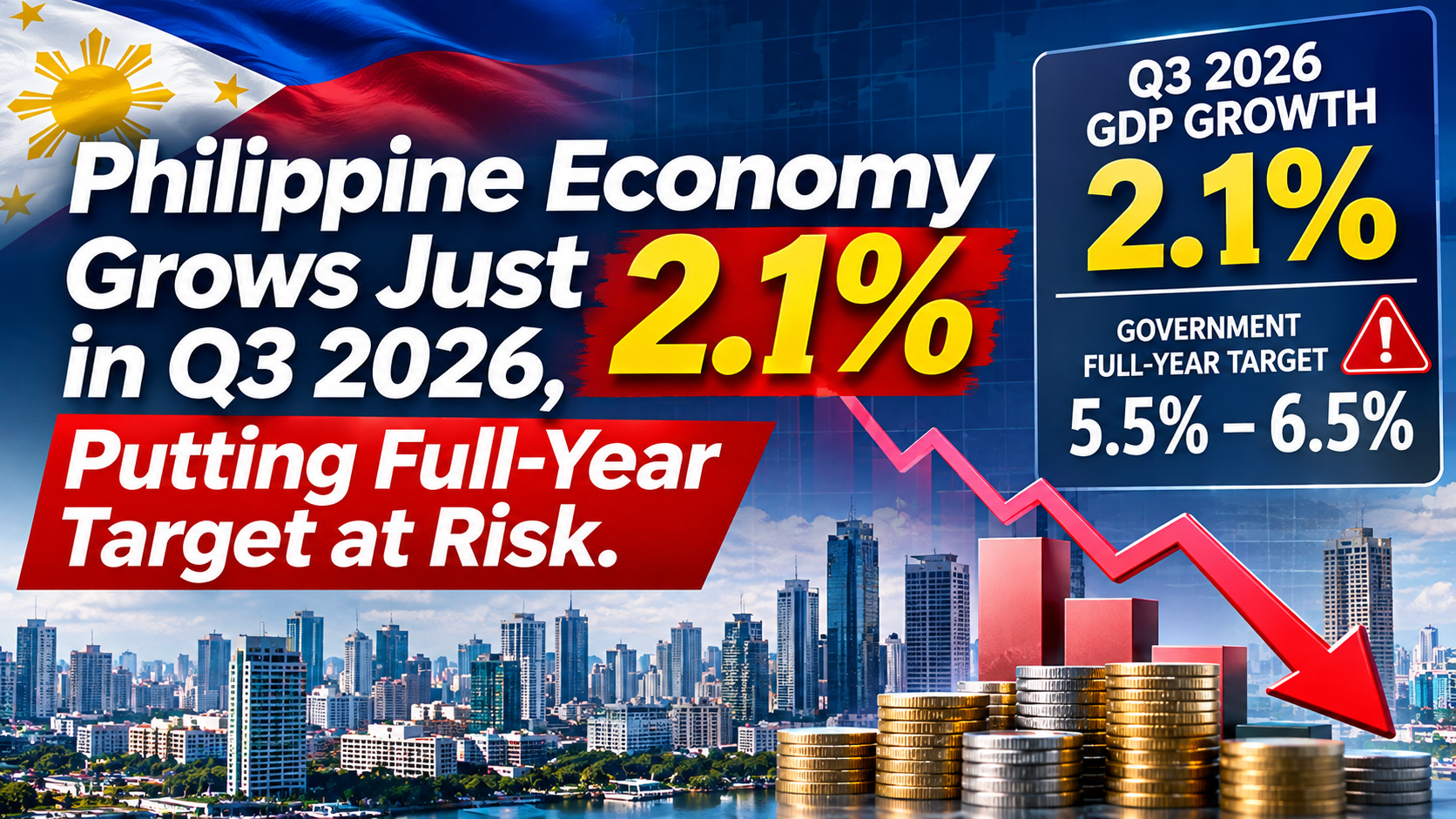
The Philippine economy expanded by 2.1% year on year in the third quarter of 2026, according to the Philippine Statistics Authority (PSA), a weaker result than both the revised 2.4% growth in the second quarter and the 3.0% median forecast cited in Reuters-based reporting. The new data, released on November 9, 2026, adds to signs of a softer economic environment as households and businesses continue to navigate elevated costs and uneven sector performance.
In its official release, the PSA said gross domestic product grew 2.1% in Q3 2026, while gross national income rose 2.7%. On a seasonally adjusted quarter-on-quarter basis, GDP edged up by 0.1%, suggesting only marginal momentum from the previous quarter.
The slowdown matters because GDP is one of the broadest measures of economic activity. While it does not capture every household’s experience, slower growth can signal weaker hiring, softer business expansion, lower tax revenues, and more pressure on policymakers to support the economy without worsening inflation.
What changed in the third quarter
The PSA data showed an uneven picture across the economy.
Services remained the main growth engine, expanding 3.7% from a year earlier. According to the PSA, the top contributors to overall growth were wholesale and retail trade; repair of motor vehicles and motorcycles, public administration and defense; compulsory social security, and financial and insurance activities.
But two major sectors underperformed. Agriculture, forestry and fishing contracted 4.8%, while industry was virtually flat, down 0.003% year on year. Gross capital formation, a measure tied to investment, slipped 0.2%.
That combination matters. A services-led expansion can keep the economy growing, but weakness in agriculture and investment raises concerns about food supply conditions, rural livelihoods, and whether businesses are confident enough to expand production.
Demand held up, but not strongly enough
On the spending side, household final consumption expenditure increased 2.4% in the third quarter, while government final consumption expenditure rose 6.8%. Exports of goods and services grew 8.6%, and imports increased 7.7%.
Those figures suggest consumers were still spending and trade activity remained positive, but the pace was not enough to offset weakness elsewhere in the economy. The Q3 result also came against a backdrop of price pressures already affecting Filipino families. Earlier, The Daily Caffeine reported that Philippine inflation climbed to 7.8% in October 2026, while a separate report noted unemployment rose to 5.4% in September 2026.
Those indicators do not prove a direct cause of the GDP slowdown on their own, but they help explain why many households may still feel financially stretched even when the economy is technically growing.
Why the full-year target is now harder to reach
The Q3 figure has also made the government’s 2026 growth goal more difficult to achieve.
Reuters-based reporting carried by The Straits Times said Economic Planning Secretary Arsenio Balisacan estimated the country would need around 6.3% growth in the fourth quarter to reach the lower end of the government’s 3.5% to 4.5% full-year target. The same report said average growth in the first nine months of 2026 stood at 2.5%, leaving little room for further weakness. That makes the annual target increasingly difficult, though not yet impossible, to hit.
Markets were also expecting a better result. Reuters-based coverage published by Zawya said the median forecast in a poll was 3.0%, meaning the official outcome undershot expectations.
Why ordinary Filipinos should pay attention
For many readers, GDP can sound distant from daily life. But broad economic slowdowns often filter down in practical ways.
Workers and jobseekers: Slower growth can make employers more cautious about hiring or expanding payrolls.
Families dealing with food costs: A sharp contraction in agriculture raises concern because weaker farm output can add stress to supply and incomes in rural communities.
Commuters and consumers: When overall growth softens while inflation stays high, households may have less room in their budgets for transport, electricity, and essentials.
Taxpayers: Slower expansion can affect government revenues, potentially shaping future decisions on spending, subsidies, and public services.
Still, GDP should be read carefully. A slower national growth rate does not automatically mean every business is struggling or every household is worse off. Some sectors are still expanding, and exports and government spending remained positive in the third quarter.
What remains unclear
The latest data confirms the slowdown, but several key questions remain unresolved.
First, the immediate policy response is still uncertain. The supplied research does not establish what specific new fiscal or monetary measures officials will take following the GDP release.
Second, while the PSA data clearly identifies the sectors that weakened, it does not fully settle the relative weight of different pressures behind the slowdown. Agriculture contracted sharply, industry was nearly flat, and investment slipped, but a fuller official and analyst breakdown would be needed to explain how much each factor drove the result.
Third, the size of any fourth-quarter rebound remains unknown. The government can still mathematically reach the low end of its target, but only with a much stronger final quarter than what the economy has recently delivered.
Quick facts on Philippine GDP in Q3 2026
| Indicator | Q3 2026 |
|---|---|
| GDP growth, year on year | 2.1% |
| GDP growth, seasonally adjusted quarter on quarter | 0.1% |
| Gross national income growth | 2.7% |
| Services growth | 3.7% |
| Agriculture, forestry and fishing | -4.8% |
| Industry | -0.003% |
| Household final consumption expenditure | 2.4% |
| Government final consumption expenditure | 6.8% |
| Exports of goods and services | 8.6% |
| Imports of goods and services | 7.7% |
FAQ
What is GDP?
GDP, or gross domestic product, measures the total value of goods and services produced in the economy over a given period.
Did the Philippine economy contract in Q3 2026?
No. The economy still grew, but at a slower 2.1% pace year on year.
Why is 2.1% significant?
It is weaker than the previous quarter’s revised 2.4% growth and below the 3.0% median forecast cited in Reuters-based reporting, showing that economic momentum has softened.
Can the government still hit its 2026 growth target?
Yes, but it will be difficult. Based on Reuters-linked reporting, the economy would need around 6.3% growth in the fourth quarter to reach the lower end of the government’s 3.5% to 4.5% full-year target.
The November 9 national accounts release does not show an economy in decline, but it does show a fragile one. Services are still carrying growth, yet agriculture shrank sharply, industry was nearly flat, and investment remained weak. For policymakers, businesses, and households, the key question now is whether the fourth quarter can deliver a meaningful rebound or whether 2026 will end well below the government’s original hopes.