
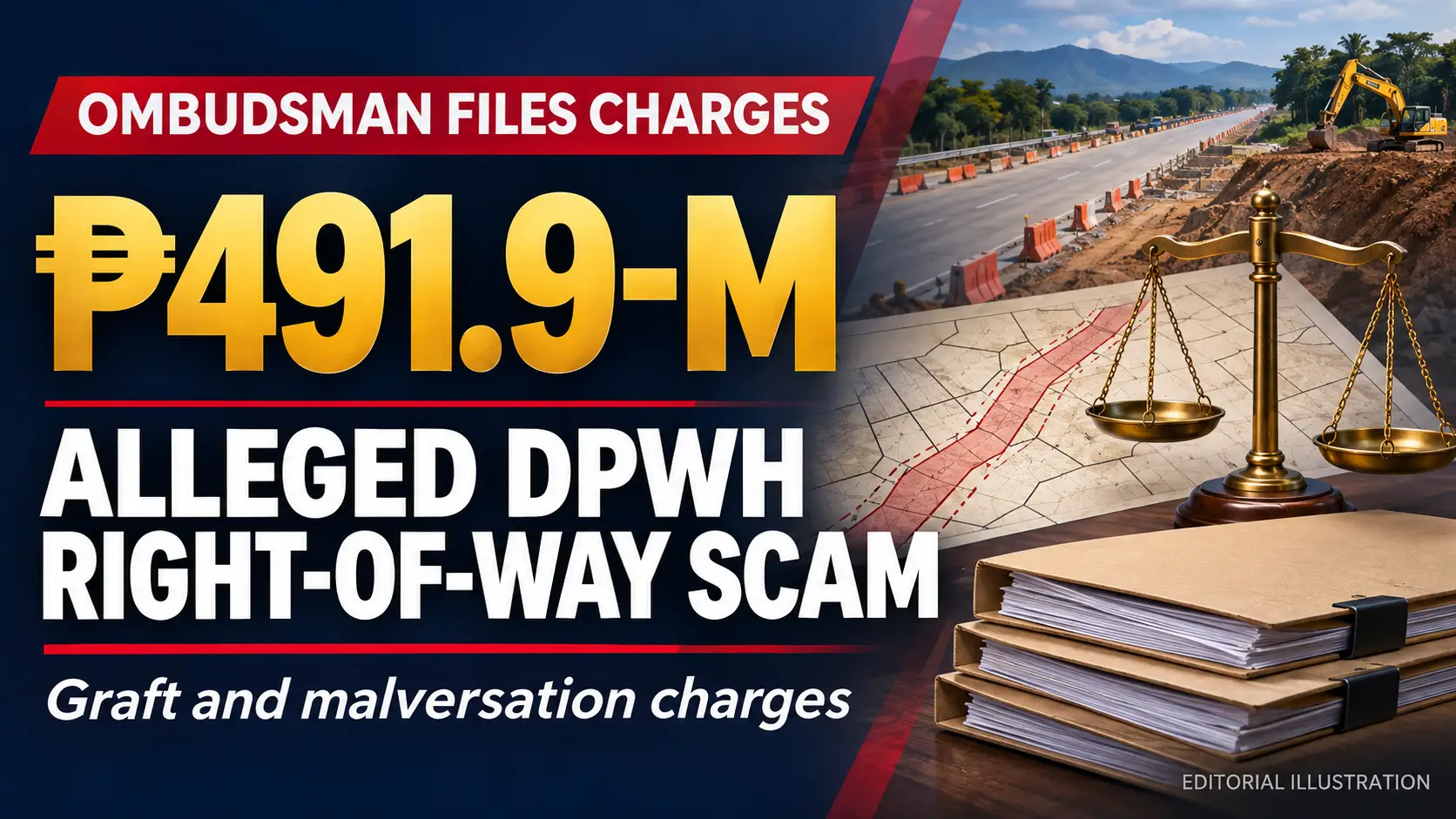
The Office of the Ombudsman has filed criminal charges before the Sandiganbayan against six former Department of Public Works and Highways (DPWH) Region XII personnel and seven private individuals over an alleged ₱491.9-million right-of-way scheme tied to a road project in General Santos City, according to reports published on November 3 and 4, 2026.
As reported by GMA News, the cases include 18 informations for malversation of public funds through falsification of public documents and 18 informations for alleged violation of Republic Act No. 3019, or the Anti-Graft and Corrupt Practices Act. The filing of charges means prosecutors believe there is sufficient basis to proceed in court; it is not a conviction, and the respondents remain entitled to answer the allegations.
What the Ombudsman filed
The key development is the formal filing of cases, not just an investigation or complaint. GMA News reported that the Ombudsman found prima facie evidence with what it described as reasonable certainty of conviction against the named respondents at the charging stage.
The respondents, based on the reports, include six former DPWH Region XII personnel and seven private individuals. The available source material confirms the number of respondents and the amount involved, but the full verified roster of all 13 names was not consistently laid out across the supplied reports.
The alleged scheme centers on right-of-way payments worth around ₱491.9 million in General Santos City. Because the cases were filed before the Sandiganbayan, the matter now moves from prosecutorial review to judicial proceedings.
How the alleged scheme worked
According to a Philstar report cited in the research, the alleged overpayment scheme involved the use of a 2009 appraisal value of ₱3,500 per square meter to compute compensation for properties that had allegedly been taken by government in the early 1990s.
That distinction matters. If prosecutors prove that later appraisal values were improperly applied to much earlier takings, the resulting compensation could have been substantially inflated. At this stage, however, that remains an allegation forming part of the Ombudsman’s case theory.
The supplied sources do not consistently specify the exact project name connected to the disputed right-of-way payments. That missing detail limits how far the facts can be taken beyond the core legal development already reported: charges have been filed over a nearly half-billion-peso alleged scheme involving public works right-of-way compensation in General Santos City.
Why this case matters
Right-of-way spending is one of the most sensitive parts of infrastructure delivery. Governments need land to build roads and other public projects, but land valuation, documentation, ownership claims and payment schedules can become flashpoints for delays, disputes and, in some cases, alleged abuse.
For taxpayers, the issue is not abstract. Alleged overpayments on right-of-way claims can increase the cost of public works, reduce funds available for other projects, and weaken trust in how agencies handle public money. For commuters and local communities, irregularities can also contribute to slower project delivery and prolonged infrastructure bottlenecks.
The case also lands amid broader public scrutiny of DPWH-linked spending and oversight. That wider accountability backdrop is one reason stories like this draw attention beyond the courtroom, especially after recent debates over public-works budgeting and documentation.
What is verified, and what remains uncertain
Several facts are clearly established by the supplied reporting: the Ombudsman filed charges; the cases were filed before the Sandiganbayan; the amount involved was reported at about ₱491.9 million; and the respondents include six former DPWH Region XII personnel and seven private individuals.
But several important details remain less clear from the materials provided. The full text of the Ombudsman’s filing was not included in the research. The exact project identification was not consistently specified in the accessible reports. And no response, denial or statement from the respondents, their counsel, or the DPWH central office was clearly available in the supplied source set.
That means readers should treat the reported mechanics of the alleged scheme as prosecution-stage claims, not as established findings of guilt.
What happens next at the Sandiganbayan
Once charges are filed, the court process begins. The respondents will have the opportunity to challenge the allegations, enter their pleas, and present their own evidence and defenses.
The Sandiganbayan will ultimately determine whether the prosecution can prove the charges beyond reasonable doubt in the criminal cases. Until then, the case remains an allegation under litigation, not a final legal determination.
For the public, the next significant developments will likely include arraignment, possible motions from the defense, and any future court rulings on whether the cases proceed to full trial.
Why accountability cases like this matter in the Philippines
Large infrastructure budgets are often justified in terms of jobs, mobility and regional development. But those same budgets require strong controls over procurement, documentation and land acquisition. Allegations involving right-of-way payments are especially significant because they sit at the intersection of engineering, law, property rights and public finance.
In practical terms, every questionable peso in a right-of-way payout is money that could have gone to road safety, maintenance, classrooms, hospitals or debt reduction. That is why even a single case involving alleged irregularities worth hundreds of millions of pesos can carry national significance.
It also explains why the legal distinction matters. Anti-corruption reporting must be precise: filing charges is an important accountability step, but it is not the same as a conviction. For readers following government accountability, both truths are important at once.
FAQ
What case did the Ombudsman file?
The Ombudsman filed graft and malversation cases tied to an alleged ₱491.9-million right-of-way scheme involving six former DPWH Region XII personnel and seven private individuals.
Where were the charges filed?
The supplied reports say the charges were filed before the Sandiganbayan.
Does this mean the respondents are guilty?
No. The filing of charges means prosecutors believe there is sufficient basis to bring the case to court. Guilt still has to be proven through judicial proceedings.
Who may be affected by this case?
Taxpayers, commuters and communities that depend on timely and efficient infrastructure projects may all be affected by how government handles right-of-way payments and public-works funds.
The immediate significance of the case is clear: a major anti-corruption office has moved a high-value public-works allegation into court. What remains uncertain is whether prosecutors can prove that the right-of-way payments were unlawfully inflated and whether the respondents can rebut the charges. That legal process now shifts to the Sandiganbayan.
Sources
- Ombudsman files charges vs 6 DPWH personnel over alleged P491.9-M right-of-way ‘scam’ | GMA News Online
- DPWH execs face graft for P491.9 million right-of-way scam – Philstar.com
- eClips Senate News Updates
- P491 million ROW scam: Ombudsman sues 6 DPWH execs | Philstar.com
- 278 PHILIPPINE JOURNAL OF PUBLIC ADMINISTRATION
- 8 DPWH execs suspended over Surigao flood projects – Philstar.com