
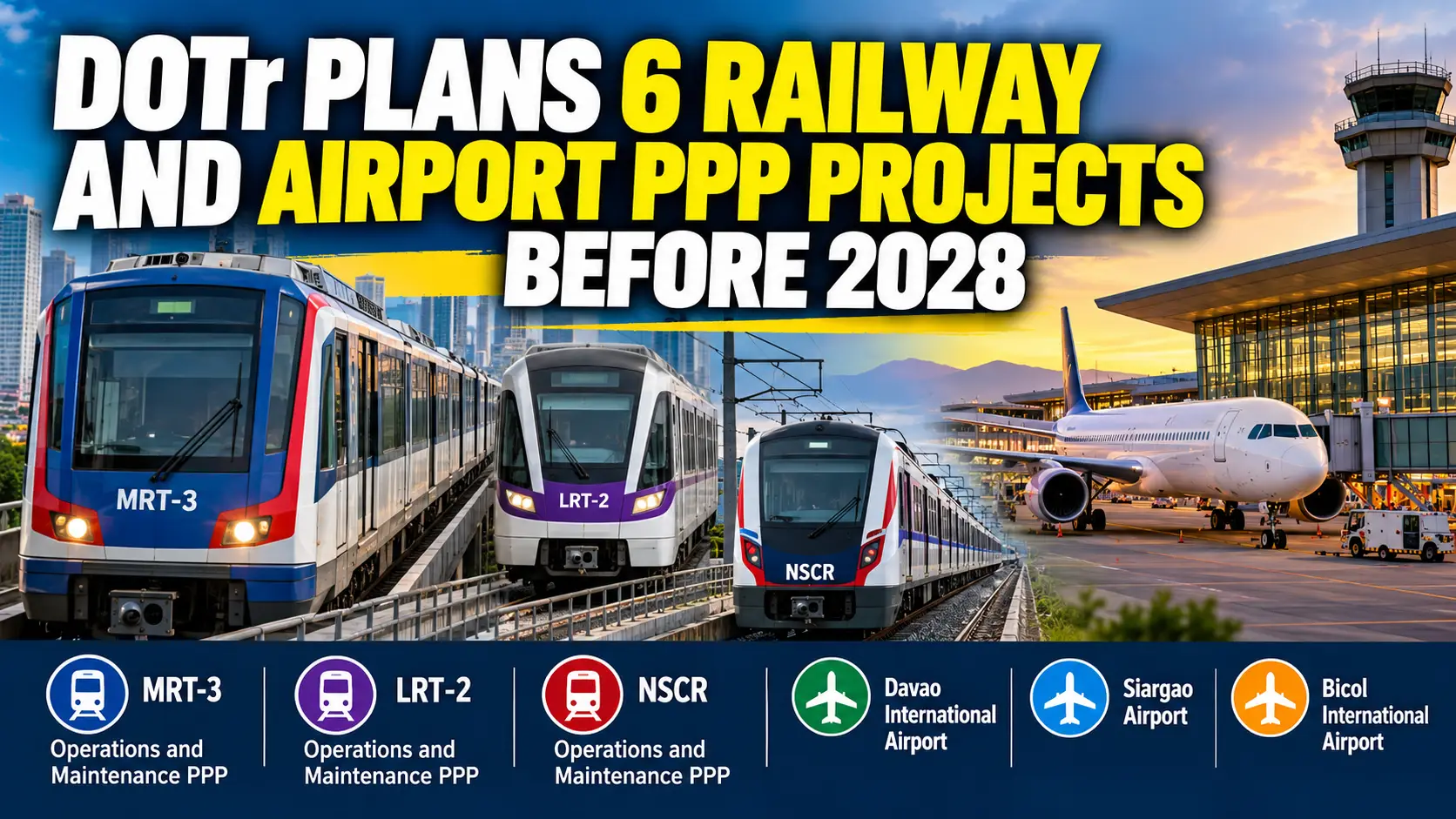
The Philippine government is preparing to bring private-sector partners into six major railway and airport projects before the end of President Ferdinand Marcos Jr.’s term in 2028. But does this mean the country’s railways and airports are being sold to private companies?
The Department of Transportation (DOTr) is pursuing public-private partnership (PPP) arrangements covering three railway systems and three regional airports, with the goal of attracting investment, improving operations and accelerating transport infrastructure development.
Acting Transportation Secretary Giovanni “Banoy” Lopez outlined the plans during the Economic Journalists Association of the Philippines Infrastructure Forum in Makati City on October 19, 2026.
The six projects involve Metro Rail Transit Line 3 (MRT-3), Light Rail Transit Line 2 (LRT-2), the North-South Commuter Railway (NSCR), Davao International Airport, Siargao Airport and Bicol International Airport.
For millions of commuters and travelers, the central questions are straightforward: Will trains become more reliable? Will airport services improve? Will fares and fees increase? And who will remain accountable when services fail?
Here is what the government has announced, what remains undecided and what passengers should watch.
Which Six Transport Projects Are Included?
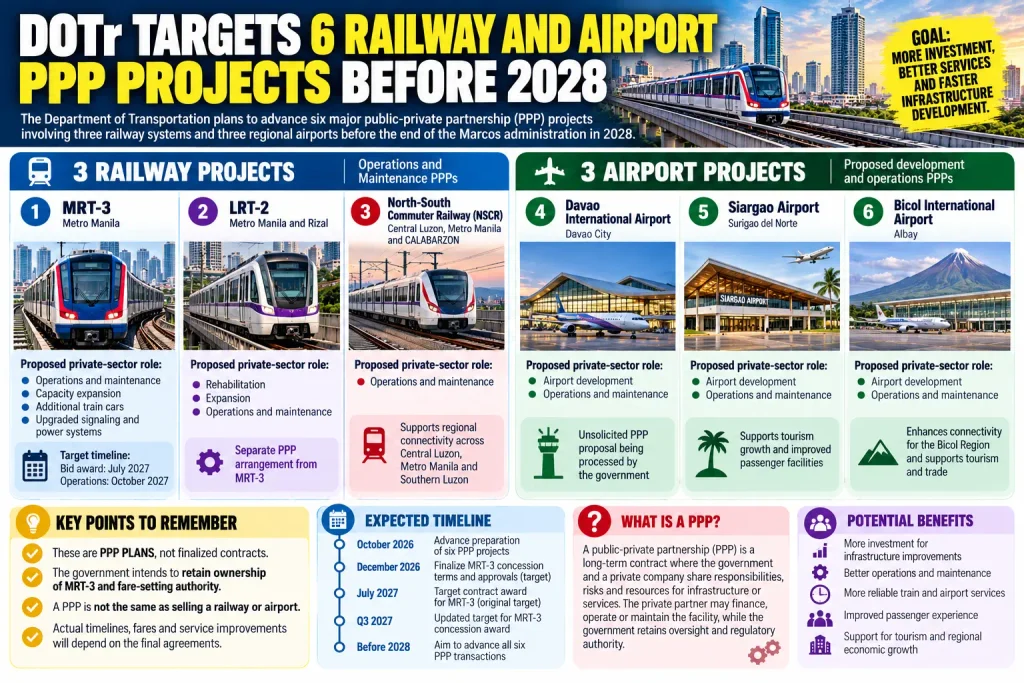
The DOTr’s plans cover three railway operations-and-maintenance partnerships and three airport PPP proposals.
| Project | Location | Proposed private-sector role |
|---|---|---|
| MRT-3 | Metro Manila | Capacity expansion, operations and maintenance |
| LRT-2 | Metro Manila and Rizal | Rehabilitation, expansion, operations and maintenance |
| North-South Commuter Railway | Central Luzon, Metro Manila and CALABARZON | Operations and maintenance |
| Davao International Airport | Davao City | Proposed airport development and operations PPP |
| Siargao Airport | Surigao del Norte | Proposed airport development and operations PPP |
| Bicol International Airport | Albay | Proposed airport development and operations PPP |
These projects are at different stages of preparation, evaluation or procurement.
The October 19 announcement does not mean all six contracts have been awarded or that private companies have already taken over their operations.
1. MRT-3: Private Operator Could Take Over Operations and Maintenance
MRT-3 is one of Metro Manila’s busiest railway lines, running along EDSA between North Avenue in Quezon City and Taft Avenue in Pasay City.
The government is pursuing a Capacity Expansion, Operations and Maintenance PPP intended to address persistent problems such as overcrowding, aging equipment, service disruptions and maintenance requirements.
In May 2026, the DOTr reported that 74 local and international companies from 14 countries had expressed interest during a market-sounding exercise conducted with the Asian Development Bank.
The reported scope includes:
- Operating and maintaining the existing railway.
- Acquiring and deploying additional train cars.
- Introducing the existing Dalian train fleet into commercial service.
- Upgrading signaling, power and communications equipment.
- Improving depots and other maintenance facilities.
- Expanding passenger capacity and reducing waiting times.
When could the MRT-3 PPP begin?
The DOTr initially identified July 2027 as a target for awarding the contract, with a possible operational transition in October 2027.
In a subsequent October 24 clarification, DOTr Undersecretary Timothy John Batan said the agency was working to finalize the concession structure and obtain approvals by December 2026, with contract award targeted for the third quarter of 2027.
These are government targets, not guaranteed completion dates.
Will MRT-3 be sold to a private company?
According to the DOTr’s October 24 clarification, the government intends to retain ownership of MRT-3 and the authority to set passenger fares, service-quality requirements and performance standards.
The proposed concessionaire would be responsible for operations, maintenance and agreed capacity-expansion investments.
This is an important distinction. Transferring operating responsibilities under a PPP is not necessarily equivalent to selling the railway itself.
Could MRT-3 carry more passengers?
The DOTr is studying whether MRT-3’s capacity could be increased substantially through longer train formations, more rolling stock and signaling upgrades.
Officials have discussed potential daily capacity levels of 800,000, 900,000 or even one million passengers.
These figures are study scenarios, not approved or delivered capacity.
2. LRT-2: Separate Partnership Planned for the East-West Railway
The government is also preparing a PPP for LRT-2, which connects Recto in Manila with Antipolo in Rizal.
Unlike MRT-3, which primarily serves the EDSA corridor, LRT-2 is an east-west commuter route connecting residential communities, commercial districts, schools and employment centers.
The DOTr has said it does not currently intend to combine the MRT-3 and LRT-2 contracts into a single concession.
Instead, the agency is pursuing separate arrangements suited to each system.
The PPP Center identifies an LRT-2 rehabilitation, expansion, operations and maintenance project among the government’s transport initiatives under development.
What could change for LRT-2 passengers?
Depending on the final contract, a private operator could become responsible for maintaining trains and stations, improving operational efficiency and carrying out specified rehabilitation works.
Potential improvements could include more dependable train availability, better station facilities and reduced service interruptions.
However, the precise investment requirements, concession terms and passenger-service commitments must be established in the final project documents.
No automatic fare increase has been announced as part of this proposed LRT-2 partnership.
3. North-South Commuter Railway: Planning for Long-Term Operations
The North-South Commuter Railway is one of the Philippines’ largest ongoing railway infrastructure projects.
Designed to improve regional connectivity, the system will link parts of Central Luzon, Metro Manila and Southern Luzon.
The government is pursuing a separate PPP for the railway’s operations and maintenance.
The PPP Center lists the NSCR O&M project under procurement.
Why involve private operators?
A large commuter railway requires extensive operational expertise, including train scheduling, safety management, rolling-stock maintenance, signaling-system upkeep and passenger-service coordination.
An operations-and-maintenance partnership can establish a contractual framework for managing these responsibilities.
The government’s challenge is to ensure that private operators are held to measurable standards without creating excessive costs for passengers or taxpayers.
Does the PPP mean NSCR construction is complete?
No.
Construction and infrastructure development are separate from the planned long-term operating arrangement.
The existence of an O&M procurement process does not establish that the entire railway is ready to carry passengers.
Actual opening dates depend on construction progress, testing, safety certification and other requirements.
4. Davao International Airport: Proposed Private-Sector Development
Davao International Airport is among the regional airports being considered for a private-sector partnership.
The airport serves Davao City and the wider Davao Region, providing important connections for business, tourism, cargo and domestic and international travel.
The DOTr said the airport’s unsolicited PPP proposal was being processed through the government’s PPP system.
What is an unsolicited proposal?
An unsolicited proposal is submitted by a private proponent rather than originating from a conventional government-issued bidding invitation.
Such proposals remain subject to applicable evaluation, approval and competitive-challenge or procurement requirements.
An unsolicited proposal does not automatically grant its proponent the right to operate the airport.
What could travelers expect?
Depending on the approved project scope, private investment could support terminal upgrades, passenger facilities, equipment improvements and more efficient airport operations.
However, specific construction commitments, concession fees and passenger charges should not be presented as final until the government releases approved terms.
5. Siargao Airport: Improving Access to a Major Tourism Destination
Siargao has become an important Philippine tourism destination, attracting domestic and international travelers for surfing, beaches, island activities and nature tourism.
Growing visitor demand places pressure on airport facilities, passenger handling and supporting infrastructure.
The DOTr has included Siargao Airport among the regional airports with unsolicited PPP proposals under consideration.
Separately, the department has been implementing terminal improvements.
An October 20 report in BusinessMirror said an expanded modular terminal was expected to increase pre-departure capacity from approximately 200 to 750 passengers.
That terminal improvement should not be confused with approval or completion of the separate airport PPP proposal.
Why does airport development matter for Siargao?
Airport capacity influences how efficiently passengers can enter and leave the island, particularly during holidays and peak tourism periods.
Better facilities could reduce congestion and support tourism-related businesses.
But increased visitor numbers also create environmental, waste-management and infrastructure pressures.
Airport expansion should therefore be considered alongside sustainable tourism planning and local infrastructure capacity.
6. Bicol International Airport: A Regional Aviation Development Opportunity
Bicol International Airport in Albay is another facility included in the DOTr’s planned airport PPP pipeline.
The airport serves the Bicol Region and supports tourism, trade and regional mobility.
The proposed partnership could create opportunities for private-sector investment in airport facilities and operational improvements.
However, the proposal remains subject to government review and applicable PPP procedures.
Existing infrastructure issues still matter
The DOTr has also identified infrastructure work involving transmission lines near the airport.
According to the department’s October 2026 statements, funding had been secured for the relocation and replication of certain National Grid Corporation of the Philippines transmission lines affecting airport operations.
Resolving infrastructure and safety issues remains important regardless of who eventually operates the airport.
A PPP arrangement should not be mistaken for proof that every existing infrastructure constraint has been resolved.
What Exactly Is a Public-Private Partnership?
A public-private partnership is a long-term contractual arrangement in which the government and a private company share specified responsibilities, risks and resources for delivering public infrastructure or services.
Depending on the structure, a private partner may finance improvements, operate facilities, maintain equipment or provide agreed services over a defined period.
In return, the partner may receive payments, operating revenue or other compensation under the contract.
The government generally retains regulatory and oversight responsibilities, although the precise allocation of authority depends on the agreement and applicable law.
PPP versus privatization: What’s the difference?
| Question | PPP arrangement | Outright asset sale |
|---|---|---|
| Does the private sector participate? | Yes | Yes |
| Must government ownership transfer? | No | Typically yes |
| Can the private partner operate the facility? | Yes, if contracted | Yes, subject to applicable rules |
| Does the government retain oversight? | Yes, under the contract and law | Regulatory oversight may continue |
| Are performance requirements important? | Yes | Yes, depending on regulation and sale terms |
For MRT-3, the DOTr has specifically stated that government ownership and fare-setting authority would remain with the state under the proposed arrangement.
Will MRT-3 and LRT-2 Fares Increase?
This is likely to be one of the biggest concerns among commuters.
Private-sector involvement does not automatically mean higher fares.
For MRT-3, the DOTr has said the government will continue setting fares.
However, future fare adjustments remain a separate policy issue and may be affected by government decisions, regulatory requirements, operating costs and any applicable contractual arrangements.
For LRT-2 and NSCR, the eventual concession terms will need to clarify fare-setting responsibilities and the relationship between operating revenue, government support and service obligations.
As of October 25, 2026, the six-project announcement does not establish any new passenger fare schedule.
Commuters should watch for the final concession documents rather than assume that fares will either rise or remain unchanged.
Can Private Operators Actually Improve Railway Services?
Private participation can bring technical expertise, investment and more clearly defined operational responsibilities.
But successful outcomes are not automatic.
A railway operator must still deal with equipment reliability, power systems, signaling, passenger demand, maintenance costs and coordination with government agencies.
Performance depends heavily on how the contract is designed and enforced.
What should government contracts require?
Important safeguards include:
- Measurable train availability and reliability targets.
- Minimum safety and maintenance standards.
- Transparent reporting of service disruptions.
- Clear penalties for repeated performance failures.
- Passenger complaint and compensation procedures where applicable.
- Transparent rules governing public subsidies and fare changes.
- Independent monitoring of infrastructure investments.
- Defined responsibilities during emergencies and major breakdowns.
These safeguards are particularly important when public funds and private investment are combined in a long-term concession.
Why Is the Government Turning to PPPs?
The Philippines faces substantial demand for new infrastructure while also funding education, healthcare, social assistance, disaster preparedness and other public services.
Transport projects can require large upfront investments and decades of maintenance.
The DOTr has acknowledged that budget limitations and lengthy implementation periods remain obstacles to completing major projects.
At the October infrastructure forum, Lopez described the difficulty of maintaining momentum across numerous large projects with limited funding.
PPP arrangements are one mechanism for attracting investment and technical expertise.
However, they are not free infrastructure.
Private investors generally expect to recover their investment, and some PPP structures may create long-term payment obligations or financial risks for the government.
A proper assessment therefore needs to consider the total cost over the concession period, not merely the amount of private capital initially committed.
What Happens to Existing Railway Workers?
The government’s six-project announcement does not establish a uniform employment arrangement for workers across all the affected railways and airports.
Questions about staffing, employment continuity, existing service contracts, labor protections and potential transfers will depend on each project’s final structure.
Workers and unions will need access to the relevant transition plans and contractual commitments.
The government should also clarify how existing technical expertise will be retained during any operational handover.
What About the Mindanao Railway?
The Mindanao Railway is not one of the six PPP projects identified in the October 19 announcement.
Nevertheless, Lopez provided an update on the project during the same infrastructure forum.
The proposed first phase would cover approximately 100.2 kilometers, connecting Tagum City, Davao City and Digos City through eight planned stations.
The DOTr is continuing right-of-way work while seeking potential financing, including possible investment interest from India.
The project has not secured the required financing, according to Lopez’s October 19 statements.
The planned railway therefore remains a separate infrastructure initiative with significant funding challenges.
Timeline: What Happens Next?
| Period | Expected milestone |
|---|---|
| October 2026 | DOTr advances preparation of six PPP projects |
| December 2026 | Target for finalizing MRT-3 concession terms and approvals |
| 2027 | Planned MRT-3 competitive bidding and contract award |
| Third quarter of 2027 | Updated target period for MRT-3 concession award |
| Before 2028 | Government aims to advance the six rail and airport PPP transactions |
These dates are targets announced by government officials. They are subject to regulatory approvals, procurement outcomes, financing, technical studies and other requirements.
The October 2026 announcement does not establish binding award dates for all six projects.
Frequently Asked Questions
Is MRT-3 being sold to a private company?
The DOTr says no. Under the proposed PPP, the government would retain ownership while a private concessionaire handles operations, maintenance and agreed expansion investments.
Will MRT-3 fares increase after privatization?
No fare increase has been established by this announcement. The DOTr says the government will retain fare-setting authority.
Who will operate MRT-3 in 2027?
No winning concessionaire has been announced. The government is preparing a competitive bidding process.
Is LRT-2 included in the privatization plan?
Yes. The government is preparing a separate LRT-2 rehabilitation, expansion, operations and maintenance PPP.
Will NSCR be operated by a private company?
The government is procuring an operations-and-maintenance PPP for NSCR. The final operator has not been established.
Are Davao, Siargao and Bicol airports already privatized?
No. The October 19 announcement concerns unsolicited PPP proposals being processed by the government.
Does a PPP guarantee better transport services?
No. Results depend on investment, technical execution, contract design, enforcement and public accountability.
Will all six projects be completed before 2028?
Not necessarily. The government aims to advance the transactions before the administration ends. This does not guarantee that every project will be awarded, constructed or fully operational by then.
Conclusion: Six Projects, One Important Test of Public Accountability
The DOTr’s plan to advance three railway and three airport PPP projects represents a significant proposed change in how parts of the Philippine transport system could be operated and developed.
For commuters, the most important outcome will not be the number of companies interested in bidding or the announcement of new concession agreements.
It will be whether trains become more reliable, stations and airports become more accessible, passenger safety improves and public transport remains affordable.
For taxpayers, the central questions are equally important: Are the contracts transparent? Are financial risks fairly allocated? Are service standards enforceable? And does the government retain the capacity to protect the public interest?
As the six projects move through their respective approval and procurement processes, these questions will determine how their eventual results should be assessed.
This article reflects publicly reported developments through October 25, 2026. Project schedules and procurement status may change.
Sources and References
- GMA News — DOTr Targets Three Rail and Three Airport PPP Projects Before 2028, October 19, 2026
- GMA News — DOTr Clarifies Government Ownership and Fare-Setting Authority for MRT-3, October 24, 2026
- BusinessMirror — 74 Firms Express Interest in MRT-3 Operations, May 19, 2026
- BusinessMirror — Budget Constraints Affect Railway and Airport Projects, October 20, 2026
- PPP Center of the Philippines — Official Project Database