

Vice President Sara Duterte’s impeachment trial has become one of the biggest political and constitutional stories in the Philippines in recent years.
But following the story can be confusing.
The controversy did not begin with the Senate trial in July 2026. It stretches back to late 2024, went through a first impeachment in 2025, reached the Supreme Court, effectively restarted in 2026, and eventually resulted in a full impeachment trial before the Senate.
Here is how the Sara Duterte impeachment case developed from the beginning.
Where Did the Sara Duterte Impeachment Case Begin?
The impeachment controversy grew out of several issues involving Vice President Sara Duterte, particularly questions surrounding confidential funds used by the Office of the Vice President and the Department of Education during her tenure as education secretary.
Political tensions between the Duterte and Marcos camps had also increased significantly by late 2024.
The situation became even more serious after Duterte made controversial statements in November 2024 concerning President Ferdinand Marcos Jr., First Lady Liza Araneta-Marcos and then-House Speaker Martin Romualdez.
Those statements would later become part of the impeachment allegations against her.
It is important to distinguish an impeachment allegation from a finding of guilt. The allegations contained in impeachment complaints are accusations that must ultimately be proven before the Senate if they reach trial.
December 2024: The First Impeachment Complaints
The formal impeachment process began on December 2, 2024.
A group composed of civil society organizations, religious leaders, sectoral representatives and families of alleged extrajudicial-killing victims filed the first impeachment complaint against Duterte.
The complaint accused her of offenses including culpable violations of the Constitution, graft and corruption, bribery, betrayal of public trust and other high crimes.
Two days later, on December 4, a second complaint was filed.
That complaint focused heavily on Duterte’s handling of confidential funds and her response to congressional scrutiny.
A third complaint followed on December 19.
Among its allegations was the supposed misuse of at least ₱612 million in confidential funds.
By the end of 2024, Duterte was therefore facing three separate impeachment complaints.
Duterte said she welcomed the impeachment process because it would provide her an opportunity to answer the accusations against her.
February 5, 2025: Sara Duterte Is Impeached
The situation changed dramatically on February 5, 2025.
A fourth impeachment complaint was filed and endorsed by 215 members of the House of Representatives.
That number was significant.
Under Article XI of the 1987 Constitution, when an impeachment complaint is filed or endorsed by at least one-third of all members of the House, the complaint becomes the Articles of Impeachment and is transmitted directly to the Senate for trial.
The 215 signatures comfortably exceeded the constitutional requirement.
The House transmitted the Articles of Impeachment to the Senate later that day.
The allegations included the alleged misuse of confidential and intelligence funds, alleged threats involving President Marcos and other officials, and other accusations involving corruption, abuse of power and betrayal of public trust.
Sara Duterte had now officially been impeached.
But an impeachment by the House is not the same as removal from office.
The Senate must conduct a trial, and conviction requires the constitutionally required vote of senator-judges.
Why Didn’t the Trial Immediately Begin?
The timing created a major constitutional and political controversy.
Congress was about to go on recess when the Articles of Impeachment reached the Senate.
Senate President Francis Escudero said the Senate would not immediately convene as an impeachment court during the recess.
Preparations nevertheless began.
The Senate reviewed its impeachment procedures, verified the signatures and prepared administrative arrangements for a possible trial.
A tentative timetable contemplated proceedings beginning later in 2025.
Meanwhile, Duterte challenged the impeachment before the Supreme Court.
July 2025: Supreme Court Blocks the First Impeachment
Then came the decision that completely changed the case.
On July 25, 2025, the Supreme Court declared the Articles of Impeachment against Duterte unconstitutional.
One of the central issues involved the Constitution’s one-year prohibition against initiating more than one impeachment proceeding against the same official within a one-year period.
The Court also raised due-process concerns surrounding how the fourth complaint had been handled.
The ruling did not determine whether Duterte was innocent or guilty of the substantive accusations against her.
Instead, the Court ruled on the constitutionality of the impeachment process itself.
That distinction is important.
The allegations were not tried on their merits before the Senate.
The first impeachment process was stopped because the Supreme Court found constitutional defects in the proceedings.
January 2026: Supreme Court Makes Its Ruling Final
The House sought reconsideration.
But on January 29, 2026, the Supreme Court announced that it had unanimously denied the House’s motion for reconsideration with finality.
The Court maintained that the February 5, 2025 impeachment was barred by the Constitution’s one-year rule.
That effectively ended the first impeachment case.
But it did not end attempts to impeach Sara Duterte.
The constitutional timing had changed.
And another round was about to begin.
February 2026: New Impeachment Complaints Are Filed
New complaints began arriving almost immediately.
On February 2, 2026, two impeachment complaints were filed against Duterte.
Another complaint followed on February 9.
A fourth was filed on February 18.
The new proceedings again raised issues involving confidential funds, alleged corruption, unexplained wealth, Duterte’s controversial statements regarding President Marcos and other allegations.
This time, however, the House took a different procedural route.
Rather than immediately obtaining one-third of House members’ signatures and sending the case directly to the Senate, complaints went through the House Committee on Justice.
That meant hearings, evaluations and votes on whether the complaints were sufficient in form and substance and whether probable cause existed.
March 2026: House Justice Committee Moves the Case Forward
On March 4, the House Committee on Justice found two of the remaining complaints sufficient in substance.
The vote was 54 in favor, one against and no abstentions.
The proceedings continued.
Hearings examined allegations and evidence connected to Duterte’s conduct and financial activities.
The committee eventually consolidated the complaints that continued through the process.
May 4, 2026: Committee Finds Probable Cause
On May 4, the House Committee on Justice unanimously approved its committee report finding probable cause to impeach Duterte.
All 55 committee members present voted for the report.
The proposed Articles of Impeachment included allegations involving several major areas.
Among them were alleged irregularities involving ₱612.5 million in confidential funds of the Office of the Vice President and Department of Education, alleged unexplained wealth, financial transactions, alleged bribery involving DepEd officials, and Duterte’s statements interpreted by prosecutors as threats against President Marcos, First Lady Liza Marcos and former Speaker Martin Romualdez.
Duterte and her lawyers have disputed allegations against her and challenged aspects of the prosecution’s case.
The committee’s finding of probable cause was not a conviction.
It meant the committee believed there was sufficient basis for the House to consider impeachment.
The issue then went to the entire House.
May 11, 2026: Sara Duterte Is Impeached Again
On May 11, the House voted.
The result was decisive:
257 voted for impeachment.
25 voted against.
9 abstained.
For the second time, Sara Duterte had been impeached by the House of Representatives.
This time the Articles of Impeachment were sent to the Senate following months of committee proceedings.
The stage was finally set for an actual trial.
May–June 2026: Preparing for the Senate Trial
On May 20, the Senate impeachment court issued a summons to Duterte.
The Office of the Vice President confirmed receiving it.
On June 1, Duterte’s lawyers submitted her answer to the Articles of Impeachment and asked that the case be dismissed.
The Senate continued preparing for trial.
Pre-trial proceedings formally began on June 18.
Prosecutors and defense lawyers discussed evidence, witnesses and other procedural matters.
By June 26, the prosecution said the pre-trial process had been completed and the case was ready to proceed.
The trial date was set:
July 6, 2026.
July 6, 2026: The Sara Duterte Impeachment Trial Begins
More than a year after the first attempt to try Duterte in the Senate, an impeachment court finally convened.
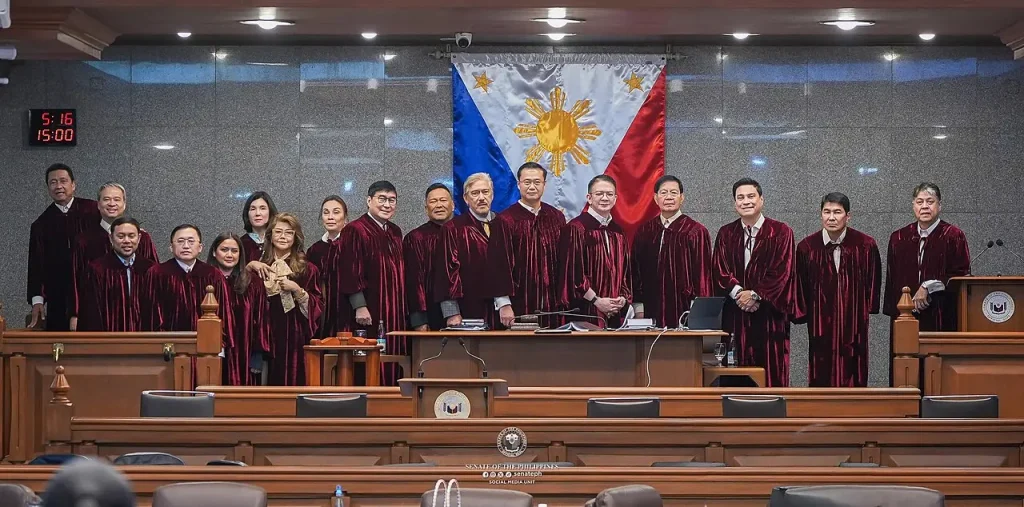
On July 6, 2026, the Senate formally opened the impeachment trial.
Twenty-one senators were present.
Senator Francis Escudero was elected presiding officer of the impeachment court.
House prosecutors presented their opening argument.
Duterte’s defense team presented its response.
The Vice President herself did not take the witness stand at the opening of the trial.
Her lawyers represented her.
The Alleged Threat Against Marcos Takes Center Stage
One of the first major subjects examined by prosecutors concerned Duterte’s controversial November 2024 statements.
During the second day of trial, prosecutors presented video evidence involving the remarks.
The defense repeatedly objected to portions of the prosecution’s presentation.
The National Bureau of Investigation was brought into the proceedings to discuss the authenticity and investigation of the video and related evidence.
NBI officials subsequently testified about their investigation.
The prosecution argued that the statements supported the impeachment article concerning alleged threats.
The defense challenged both the prosecution’s interpretation and aspects of the evidence.
July 22: Prosecution Finishes Its Presentation on the Threat Allegations
By July 22, prosecutors completed their presentation relating to the impeachment article concerning the alleged threat against President Marcos and others.
Attention then shifted increasingly toward another potentially important part of the case:
money.
Financial Records Become a Major Battleground
The prosecution sought access to financial records involving Duterte and her husband, Manases “Mans” Carpio.
The defense opposed the request and characterized it as an improper attempt to search for evidence beyond what prosecutors had already established.
On July 20, however, the impeachment court granted a prosecution request to subpoena financial records.
Bank officials would eventually appear before the court.
The proceedings increasingly began examining financial transactions, confidential-fund disbursements and other records connected to the impeachment allegations.
August and September 2026: The Trial Expands
The impeachment court continued hearing testimony and reviewing documentary evidence.
Much of the proceedings became highly technical.
Bank records, government documents, confidential-fund transactions, witnesses and questions about what evidence could legally be admitted became central to the trial.
Both sides repeatedly fought over evidentiary issues.
Prosecutors attempted to establish connections between records and the allegations contained in the Articles of Impeachment.
Duterte’s defense challenged the relevance, admissibility and interpretation of evidence presented against her.
September 2026: A Major Question Over the Conviction Threshold
Another constitutional issue emerged during the trial:
How many votes would actually be required to convict?
The Constitution states that conviction requires the concurrence of two-thirds of all members of the Senate.
But questions arose over how that rule should operate depending on the number of senator-judges participating.
The impeachment court eventually ruled that the threshold would depend on the number of senator-judges qualified and participating under the circumstances addressed by the court.
It became another major procedural development in a trial already filled with constitutional questions.
September 28, 2026: Baste Duterte Appears
The trial took another turn when Davao City Mayor Sebastian “Baste” Duterte, the Vice President’s brother, became involved in the proceedings as a witness.
His testimony attracted considerable attention because of both his family relationship with the Vice President and questions connected to transactions being examined during the trial.
The proceedings were now moving deeper into the prosecution’s financial allegations.
September 29, 2026: Day 31
On September 29, the Senate impeachment court held Day 31 of the trial.
Among the important developments was the court’s handling of prosecution attempts to introduce additional evidence.
The court rejected a prosecution request involving evidence that prosecutors wanted admitted into the proceedings.
As had happened repeatedly throughout the trial, the dispute demonstrated how much of the case could depend not simply on what information exists but on what evidence the impeachment court allows prosecutors to formally use.
October 1, 2026: Day 32
By October 1, the impeachment trial had reached Day 32.
The prosecution was continuing its presentation involving the financial allegations against Duterte.
The trial was also moving faster than originally expected.
Some witnesses initially expected to testify had been dropped, shortening the prosecution’s presentation.
The Senate impeachment court subsequently indicated that the proceedings were significantly ahead of the original schedule.
That raised the possibility that a verdict could arrive before the Senate’s December recess rather than extending into early 2027.
But as of the end of the week covered by this timeline, there was still no verdict.
Sara Duterte remained Vice President.
The prosecution was still presenting its case.
The defense had not yet completed its own full presentation.
And the senator-judges had not voted on whether Duterte should be convicted or acquitted.
What Happens Next?
The impeachment trial is now entering one of its most consequential phases.
The prosecution has moved from the politically explosive allegations surrounding Duterte’s statements about President Marcos into allegations involving financial records, confidential funds and unexplained wealth.
Once prosecutors complete their presentation, the defense will have the opportunity to present its case and witnesses.
Eventually, both sides will conclude their arguments.
The senator-judges will then have to answer the question at the center of the entire proceeding:
Has the prosecution proven any Article of Impeachment sufficiently to warrant conviction?
That decision belongs to the Senate impeachment court.
Until the senator-judges vote, the allegations against Duterte remain allegations rather than findings of guilt.
The Sara Duterte Impeachment Timeline at a Glance
December 2, 2024 — First impeachment complaint filed.
December 4, 2024 — Second complaint filed.
December 19, 2024 — Third complaint filed.
February 5, 2025 — 215 House members endorse a fourth complaint, resulting in Duterte’s first impeachment.
July 25, 2025 — Supreme Court declares the Articles of Impeachment unconstitutional.
January 29, 2026 — Supreme Court denies the House’s motion for reconsideration with finality.
February 2, 2026 — Two new impeachment complaints are filed.
February 9, 2026 — Another complaint is filed.
February 18, 2026 — A fourth 2026 complaint is filed.
March 4, 2026 — House Justice Committee finds two complaints sufficient in substance.
May 4, 2026 — Justice Committee unanimously finds probable cause and approves proposed Articles of Impeachment.
May 11, 2026 — House votes 257–25–9 to impeach Duterte.
May 20, 2026 — Senate impeachment court issues summons.
June 1, 2026 — Duterte submits her answer and seeks dismissal.
June 18, 2026 — Pre-trial proceedings begin.
July 6, 2026 — Senate impeachment trial formally begins.
July 7, 2026 — Prosecutors begin presenting evidence concerning Duterte’s controversial November 2024 statements.
July 20, 2026 — Impeachment court grants a request for subpoenas involving financial records.
July 22, 2026 — Prosecution concludes its presentation on the article involving the alleged threats.
July 29, 2026 onward — Financial witnesses and records become an increasingly important part of the prosecution’s case.
September 28, 2026 — Trial reaches Day 30, with Davao City Mayor Sebastian Duterte among the figures involved in the proceedings.
September 29, 2026 — Day 31.
October 1, 2026 — Day 32 of the Sara Duterte impeachment trial.
Why This Impeachment Trial Matters
Whatever the eventual verdict, the Sara Duterte impeachment case has already raised major constitutional questions.
It has tested the one-year impeachment rule.
It has tested the procedures the House must follow when initiating impeachment.
It has raised questions about the continuation and timing of impeachment proceedings across Congresses.
It has forced the Senate to confront procedural questions involving evidence, subpoenas and the number of votes necessary for conviction.
And politically, it has placed the sitting Vice President on trial while the country moves closer to the 2028 presidential election cycle.
But the central legal question remains narrower than the political battle surrounding it.
The Senate is not deciding whether people support or oppose Sara Duterte politically.
It is deciding whether the evidence presented during the impeachment trial establishes one or more of the constitutional grounds for removing her from office.
As of October 1, 2026, that question remains unanswered.
The trial continues.