
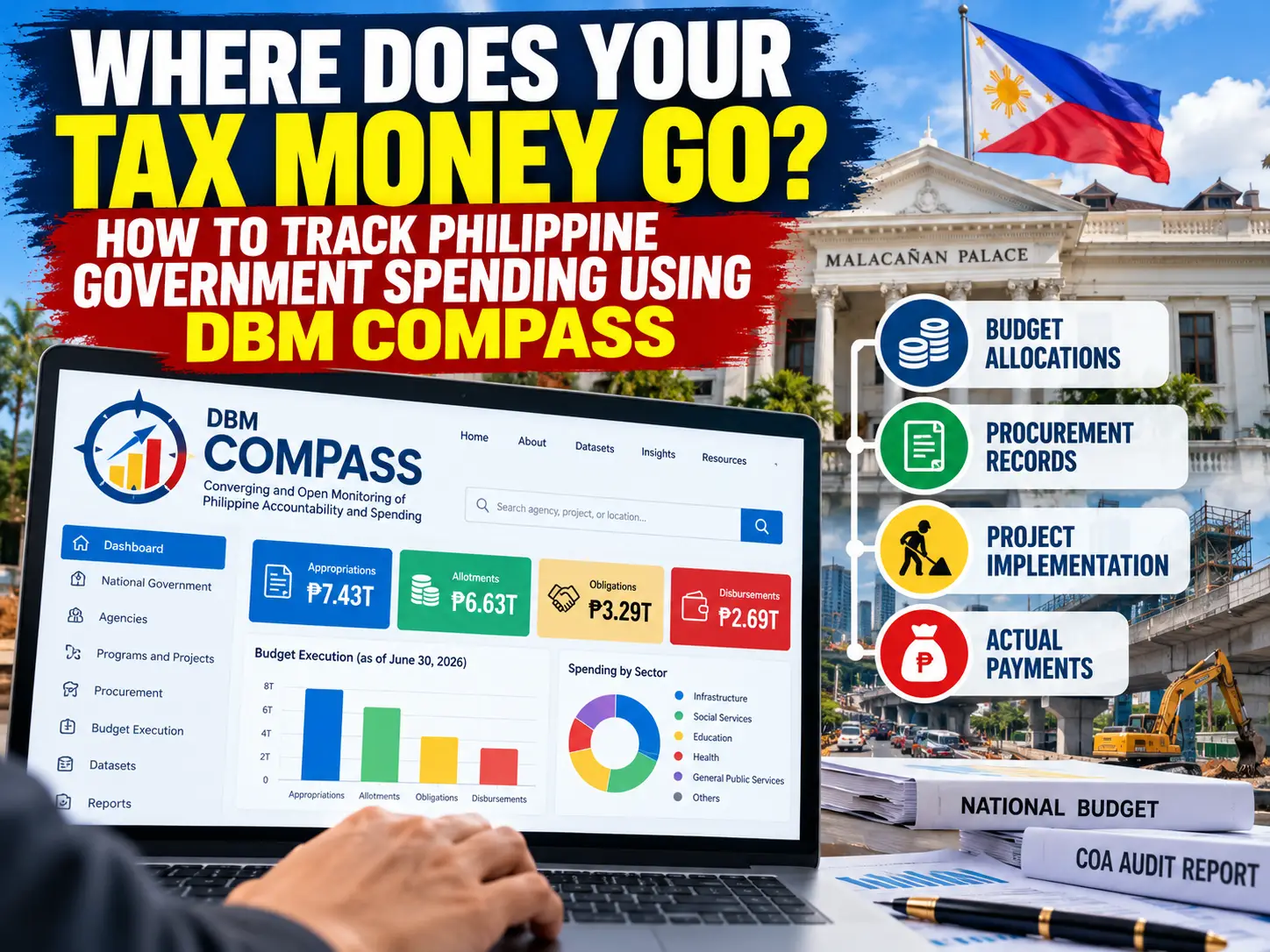
Every year, the Philippine government allocates trillions of pesos to public services, infrastructure, education, healthcare, transportation, and other programs.
But once the national budget is approved, how can ordinary Filipinos find out where that money actually goes?
The Department of Budget and Management (DBM) has introduced a digital platform called COMPASS, designed to make government financial information more accessible to the public.
And with the signing of Executive Order No. 126 on September 28, 2026, the government has moved to strengthen the disclosure of budget allocations, procurement activities, project implementation, and public spending.
The initiative comes at a time when questions about government spending, infrastructure projects, and accountability remain central to public debate.
Here’s what Filipinos should know about DBM COMPASS, how it works, and what it can—and cannot—tell us about the use of taxpayers’ money.
What Is DBM COMPASS?
COMPASS is a government transparency platform developed by the Department of Budget and Management.
Its purpose is to help citizens access information about how government funds are allocated, released, committed, and eventually spent.
The platform was launched on June 26, 2026, as part of efforts to improve public access to government financial information.
Instead of requiring citizens to search through numerous budget documents and government websites, COMPASS aims to provide a centralized way to examine public financial data.
The system is also intended to connect financial information with government procurement and project implementation records.
Official website: https://compass.dbm.gov.ph/
Executive Order No. 126: What Changed?
On September 28, 2026, President Ferdinand Marcos Jr. signed Executive Order No. 126, establishing COMPASS as a unified government transparency platform.
The executive order seeks to improve the publication and monitoring of information concerning government spending and project implementation.
Under the order, covered government entities are expected to submit and update required information for public disclosure.
These include:
- National government agencies
- Government-owned or controlled corporations
- Government financial institutions
Local government units are encouraged to participate.
The goal is to improve transparency throughout the public spending process—from the approval of budgets to the implementation of government projects.
However, establishing a reporting system does not automatically guarantee that every project or transaction will immediately be visible.
The platform’s effectiveness will depend on the accuracy, completeness, and timeliness of the information submitted by participating agencies.
How Much Money Does the Philippine Government Manage?
Government spending involves several stages, and the amounts reported at each stage are not interchangeable.
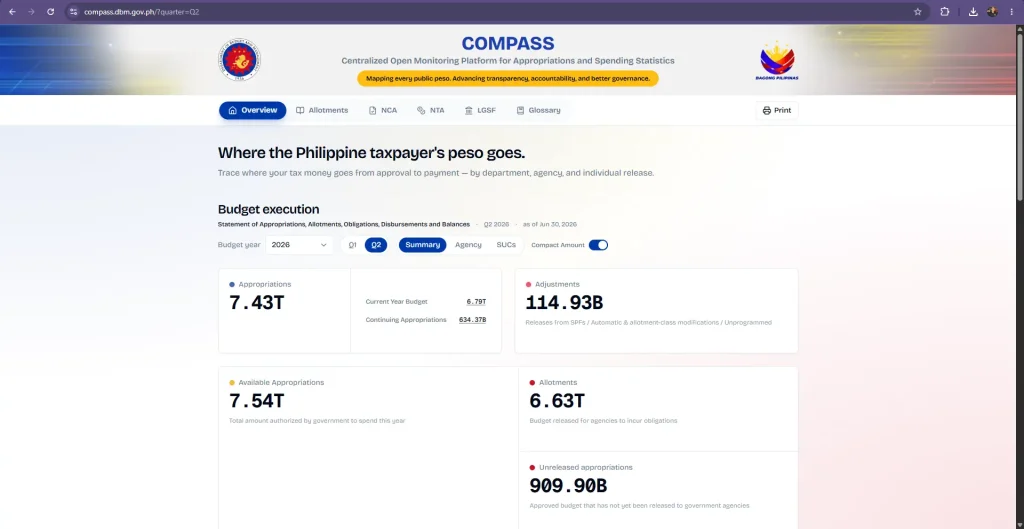
For example, the COMPASS dashboard has displayed the following figures using budget execution data dated June 30, 2026:
| Budget measure | Reported amount |
|---|---|
| Appropriations | ₱7.43 trillion |
| Allotments | ₱6.63 trillion |
| Obligations | ₱3.29 trillion |
These figures represent different stages of government budgeting and financial management.
They should not be added together or interpreted as three separate amounts of government expenditure.
Understanding these categories is essential before making conclusions about whether funds were actually spent.
Appropriations vs Allotments vs Obligations vs Disbursements
These four terms are frequently used in government budget reports.
But what do they mean?
1. Appropriations: Money Authorized by Law
An appropriation is legal authority to use government funds for a particular purpose.
For example, Congress may approve funding for roads, hospitals, classrooms, or other government programs.
An appropriation does not necessarily mean the money has already been released or spent.
2. Allotments: Authority to Incur Obligations
An allotment generally gives an agency authority to enter into financial obligations within approved limits.
It represents another step in making authorized budget funds available for implementation.
3. Obligations: Financial Commitments
An obligation occurs when a government agency enters into a valid commitment requiring payment.
This could involve awarding a contract, ordering equipment, or engaging a contractor for an infrastructure project.
But an obligation is not necessarily the same as an actual cash payment.
4. Disbursements: Payments Made
Disbursements refer to government payments made to settle obligations.
These may include payments to contractors, suppliers, employees, or other recipients.
When assessing how much money has actually been paid out, disbursement figures are particularly important.
The key distinction: a government project can have an approved budget without all the money having been spent.
How to Track Philippine Government Spending Using COMPASS
Filipinos who want to examine government financial information can start with the official COMPASS portal.
Step 1: Visit the Official Website
Open: https://compass.dbm.gov.ph
Use the official DBM domain rather than relying on screenshots or figures circulating on social media.
Step 2: Review the Budget Dashboard
Look for the latest available budget figures and the reporting period.
Pay attention to the difference between appropriations, allotments, obligations, and disbursements.
A large appropriation does not automatically indicate that the same amount has already been spent.
Step 3: Examine Agency-Level Information
Where agency-level information is available, review the relevant department or government entity.
For example, citizens interested in infrastructure spending may examine records associated with the Department of Public Works and Highways.
Those interested in education can examine information associated with the Department of Education.
The availability of detailed records may vary depending on the dashboard, reporting period, and agency submissions.
Step 4: Look for Project and Procurement Records
Where the portal provides project-level or procurement information, examine the project description, location, implementing agency, budget, contractor, and reported implementation status.
Not every field may be available for every project.
If information is missing, that should be treated as a gap requiring further verification—not automatically as evidence of wrongdoing.
Step 5: Compare With Other Government Sources
For a more complete picture, compare COMPASS information with:
- Commission on Audit reports
- Philippine Government Electronic Procurement System records
- Agency annual reports
- DBM budget documents
- Official project status reports
Cross-checking records helps distinguish incomplete reporting from genuine inconsistencies.
Can COMPASS Help Detect Corruption?
Potentially, yes.
A centralized government spending database can help citizens, journalists, researchers, and civil society organizations identify information that deserves closer examination.
For example, a researcher may want to investigate a project with a large budget but limited publicly available implementation details.
Another may compare procurement records with reported project progress.
However, an unusual spending pattern is not automatically proof of corruption.
There may be legitimate explanations for delayed payments, revised project schedules, budget adjustments, or incomplete records.
Establishing fraud or corruption requires evidence, proper investigation, and applicable legal procedures.
COMPASS should therefore be treated as a starting point for public scrutiny, not as a substitute for auditing or investigation.
Can Filipinos Track Flood-Control Projects?
Flood-control spending is one of the most relevant examples of why public financial transparency matters.
Government infrastructure programs can involve significant amounts of taxpayer money, multiple contractors, and projects spread across different provinces and municipalities.
Citizens interested in flood-control projects can examine available budget records and compare them with procurement documents, project listings, and COA findings.
Important questions include:
- How much funding was approved?
- Which government agency is responsible?
- Where is the project located?
- Which contractor received the award?
- How much money has been obligated or paid?
- What is the reported completion status?
- Are there audit findings or other official concerns?
A project appearing in a budget document does not establish that it has been completed.
Likewise, an incomplete project does not automatically prove that funds were stolen.
The purpose of transparency is to make these questions easier to investigate using verifiable records.
COMPASS vs Commission on Audit: What’s the Difference?
Both COMPASS and the Commission on Audit (COA) are relevant to government accountability, but they perform different functions.
| DBM COMPASS | Commission on Audit |
|---|---|
| Public financial transparency platform | Constitutional auditing institution |
| Displays available government budget and spending information | Audits government accounts and operations |
| Helps citizens examine reported financial data | Issues audit reports, findings, and recommendations |
| Supports monitoring and public access | Evaluates compliance and use of public resources |
COMPASS does not replace COA.
A government agency may report financial information through COMPASS while remaining subject to COA examination.
For readers investigating questionable spending, both sources can provide valuable but different information.
What Are the Limitations of COMPASS?
Although the platform is an important transparency initiative, several limitations should be considered.
Data completeness: Some agencies may have more detailed or current records than others.
Reporting delays: Financial records and project information may not be updated immediately.
Data accuracy: Published information depends partly on the quality of submissions from government agencies.
Project verification: A reported project status does not independently confirm the actual physical condition of a road, bridge, hospital, or flood-control structure.
Public accessibility: Technical budget terminology can still be difficult for readers unfamiliar with government financial reporting.
For COMPASS to be genuinely useful, information must be not only publicly available but also understandable, searchable, and verifiable.
Why Government Spending Transparency Matters
Government budgets are not abstract figures.
They represent resources that can affect everyday life.
Public money helps fund classrooms, public hospitals, infrastructure, transportation, disaster preparedness, social assistance, and other essential services.
When financial information is difficult to access, citizens have fewer opportunities to question how resources are being managed.
Better transparency can help the public examine whether spending priorities align with national needs.
It can also support more informed public debate.
Rather than relying entirely on political statements, citizens can begin asking questions based on published financial records.
Frequently Asked Questions
Is DBM COMPASS free to use?
The public COMPASS portal is intended to provide access to government financial information without requiring citizens to purchase a subscription.
What is the official COMPASS website?
The official portal is https://compass.dbm.gov.ph/.
Can I see how much the government spends on infrastructure?
The platform provides budget and spending information, with its coverage intended to expand across procurement and project implementation. The level of detail available for a particular project may vary.
Does a government budget allocation mean the money has already been spent?
No. Appropriations authorize spending, while allotments, obligations, and disbursements represent different stages of the financial process.
Can COMPASS prove that a government project is corrupt?
No. It can provide information useful for identifying questions or inconsistencies, but proving corruption requires additional evidence and investigation.
Does COMPASS replace COA reports?
No. COA remains responsible for its constitutional audit functions.
Can ordinary Filipinos use COMPASS?
Yes. The portal is intended to make government financial information more accessible to the public.
The Bottom Line
The launch of DBM COMPASS and the signing of Executive Order No. 126 represent an effort to make Philippine government spending more transparent.
For ordinary Filipinos, the value of the platform is straightforward: it provides another way to examine how public money is managed.
But transparency is only meaningful when information is accurate, complete, updated, and accessible.
The real test will be whether citizens can use the system to follow government spending from budget approval through procurement, implementation, and actual payment.
And whether the government can answer legitimate questions when published records reveal gaps or inconsistencies.
For a country where government spending and corruption remain major public concerns, giving citizens access to financial records is an important step.
The next step is making sure those records tell the full story.