
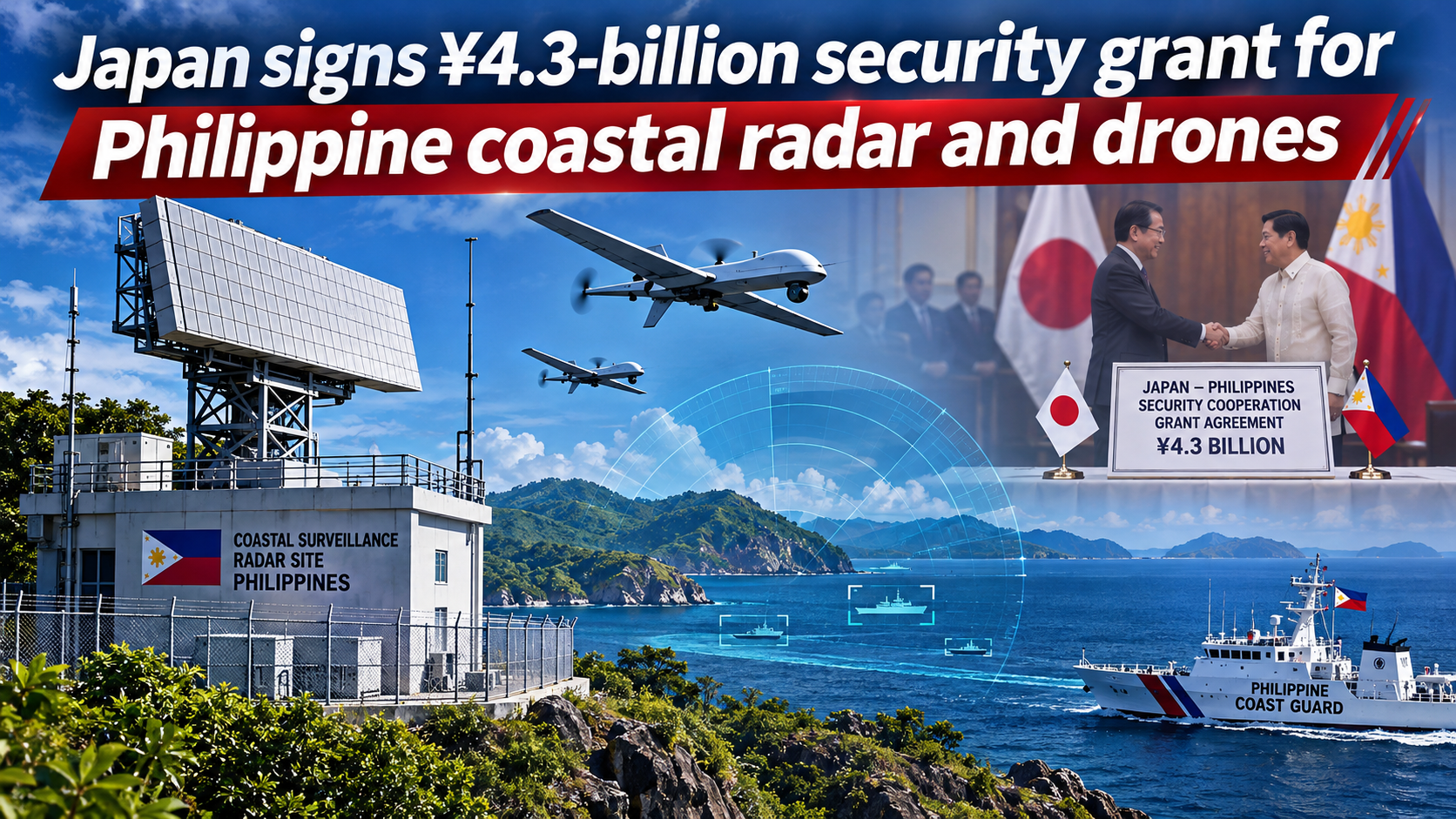
Japan and the Philippines signed and exchanged notes in Manila on November 9, 2026 for a new ¥4.3-billion Official Security Assistance (OSA) package that will provide one coastal radar system for the Philippine Navy and surveillance drones for the Philippine Air Force. The agreement was signed by Foreign Affairs Secretary Maria Theresa Lazaro and Japanese Ambassador Kitagawa Katsuro, according to Japan’s Ministry of Foreign Affairs.
The deal adds another layer to fast-growing Philippines-Japan security ties and is significant because Japan described it as the first transfer of defense equipment under its OSA program. For the Philippines, the practical value is improved monitoring capability in strategically important maritime areas, even as key details such as delivery dates and technical specifications remain undisclosed.
What Japan agreed to provide
The official Japanese announcement says the FY2026 OSA project includes a coastal radar system for the Philippine Navy and unmanned aerial vehicles, or surveillance drones, for the Philippine Air Force. The total grant amount is ¥4.3 billion.
Different reports converted that same amount into other currencies. The Philippine News Agency reported the package at about P1.72 billion, while the Associated Press described it as roughly US$27 million. These are currency conversions of the same official yen figure, not separate valuations.
The notes were signed and exchanged in Manila on November 9, 2026. Japan’s foreign ministry said the project aims to strengthen the Philippines’ monitoring capability and contribute to the security of important sea lanes and regional stability.
Why this matters for the Philippines
This is not a consumer-pocketbook story in the same way inflation, fuel prices, or transport fares are. Its impact is more strategic and institutional. A coastal radar system and surveillance drones can help the Philippine military improve maritime domain awareness, monitor approaches to Philippine waters, and track activity across air and sea spaces.
That matters for a country located along major shipping routes and facing recurring security pressure in surrounding waters. Japan’s foreign ministry explicitly cited the Philippines’ geographic position near key maritime routes as part of the project’s significance.
For ordinary Filipinos, stronger monitoring capability can matter indirectly in several ways:
- Fisheries and maritime protection: better visibility can help authorities monitor activity in coastal and offshore areas.
- Disaster response coordination: surveillance assets can support situational awareness during emergencies.
- National security planning: improved tracking helps decision-makers respond to developments at sea more quickly.
Those practical effects follow from the type of equipment being provided and the official rationale for the grant, though the governments have not publicly released an operational deployment plan.
A deeper Philippines-Japan security relationship
The November 9 signing did not happen in isolation. It builds on the broader upgrade in bilateral ties after the Philippines and Japan elevated relations to a Comprehensive Strategic Partnership in May 2026. In their joint statement, the two governments said they would continue promoting defense equipment transfers, including radar systems, under existing arrangements and Japan’s OSA framework.
That context is important because it shows the latest package is part of a longer-term trajectory, not a one-off gesture. It also helps explain why radar systems feature prominently in the two countries’ security cooperation.
The latest agreement also follows earlier Japanese assistance under OSA. According to the Embassy of Japan in the Philippines, an earlier OSA grant signed in November 2023 provided five coastal radar systems, which were formally handed over on February 11, 2026.
That means this is not Japan’s first security assistance project for the Philippines overall. However, Japan’s foreign ministry says this specific package is the first transfer of defense equipment under the OSA program, a distinction that marks a new stage in Tokyo’s security support.
Regional context without overstatement
The development comes amid sustained attention to maritime security in the region, including the South China Sea and sea lanes near the Luzon Strait. But the official materials reviewed do not state that the grant was triggered by any one specific incident. Instead, the Japanese side framed the package more broadly as support for monitoring capability, sea-lane security, and regional stability.
That distinction matters. It avoids overstating what the governments themselves have confirmed while still recognizing the wider geopolitical environment in which the agreement was signed.
For readers following related developments, this story fits into a broader pattern of security and foreign policy shifts already affecting the Philippines, alongside diplomatic tensions and regional defense coordination. It also complements other major national developments covered by The Daily Caffeine, including accountability and security reporting such as the Philippines’ recent diplomatic protest involving the Chinese ambassador.
What is still unclear
Several important details were not disclosed in the reviewed sources.
- No delivery timetable was specified.
- No model or technical specifications were publicly identified for the coastal radar system.
- No UAV type, range, payload, or basing details were disclosed.
- The sources did not say which units, commands, or locations would receive the equipment first.
- There was no public cost breakdown showing how much of the ¥4.3 billion would go to the radar system versus the drones.
Those gaps do not undermine the story, but they do define its current limits. For now, the agreement is verified; the operational details are not yet public.
What happens next
The next developments to watch are implementation details: procurement and transfer timelines, unit assignments, training arrangements, and possible follow-up statements from Philippine defense agencies. Those specifics will determine how quickly the equipment moves from a signed agreement to actual field capability.
The agreement also signals that Japan is likely to remain a major security partner for Manila, especially in capability-building projects tied to maritime monitoring and regional stability.
FAQ
What did Japan agree to give the Philippines?
Japan signed a grant package that will provide one coastal radar system for the Philippine Navy and surveillance drones for the Philippine Air Force.
How much is the Japan security grant worth?
The official value is ¥4.3 billion. Philippine state media reported that as about P1.72 billion, while AP reported it as roughly US$27 million.
When was the deal signed?
The notes were signed and exchanged in Manila on November 9, 2026.
Is this Japan’s first security grant to the Philippines?
No. Japan had previously provided OSA support, including coastal radar assistance. But Japan says this is the first transfer of defense equipment under the OSA program.
The November 9 agreement is a clear sign that Japan-Philippines defense cooperation is expanding in concrete ways. What changed is not just another diplomatic statement, but a signed package tied to specific surveillance capabilities. What remains to be seen is how fast those assets are delivered, where they will be deployed, and how much they will improve the Philippines’ real-world monitoring capacity.
Sources
- Signing and Exchanging of Notes for Official Security Assistance (OSA) FY2026 Project to the Republic of the Philippines -The first defense equipment transfer project under Japan’s OSA – | Ministry of Foreign Affairs of Japan
- Japan to provide PH coastal radar, drones under P1.72-B security grant | Philippine News Agency
- Japan to provide coastal radar and drones to the Philippines under $27M deal
- The Philippines-Japan Joint Statement on the Elevation to a Comprehensive Strategic Partnership: “Weaving the Future Together: Peace, Prosperity, Possibilities” – Presidential Communications Office
- Ambassador ENDO attends the handover ceremony for coastal radar systems provided through Official Security Assistance (OSA) | Embassy of Japan in the Philippines