
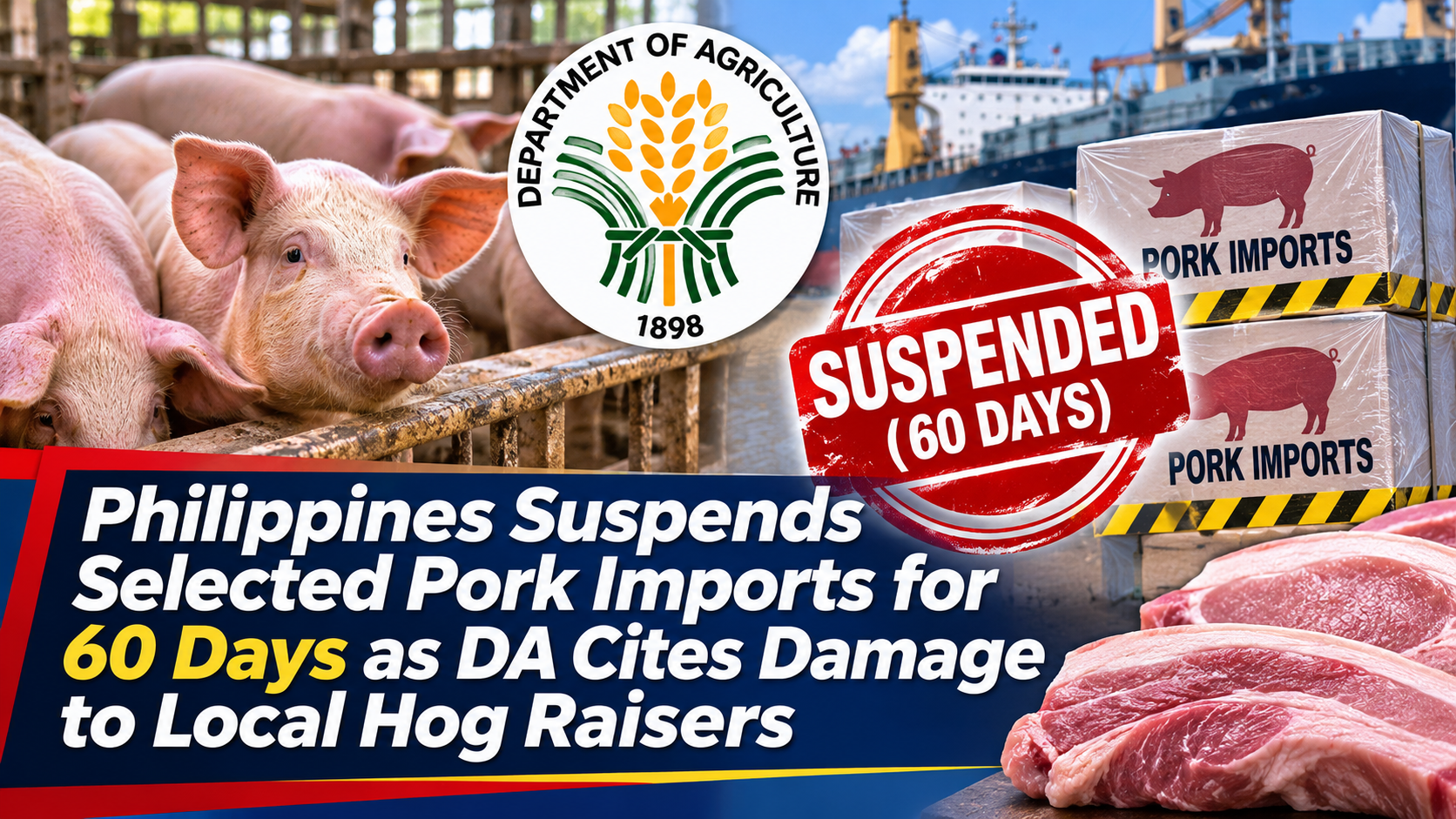
The Philippine government has ordered a 60-day temporary suspension of selected pork imports after the Department of Agriculture said a surge in foreign shipments had seriously injured the domestic hog industry, a move that could help local hog raisers but also raises fresh questions about pork prices for consumers.
Department Order No. 33, signed by Agriculture Secretary Francisco Tiu Laurel Jr. on November 7, 2026 and announced by the DA on November 9, imposes the provisional safeguard measure under Republic Act No. 8800, or the Safeguard Measures Act. The department said a preliminary investigation found that increased pork imports from 2021 to August 2026 caused “serious injury” to domestic producers and that delaying action could lead to irreparable damage.
The order covers pork products under AHTN codes 0203 and 0206. In practical terms, the policy puts selected pork imports on hold while the government’s broader safeguard case moves forward.
Why the government says it acted
The DA has framed the suspension as an emergency response to losses among local hog raisers, many of whom are still recovering from the long-running impact of African swine fever.
In a separate agency release, the DA said pork imports rose 42%, from 589,675 metric tons in 2023 to 836,240 metric tons in 2025. It also said imports’ share of domestic production climbed from 39% in 2021 to 61% in 2025, then to 65% in the first half of 2026. The agency estimated that local producers lost about ₱27.9 billion from January to July 2026 because of falling farmgate prices, excess inventories and pressure from cheaper imported meat. According to the same DA statement, frozen pork inventories reached around 121,000 metric tons in July 2026, with imported products making up 94% of those stocks.
Those figures help explain why the department is treating the issue as more than a normal trade dispute. The government’s position is that the domestic industry is not just facing competition, but potentially unsustainable losses.
What it could mean for hog raisers
For farmers and commercial producers, the immediate goal is to lift farmgate prices.
The Philippine News Agency reported that Tiu Laurel said the government hoped farmgate prices would rise by about ₱50 per kilo, or at least enough to remove producers’ losses. PNA also reported that the breakeven cost was around ₱165 per kilo, while average farmgate prices were only about ₱140 per kilo for backyard pork and ₱150 per kilo for commercial pork when the measure was announced.
If those price levels improve, the temporary suspension could give hog raisers short-term relief, especially smaller operators that have struggled with disease outbreaks, high feed costs and weaker selling prices. Farm groups, according to PNA’s report, welcomed the move.
What it could mean for consumers
The harder question is what happens to retail pork prices, especially with the holiday season approaching.
The DA has argued that the intervention is necessary to prevent deeper damage to local producers. But the sources reviewed do not yet establish the exact effect on consumer prices. That means any claim that pork will definitely become significantly more expensive would go beyond the available evidence.
Still, the risk is easy to understand. Imported pork has helped supplement supply in recent years, particularly as the local hog sector struggled to rebuild after ASF-related losses. Suspending part of that flow, even temporarily, could tighten supply depending on how much stock is already in the market and how quickly domestic producers can respond.
For households already dealing with elevated food costs, even a modest retail increase would matter. Pork remains a staple protein for many Filipino families, eateries and small food businesses.
What exactly changed
The latest verified development is not a tariff hike but a temporary import suspension as a provisional safeguard measure.
That distinction matters. PNA reported that separate tariff changes were still undergoing consultation and review by the Tariff Commission. In other words, the 60-day suspension and any possible tariff adjustment are not the same policy action.
The DA’s order also relies on a specific legal process. Under the Safeguard Measures Act, provisional action may be imposed after a preliminary determination that increased imports have caused serious injury and that delay would cause damage that would be difficult to repair.
The unresolved issue: when does the suspension take effect?
One important detail remains unclear based on the supplied sources: the exact effective date.
The DA’s notice says the order takes effect on the earlier of two events: issuance of an implementing order by the Bureau of Customs, or 15 days after publication in two newspapers of general circulation. The DA also said publication took place in The Manila Times and Manila Standard on November 11, 2026.
However, PNA reported that the import halt would be effective on November 24, 2026. Without a Bureau of Customs implementing order in the provided materials, the exact start date cannot be stated as settled fact. That uncertainty is important for importers, traders and retailers trying to plan shipments and inventory.
Why this matters beyond the hog industry
This story sits at the center of a familiar Philippine policy dilemma: how to protect domestic food producers without worsening inflation for consumers.
For years, the government has had to balance competing pressures. Farmers want protection from low-priced imports. Consumers want affordable food. Officials, meanwhile, are judged on both farm incomes and headline inflation.
The pork sector is especially sensitive because it directly affects food budgets, wet market prices and restaurant costs. It also has a public accountability angle. Once government intervenes in trade, the public has a legitimate interest in whether the evidence supports the action and whether officials are prepared for possible side effects.
Readers following inflation and household expenses may also want to track related developments, including Philippine inflation in October 2026 and the recent fuel price rollback announced for November 10, 2026, both of which affect overall cost-of-living pressures.
What happens next
In the short term, attention will focus on three things: whether farmgate prices actually improve, whether retail pork prices rise, and whether customs or trade authorities issue clarifications on implementation.
The broader safeguard case is also not finished. Further review by the relevant authorities could determine whether longer-term measures, including tariff-related actions, will follow.
For now, the government has made a clear policy choice: give local hog raisers immediate breathing room while accepting the possibility of tighter market conditions. Whether that choice stabilizes the industry without hurting consumers too much will likely become clearer in the weeks ahead.
FAQ
What did the Philippine government suspend?
The DA temporarily suspended selected pork imports covered by AHTN codes 0203 and 0206 under Department Order No. 33.
Why did the DA suspend pork imports?
The department said its preliminary safeguard investigation found that increased imports caused serious injury to the domestic pork industry.
Is this the same as a pork tariff hike?
No. The temporary suspension is separate from any tariff change, which PNA reported was still under consultation and review.
Will pork prices go up?
Possibly, but the exact retail impact is still unclear based on the supplied sources. The DA has said the move is intended to raise farmgate prices and ease producer losses.
Sources
- Issuance of DO No. 33 Imposing a 60-Day Temporary Suspension of Importation of Pork as the Provisional Safeguard Measure under the DA Safeguard Measures Case No. 2, 2026 | Official Portal of the Department of Agriculture
- DA imposes 60-day pork import curbs as local hog industry loses P27.9B | Official Portal of the Department of Agriculture
- 60-day import halt to help pull up pork farmgate prices | Philippine News Agency