
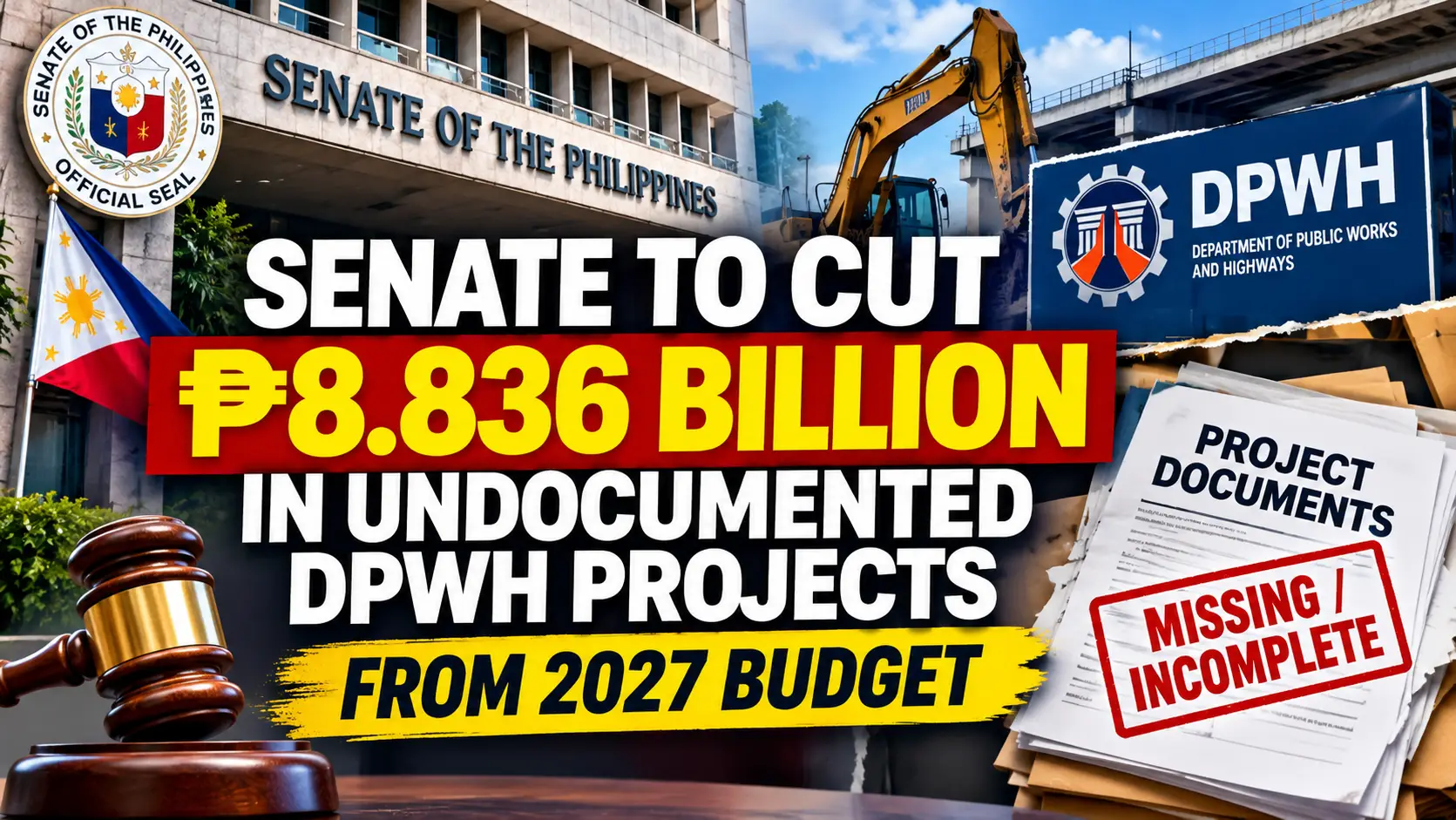
Senate President Sherwin Gatchalian said on November 3, 2026 that the Senate would remove 295 Department of Public Works and Highways (DPWH) infrastructure projects worth ₱8.836 billion from the proposed 2027 national budget after the required supporting documents were not submitted by the Senate’s deadline.
The announcement adds a major accountability issue to deliberations on the proposed ₱7.2-trillion 2027 budget. Based on the Senate update and a News5 report on Gatchalian’s statement, the projects were flagged not because they had already been proven illegal, but because they lacked the documentation senators required to justify keeping them in the spending bill.
That distinction matters. In budget debates, undocumented or unsupported line items are not automatically fake or unlawful. But they do raise a clear public-interest problem: taxpayers are being asked to fund projects that lawmakers say were not backed by the basic documents needed for review.
What changed in the 2027 budget review
The new development is the Senate leadership’s decision to strike specific projects after a deadline for submissions passed. According to the Senate’s eClips news update page, Gatchalian said 295 projects with a combined value of ₱8.836 billion would be removed from the proposed budget.
This moves the issue beyond a general warning. For days, senators and outside groups had been raising concerns about infrastructure items that may have been added or altered without enough technical basis. The November 3 announcement turned that scrutiny into a concrete action affecting a measurable portion of the public works budget.
Why the missing documents matter
Congress has the power to amend the national budget, but those changes are expected to be supported by documentation, technical justification, and transparency. When line items cannot be properly explained or documented, the risk is not only legal or procedural. It can also affect whether scarce public funds go to projects with the strongest public value.
For ordinary Filipinos, that has practical consequences:
Taxpayers face a higher risk of waste when projects cannot be fully scrutinized.
Commuters and logistics-dependent businesses may be affected if questionable local items crowd out transport or other major infrastructure spending.
Local governments and communities may face uncertainty if legitimate small-scale projects are caught in a wider cleanup of poorly documented items.
The current evidence supports only one verified conclusion: these 295 projects were set for removal because required supporting documents were not submitted. It does not yet establish where each project is located, who endorsed each item, or whether any of them will eventually return in another form.
Broader pressure on Congress over budget insertions
The Senate action did not happen in isolation. Business groups had already urged Congress to remove insertions they said lacked technical basis and to restore higher-priority projects that were reportedly reduced or displaced. A Philstar report on the groups’ appeal said their concerns were tied to transparency and spending priorities, especially in infrastructure.
Those outside calls do not by themselves prove wrongdoing. Still, they help explain why the Senate’s review has drawn unusual public attention. The debate is no longer just about which chamber gets the final say over amendments. It is also about whether Congress can show that added projects have a legitimate technical basis and are not merely politically convenient.
The constitutional and transparency angle
The budget fight is unfolding alongside a broader push to make the 2027 budget more defensible. In an October 22, 2026 statement, the Department of Budget and Management said it was working with the Senate for a constitutionally sound and more transparent 2027 budget, particularly after a Supreme Court ruling involving unprogrammed appropriations in earlier budgets.
That DBM statement does not specifically decide the fate of the 295 DPWH projects. But it does show that the current review is part of a bigger effort to tighten budget safeguards, not just a routine inter-chamber dispute.
For readers trying to follow how public money is allocated, The Daily Caffeine previously published a guide on how to track Philippine government spending using DBM COMPASS, which helps explain why documentation and line-item transparency matter during budget season.
What is still unclear
Several important details remain unresolved.
| Question | What is confirmed | What remains unclear |
|---|---|---|
| Which projects are affected? | 295 DPWH projects worth ₱8.836 billion were identified for removal. | The available sources do not list all projects, locations, or sponsors. |
| Why were they cut? | The Senate said required supporting documents were not submitted. | The specific missing documents for each project were not detailed in the supplied sources. |
| What happens to the funds? | The Senate plans to remove the items from its version of the budget. | It is not yet clear whether the money will be reallocated, deleted, or revived in bicameral talks. |
That last point may become the most important. Even if the Senate removes the projects now, budget details can still change during plenary deliberations and later in the bicameral conference committee, where the House and Senate reconcile their versions of the bill.
What this means for taxpayers and commuters
The immediate effect is political and procedural: senators are signaling that unsupported infrastructure items may no longer pass on trust alone. If enforced consistently, that could reduce room for poorly justified spending and put more pressure on agencies and lawmakers to submit complete documents before asking for funding.
For commuters and businesses, the bigger question is whether removing undocumented projects will free up fiscal space for transport links, foreign-assisted infrastructure, or other projects with stronger planning support. The current sources suggest that business groups want exactly that outcome, but no final reallocation has been confirmed.
For local communities, the message is mixed. Stronger scrutiny can protect public funds, but it can also delay projects if documentation systems are weak. Whether the cleanup improves project quality or simply shifts the bargaining to a later stage of the budget process is still uncertain.
What happens next
Readers should watch three stages closely:
Senate committee and plenary action — this is where the removal of the 295 projects will be reflected in the Senate’s budget version.
Possible reallocation decisions — lawmakers may decide whether the removed amount should fund other priorities.
Bicameral conference — deleted items can still become a point of negotiation before the final General Appropriations Act is approved.
FAQ
What did the Senate announce?
The Senate said it would remove 295 DPWH projects worth ₱8.836 billion from the proposed 2027 national budget because required supporting documents were not submitted.
Does this mean the projects were illegal or fake?
No. The verified issue in the supplied sources is the lack of required documentation, not a final finding of illegality or fraud.
Are budget insertions automatically banned?
No. Congress can amend the budget, but amendments are expected to have technical basis, documentation, and transparency.
Can the projects still return later?
Possibly. The available sources say it is still unclear whether the funds will be reallocated, deleted entirely, or brought back during bicameral negotiations.
The significance of the November 3 announcement is straightforward: the Senate is trying to show that at least some unsupported infrastructure items will not survive the 2027 budget review. Whether that becomes a lasting standard for public spending — or only an early bargaining position before final negotiations — is what taxpayers should watch next.
Sources
- eClips Senate News Updates
- Gatchalian: Senate to axe 295 infra projects under 2027 budget bill
- Business groups urge removal of insertions | Philstar.com
- DBM, Senate Push for Constitutionally Sound 2027 Budget Amid SC Ruling on Unprogrammed Funds
- Senate vows zero funding toward unverified DPWH line items | Daily Tribune
- Senate could weed out thousands of infrastructure projects in budget – Philstar.com
- Senate to correct 2027 budget without House recall | Philippine News Agency