
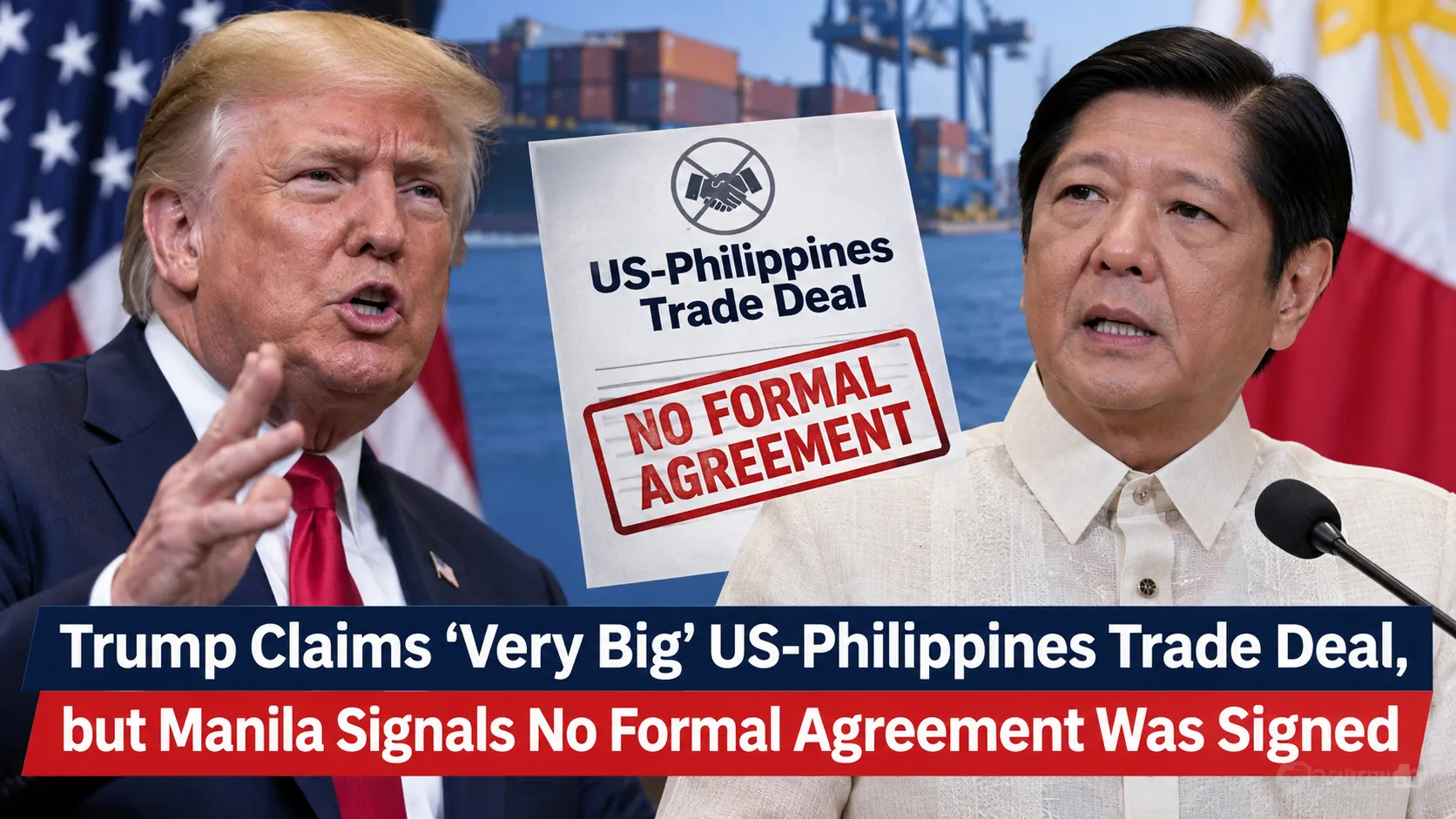
US President Donald Trump said on November 18, 2026 that Washington and Manila had sealed a major trade deal during his visit to the Philippines, but the Philippine side and even the White House’s own wording suggested the arrangement was not yet a formally signed agreement.
The gap matters because any real US-Philippines trade pact could affect export tariffs, agriculture imports, supply chains, and prices for businesses and consumers. It also comes at a time when Philippine exporters have been seeking relief from higher US tariffs imposed earlier in 2026.
What Trump said in Manila
During his meeting with President Ferdinand Marcos Jr. in Manila, Trump said the two countries had concluded what Philippine state media described as the “biggest trade deal” ever between the United States and the Philippines. The meeting itself is confirmed in a Philippine News Agency report on the Marcos-Trump talks, while a separate PNA report quoted Trump’s trade-deal claim.
On its face, that sounded like a completed bilateral breakthrough. For exporters and importers, such a statement would normally imply that the two governments had already finalized terms and signed a concrete trade instrument.
Why questions remain about the supposed deal
Reuters, in a November 18 report carried by StreetInsider, said no formal trade agreement was signed that day and that Manila described the outcome only as an understanding on economic cooperation, not a completed trade pact. That is a materially different description from Trump’s public claim.
The uncertainty is reinforced by the White House’s own November 18 fact sheet. The document said the Philippines and the United States committed to reduce the US trade deficit through increased Philippine imports of American energy and agricultural products. But it also said the trade deal would eliminate tariffs on 99 percent of goods and remove non-tariff barriers on selected US exports “once signed.” That phrasing indicates the arrangement was still prospective rather than already in force. The relevant language appears in the White House fact sheet released after Trump’s Asia meetings.
In short, three things can be true at once: Trump publicly declared a deal, Washington outlined what it said the deal would do, and yet the formal legal text may still be unsigned or undisclosed.
Why this matters to the Philippines
The timing is significant. Ahead of the Trump-Marcos meeting, Trade Secretary Cristina Roque had already said she was hoping bilateral talks would help reduce tariffs on Philippine exports to the United States. According to a November 16 PNA report on Roque’s remarks, Philippine exports to the US had been facing a 12.5 percent tariff since July 2026.
That tariff issue is especially important in an economy already dealing with weak growth, elevated inflation and trade pressures. The Daily Caffeine has separately reported that the Philippine economy grew just 2.1% in the third quarter of 2026 and that the country’s trade deficit widened to $5.15 billion in September 2026. Any change in US market access could therefore have outsized consequences for exporters, factory workers, logistics firms and agricultural traders.
The White House said the arrangement would expand Philippine imports of US agricultural products and energy. If those terms are eventually finalized, local effects could cut in different directions. Some Philippine businesses might benefit from lower input costs or smoother market access, while some domestic producers could face more competition from imported goods. For now, however, those sector-by-sector effects remain uncertain because no public tariff schedule or full implementing text was available in the supplied sources.
Background: the tariff dispute did not start in Manila
The trade discussion during Trump’s visit was not happening in a vacuum. The July 2026 tariff issue cited by Philippine officials was linked by US authorities to forced-labor compliance concerns.
A July 2026 fact sheet from the Office of the United States Trade Representative said economies that had not adopted and effectively enforced a forced-labor import prohibition could face a 12.5 percent tariff rate, while those with stronger commitments would face 10 percent. That policy context is laid out in the USTR fact sheet on Section 301 action.
That helps explain why Philippine officials were seeking tariff relief before Trump arrived. The issue was not only diplomatic theater; it had direct commercial implications for Philippine exporters already competing in a difficult environment.
Another sign that not everything was finalized
On the same day, Marcos said the Philippines and the United States would not discuss or sign the controversial Pax Silica initiative during Trump’s visit. That detail, reported by PNA in a separate November 18 story, added to the broader picture of an important visit in which some major economic items were still not ready for signature.
While Pax Silica is distinct from the claimed trade arrangement, the public messaging showed that not every headline-level economic initiative attached to the visit was being formalized on November 18.
What is confirmed and what is still unclear
What is confirmed
- Trump met Marcos in Manila on November 18, 2026.
- Trump publicly said the United States and the Philippines had concluded a major trade deal.
- The White House described expected benefits and said the arrangement would eliminate tariffs on 99 percent of goods once signed.
- Philippine officials had been seeking relief from higher US tariffs on exports.
What is still unclear
- Whether both governments signed a binding bilateral trade instrument on November 18.
- The full legal text, tariff schedules, and implementation timeline of any eventual agreement.
- Which Philippine industries would benefit first, and which could face added competition.
What happens next
The next test is whether either government releases a signed text, implementing documents, or a joint statement clearly defining the arrangement as a formal trade agreement. Without those documents, businesses will have little basis for pricing, sourcing or investment decisions.
For Filipino readers, the key question is simple: will this announcement actually lower export barriers and create clearer trade rules, or was it mainly a political declaration ahead of further negotiations?
FAQ
Did the US and the Philippines sign a trade deal on November 18, 2026?
That was not clearly established in the supplied reports. Trump said a major deal had been concluded, but Reuters reported that no formal trade agreement was signed that day and that Manila described the outcome as an understanding on economic cooperation.
What did the White House say the arrangement would do?
The White House said the deal, once signed, would eliminate tariffs on 99 percent of goods and remove non-tariff barriers on selected American exports.
Why should Filipinos pay attention?
Because any real trade agreement could affect export jobs, agricultural imports, supply chains, and possibly prices for businesses and consumers. But those effects cannot yet be measured with confidence because the detailed terms have not been publicly released in the supplied sources.
Sources
- Fact Sheet: President Donald J. Trump Secures Historic Economic Deals for American Workers and Strengthens America’s Leadership in Asia – The White House
- Marcos, Trump reaffirm PH-US bond ‘formed in blood’ | Philippine News Agency
- Trump says US wraps up ‘very big trade deal’ with Philippines
- ‘Biggest trade deal’ between US, PH sealed – Trump | Philippine News Agency
- Roque hopeful for lower exports tariff after PH-US bilateral talks | Philippine News Agency
- Marcos: No Pax Silica signing during Trump visit | Philippine News Agency
- Fact Sheet: USTR Section 301 Action in Response to the Failure of 60 Economies to Ban Imports Produced with Forced Labor | United States Trade Representative