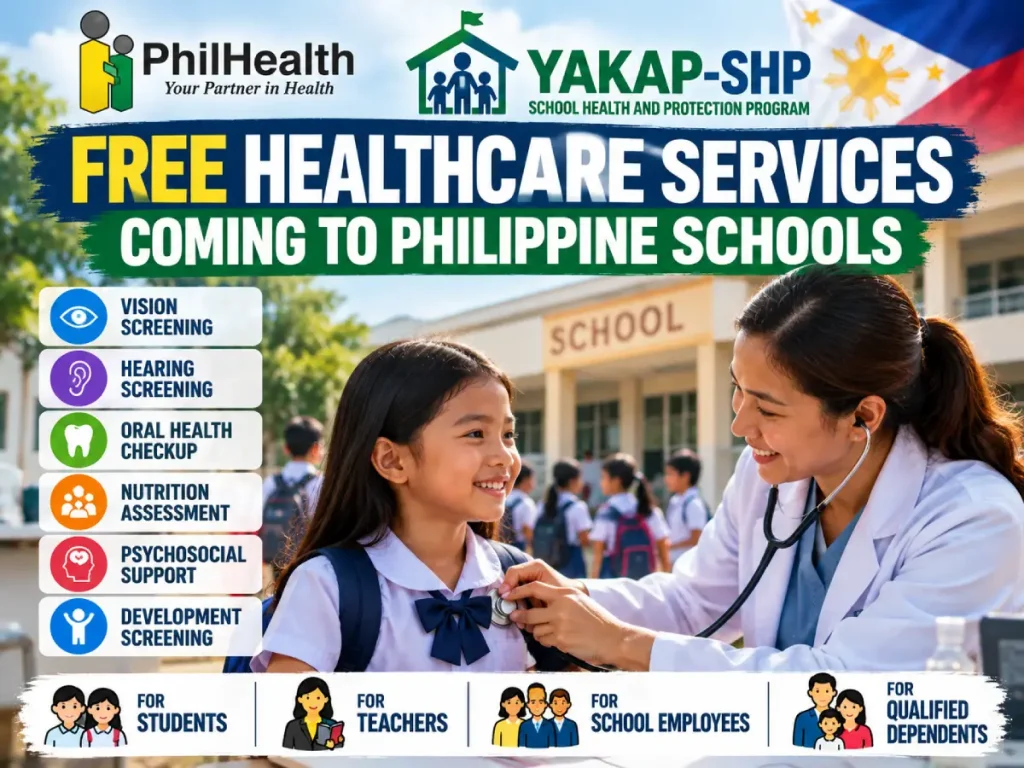
Filipino students may soon have easier access to health screening, primary healthcare and referrals without families having to navigate the healthcare system entirely on their own.
The Department of Education (DepEd), Department of Health (DOH), Department of the Interior and Local Government (DILG), and PhilHealth have formalized the YAKAP School Health and Protection Program, or YAKAP-SHP.
The agencies signed a Joint Memorandum Circular establishing a government-wide framework for delivering healthcare services through schools and other facilities serving children. Philippine Information Agency
But what exactly is YAKAP-SHP, who can benefit, and what services will students receive?
What Is YAKAP-SHP?
YAKAP-SHP stands for YAKAP School Health and Protection Program.
It expands PhilHealth’s Yaman ng Kalusugan Program (YAKAP) into schools and other child-serving settings.
Rather than expecting families to seek primary healthcare only through traditional clinics, the program uses schools and community facilities as access points connecting children with healthcare providers and services. Philippine Information Agency
The program covers more than conventional public schools.
Its framework includes:
- Public and private schools
- Community Learning Centers
- Child Development Centers
- Other Early Childhood Care and Development facilities
- Inclusive Learning Resource Centers
This potentially gives YAKAP-SHP a much wider reach than a program limited to DepEd public-school campuses. Philippine Information Agency
Who Is Covered by YAKAP-SHP?
The program isn’t limited to enrolled students.
Government information identifies several groups that can benefit, including students, teachers, non-teaching personnel, qualified dependents and out-of-school children and youth.
Children diagnosed with developmental delays or disabilities are also specifically included in the program’s coverage. Radyo Pilipinas
This makes YAKAP-SHP both a school-health initiative and a way of connecting families with the broader PhilHealth primary-care system.
What Healthcare Services Can Students Receive?
One of the most important parts of YAKAP-SHP is early health screening.
Children registered with YAKAP may receive screening covering areas such as:
Vision — identifying possible eyesight problems.
Hearing — detecting hearing difficulties that could affect communication and learning.
Oral health — checking dental and oral-health needs.
Nutrition — identifying nutritional problems and related health risks.
Psychosocial well-being — helping identify children who may require further assessment or support.
Development — screening for possible developmental concerns.
Children who require additional care can then be referred to appropriate healthcare facilities, specialists, developmental services or therapy. Radyo Pilipinas
That referral component is important because screening alone doesn’t solve a health problem.
The system is intended to help move a child from screening → assessment → referral → appropriate care.
What Is PhilHealth YAKAP?
YAKAP-SHP builds upon PhilHealth’s broader Yaman ng Kalusugan Program.
YAKAP focuses heavily on primary and preventive healthcare—finding health problems early rather than waiting until patients become sick enough to require hospitalization.
Under PhilHealth’s current standards, YAKAP Clinics provide services including initial health assessments and risk profiling, primary-care consultations, laboratory tests, medicines, patient records and referrals to other healthcare services. PhilHealth
PhilHealth describes YAKAP as available to members and dependents, including children and adults. PhilHealth WIP
This represents an important shift in how many people think about PhilHealth.
PhilHealth isn’t only something you use when you’re admitted to a hospital.
YAKAP is designed to make PhilHealth part of routine and preventive healthcare.
Schools Become Healthcare Access Points
One of the most interesting parts of YAKAP-SHP is the role schools will play.
Under the inter-agency arrangement, schools can serve as hubs or access points for healthcare activities involving students, teachers, non-teaching personnel and families. PTV News
That does not necessarily mean every school becomes a full medical clinic.
Instead, schools can help connect people to the YAKAP system and appropriate healthcare providers.
This approach could address a practical problem: healthcare services may technically exist, but people don’t always know where to go, what benefits they’re entitled to, or how to navigate the system.
Schools already have regular contact with children and families.
Using that network may make it easier to identify health problems earlier.
Care Navigators Will Help With Referrals
Another useful part of the program is the inclusion of care navigation.
Children who need additional medical attention can be assisted in reaching appropriate healthcare facilities and specialists.
Government information says care navigators will help guide children who require further examinations, specialized health services or treatment. Radyo Pilipinas
For parents, this could potentially remove some of the uncertainty that follows a school health screening.
Instead of simply being told that a child may have a problem, the system is intended to provide a path toward the appropriate healthcare provider.
Why Early Screening Matters
A child can have a health problem that isn’t immediately obvious.
Poor eyesight, for example, can affect reading and classroom performance.
Hearing problems can interfere with communication.
Dental problems can cause pain and absences.
Nutrition problems can affect physical development and learning.
Developmental conditions can also benefit from earlier identification and intervention.
YAKAP-SHP therefore isn’t simply about treating sick students.
The larger goal is finding health risks earlier and connecting children with appropriate care before problems become more serious.
PhilHealth had already identified schools as priority areas for YAKAP implementation earlier in 2026, saying that earlier detection and treatment could help reduce student absences and parents’ work absences caused by children’s illnesses. PhilHealth
What About Teachers and School Employees?
Students aren’t the only beneficiaries.
Teachers and non-teaching personnel are also included in the program.
Some DepEd divisions had already begun YAKAP registration and profiling before the national YAKAP-SHP agreement.
For example, DepEd’s Schools Division of Quezon issued a memorandum in May asking personnel to complete YAKAP profiling so employees who were not yet registered could receive assistance with enrollment. The division also linked YAKAP with annual physical examinations for teaching and non-teaching personnel through a healthcare partner. DepEd Quezon
That gives an indication of how YAKAP can eventually work at the local school-division level.
Are YAKAP Services Free?
This needs some clarification.
YAKAP provides PhilHealth-covered primary-care benefits, but that shouldn’t be interpreted as meaning every possible medical service or treatment is automatically free.
YAKAP’s covered services can include primary-care consultations, specified laboratory tests, medicines and referrals according to PhilHealth rules and benefit packages. PhilHealth
The exact services available to an individual can depend on the applicable benefit, medical need, provider and PhilHealth rules.
Parents should therefore check the specific covered service rather than assuming all subsequent specialist treatment or procedures are automatically included.
Do Parents Need to Register Their Children?
YAKAP registration and selection of a YAKAP Clinic are important parts of accessing the broader program.
PhilHealth provides tools through its online services for members to access their records and select a YAKAP Clinic. PhilHealth
Under the school program, government agencies and participating schools are expected to help facilitate access and registration.
However, implementation can differ as the program is rolled out locally.
Parents should watch for announcements from their child’s school, local government, DepEd division or PhilHealth regarding registration activities and scheduled health services.
Is YAKAP-SHP Only for Public Schools?
No.
This is an important clarification.
Initial reporting emphasized public schools as hubs for implementation, but the government’s broader YAKAP-SHP framework explicitly covers public and private schools, along with Community Learning Centers, Child Development Centers, other ECCD facilities and Inclusive Learning Resource Centers. Philippine Information Agency
How quickly and extensively services become available at each type of facility will depend on implementation.
When Will YAKAP-SHP Start?
The Joint Memorandum Circular formally establishes the framework, but families shouldn’t assume that every school nationwide will immediately offer the same services.
National policy still has to translate into local implementation involving schools, local governments, healthcare providers and PhilHealth.
Some areas have already been conducting YAKAP orientations, registration and related activities during 2026. PhilHealth
Parents should therefore check local announcements rather than assuming a particular service is already available at their child’s school.
What Parents Should Do
Parents interested in using YAKAP-SHP don’t need to rush to the school expecting a clinic to already be operating.
A practical starting point is to check whether the child is properly included in the family’s PhilHealth records and watch for YAKAP registration or health-screening announcements from the school.
Parents can also learn about YAKAP and clinic selection directly through PhilHealth.
PhilHealth YAKAP information and benefits
PhilHealth official website and online services
Frequently Asked Questions
What does YAKAP-SHP mean?
It stands for YAKAP School Health and Protection Program, an inter-agency initiative connecting children and school communities with PhilHealth YAKAP primary healthcare and related services. Philippine Information Agency
Is YAKAP-SHP only for students?
No. It also covers teachers, non-teaching personnel, qualified dependents, out-of-school children and youth, and children with developmental delays or disabilities. Radyo Pilipinas
What health screening can children receive?
The program includes screening involving areas such as vision, hearing, oral health, nutrition, psychosocial well-being and development. Radyo Pilipinas
Can children be referred to specialists?
Yes. Children who need additional services can be referred for specialized healthcare, developmental care or therapy, with care navigation included in the program framework. Radyo Pilipinas
Does every school already offer YAKAP-SHP?
No. The national framework has been established, but actual availability will depend on implementation by schools, local governments and participating healthcare providers.
Does YAKAP include medicines and laboratory tests?
PhilHealth’s broader YAKAP program includes covered primary-care consultations, laboratory services and medicines under applicable program rules. PhilHealth
The Bottom Line
YAKAP-SHP could make one of the country’s largest existing networks—the Philippine school system—a gateway to primary healthcare.
Instead of waiting for a health problem to become serious, the program focuses on screening children earlier, identifying potential problems, providing primary care and helping families reach the appropriate healthcare provider when further treatment is necessary.
The biggest question now isn’t what the program promises on paper.
It’s how consistently YAKAP-SHP will be implemented across thousands of schools and communities nationwide.
That is the part parents, teachers and policymakers should watch as the program rolls out.