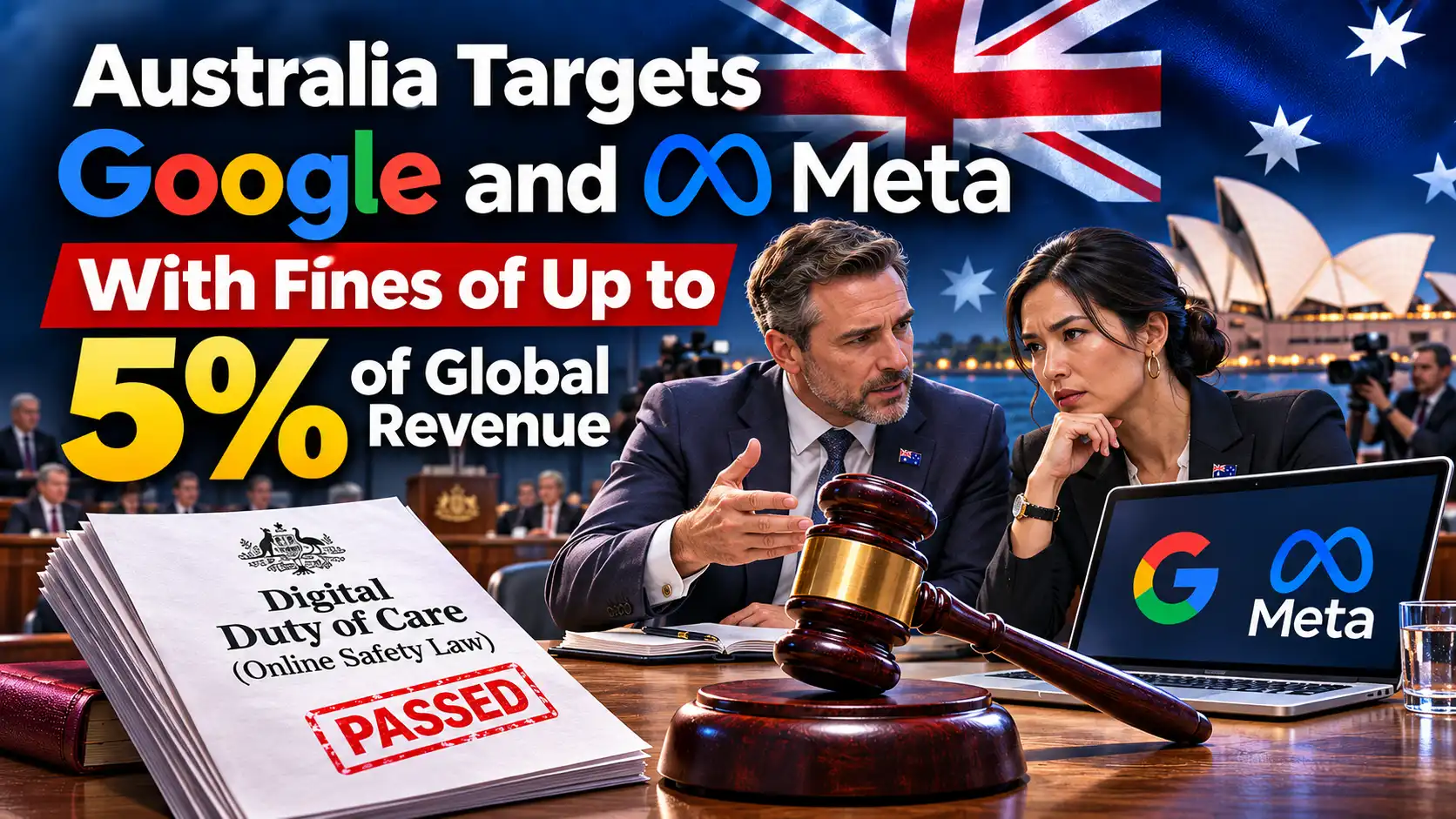
Australia has passed online safety legislation that could expose Google, Meta and other major technology companies to multibillion-dollar penalties. The new Digital Duty of Care framework shifts the emphasis from responding to online harm after it occurs to preventing foreseeable risks.
Under the legislation, the maximum penalty can be the greater of approximately A$109 million or 5% of worldwide turnover, according to Reuters. Implementation is expected approximately one year after passage. No fine against Google or Meta under the new framework has been announced in the cited reporting.
Key highlights
Why is Australia targeting Google and Meta?
The government wants online services to take greater responsibility for the risks created by their products. Communications Minister Anika Wells announced an agreement with the Greens on November 24 that increased the proposed penalties. The minister’s press conference outlined the changes.
For regulators, the central question is whether companies have taken reasonable preventive measures, rather than merely removed individual posts after complaints. For technology businesses, that can mean reassessing how safety is incorporated into product development.
What is Australia’s Digital Duty of Care law?
The framework is intended to strengthen protection from online harms. Areas of concern include child exploitation, non-consensual intimate imagery, violent extremist material, self-harm content and harmful platform design. The precise obligations depend on the type of service and applicable regulatory requirements.
How the framework works
Social media, search and other covered services
Assess foreseeable risks and take preventive action
Potential penalties for qualifying breaches
Simplified conceptual diagram; not a legal decision tree.
How much could Google and Meta be fined?
Revenue-based sanctions scale with the size of a business. A company with A$200 billion in worldwide annual turnover, for example, would have a 5% revenue component of A$10 billion. The figures below are hypothetical, not company financial results or actual penalties.
Potential revenue-based fines
Illustrative annual global turnover and its 5% penalty component, in Australian dollars.
Formula: annual global turnover × 5%. The alternative statutory component is not plotted.
Interactive Big Tech fine calculator
Enter hypothetical worldwide annual turnover in Australian dollars. The calculator compares the two reported maximum penalty components.
This is an educational estimate using the rounded A$109 million figure reported in the news. Actual statutory amounts and penalties depend on applicable law and enforcement decisions. No currency conversion is performed.
JavaScript is required to update the calculator. Formula: MAX(turnover in AUD × 0.05, 109000000).
Which technology companies could be affected?
The framework is broader than any single social network. Depending on service classification, the following businesses could face new compliance requirements.
| Company | Potentially relevant services |
|---|---|
| Alphabet (Google) | Search, YouTube and AI |
| Meta | Facebook, Instagram and messaging |
| TikTok | Video sharing and recommendations |
| Snap | Social networking and messaging |
| Microsoft | Gaming and AI services |
| OpenAI | AI chatbots |
| X | Social networking |
Illustrative list; inclusion does not establish a violation or confirm that every listed service is covered.
Could Australians sue social media companies?
The reforms also introduce avenues for individuals to seek legal remedies for certain online harms. For platforms, private litigation could add to the cost of regulatory compliance. Eligibility, remedies and liability will depend on the legal provisions and facts of individual cases.
Australia also targets harmful platform design
Online safety debates increasingly focus on the design of recommendation feeds, engagement features and user controls. Giving users greater control over algorithmic recommendations could change how they interact with platforms. Businesses should distinguish these policy objectives from specific product changes that have not yet been announced.
United States raises freedom of speech concerns
US Ambassador David Brat has expressed concern that broad definitions of harm and large penalties could cause platforms to restrict lawful speech, as reported by The Guardian. Supporters of the Australian reforms argue that preventive safety measures are necessary to protect users. Implementation will need to address the tension between safety and legitimate expression.
How Australia compares with other countries
Australia joins jurisdictions that use turnover-based penalties to enforce digital safety rules.
International online safety penalties
Revenue-based maximum components only. The laws differ in scope, turnover definitions, alternative thresholds and enforcement. Sources: Ofcom, European Commission and Reuters.
What could this mean for digital marketing and online businesses?
Social media advertising
Platforms may strengthen advertiser verification and review processes. Businesses could benefit from fewer fraudulent ads, but may face more compliance checks.
Organic reach and content distribution
Changes to recommendations could affect discovery and engagement. Publishers may want to diversify distribution through search, newsletters and direct audience relationships.
AI-generated content and brand safety
AI services may adopt additional safeguards, while advertisers could gain more controls over placement. These remain possible effects, not confirmed platform updates.
What could Australia’s Big Tech law mean for the Philippines?
The Australian law does not create equivalent obligations under Philippine law. Nevertheless, if international technology companies adopt safety changes across markets, Filipino internet users could encounter updated reporting tools, advertising controls, recommendation settings or AI safeguards.
Philippine policymakers could also examine the Australian approach when considering domestic rules. Whether such a framework will be adopted locally remains uncertain.
Will Google and Meta challenge the law?
Industry concerns about compliance costs, legal uncertainty and content moderation could lead to further consultations or litigation. The cited reporting does not establish that either company has filed a legal challenge to the new law. Future corporate responses should be assessed against official announcements.
Timeline of online safety reforms
- 2022European Union adopts the Digital Services Act.
- 2023United Kingdom passes the Online Safety Act.
- December 2025Australia’s social media minimum-age restrictions take effect.
- November 24, 2026Government announces agreement with the Greens on tougher penalties.
- November 25, 2026Digital Duty of Care legislation clears Parliament.
- Late 2027 (expected)New framework takes effect, subject to formal commencement arrangements.
Frequently asked questions
Has Australia already fined Google and Meta 5% of global revenue?
No. The legislation provides a potential maximum penalty, not an automatic fine.
Is the penalty based on Australian revenue?
The percentage component is based on worldwide turnover.
Does the law affect AI chatbots?
AI chatbots are relevant to the wider safety framework, subject to service-specific coverage.
Can Australians sue Facebook or Instagram?
New legal remedies may be available for qualifying harms, subject to the legislation’s requirements.
When will the law take effect?
Implementation is expected in approximately one year, in late 2027.
Will Australia ban Google or Facebook?
The legislation imposes safety requirements; it does not establish a general ban on either service.
Conclusion
Australia’s Digital Duty of Care adds to the international shift toward preventive online safety obligations and turnover-based enforcement. Its effects will depend on regulatory standards, platform responses and how the rules balance safety with lawful expression. For users and businesses outside Australia, the most important developments to watch will be any changes companies choose to introduce globally.