
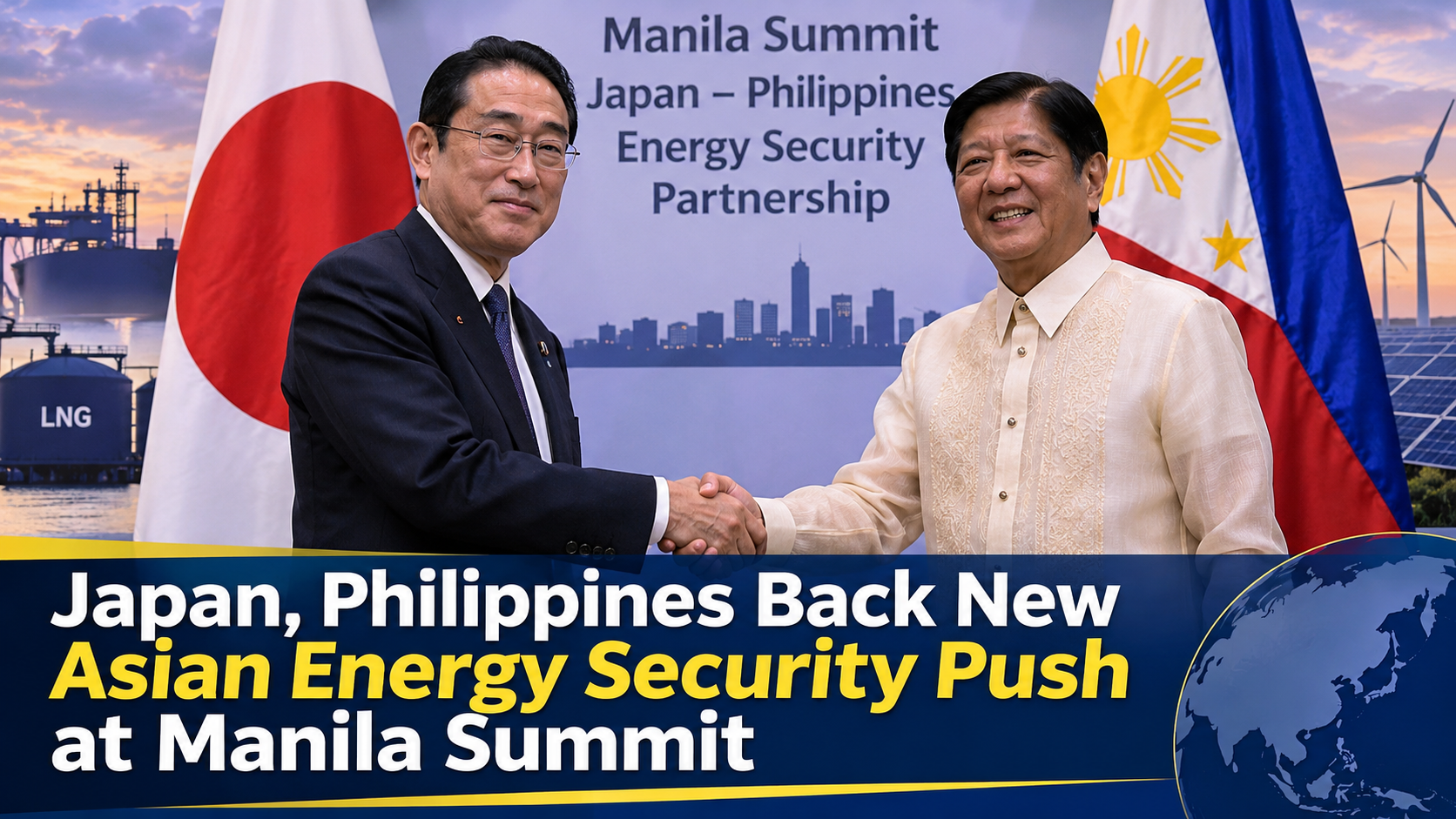
Japan and the Philippines used a Manila summit on November 17, 2026 to push a new regional energy security initiative, as Asian governments weigh how to respond to oil supply shocks and market volatility that can quickly spill over into inflation and electricity costs.
At the 4th Asia Zero Emission Community (AZEC) Leaders’ Meeting in Manila, Japanese Prime Minister Sanae Takaichi proposed a stronger Asian energy security framework, while President Ferdinand Marcos Jr. reiterated the Philippines’ case for a more diversified energy mix that includes nuclear power. Japan’s Foreign Ministry said the meeting was co-chaired by Takaichi and Marcos and formed part of a broader push to strengthen regional coordination on energy supply risks through what Japan called AZEC 2.0 and POWERR Asia.
What changed at the Manila summit
The main development was not just another diplomatic statement. The Manila meeting produced a documented regional outcome: an AZEC leaders’ joint statement and a related Japan-International Energy Agency statement supporting an “IEA-Japan Oil Security Hub for Asia.”
According to the AZEC Leaders’ Joint Statement, leaders discussed stronger cooperation on decarbonization, energy transition and energy security. A separate Japan-IEA joint statement said the proposed IEA-Japan Oil Security Hub for Asia would support the work of an Asia Oil Security Task Force established at the AZEC Leaders’ Meeting on November 17.
Associated Press reported that Takaichi framed the proposal as a way for Asian countries to respond more effectively to oil crises, including supply disruptions tied to conflict in the Middle East. AP also reported that Japan said it would help lead work on emergency stockpile releases and sharing arrangements.
Why this matters to the Philippines
For Filipino households, transport workers and businesses, the significance is straightforward: the Philippines is highly exposed to imported oil price swings. When global crude or refined fuel costs jump, the effects can spread to pump prices, public transport, delivery costs and eventually food prices.
That is why a regional mechanism designed to improve coordination during supply shocks matters, even if it does not guarantee cheaper fuel in the near term. The safest reading of the Manila initiative is that it aims to improve resilience and crisis response, not to promise immediate price relief.
This is especially relevant because fuel and power costs have already been a major inflation issue in the Philippines. The Daily Caffeine recently reported on the latest fuel price rollback, showing how closely local pump prices track global movements. Inflation has also remained a major public concern, with transport, electricity and fuel costs helping push prices higher in recent months, as covered in our report on October 2026 inflation.
Marcos ties summit to energy diversification
The Philippine side used the summit to reinforce a domestic policy message: energy security cannot rely on a single source.
According to the Philippine News Agency, Marcos argued that the Philippines needs a diversified energy mix and renewed his support for nuclear power as part of longer-term energy security planning. PNA reported that Marcos backed nuclear while Japan pitched a regional energy body at the Manila meeting.
That point is important to frame carefully. The verified development from November 17 is Marcos’ policy position, not the approval of a new nuclear plant or a final project decision. The summit did, however, show that Manila is linking regional energy diplomacy with its own debate over how to secure stable and affordable power supplies in the years ahead.
What the proposed framework could do
Based on the documents released after the summit, the emerging framework appears focused on coordination rather than a binding new treaty, at least for now.
Possible functions mentioned or implied in the released materials include:
- sharing information during oil supply disruptions;
- coordinating responses to regional fuel shortages;
- studying emergency stockpile release arrangements; and
- building an institutional hub linking Japan and the IEA to Asian partners.
If developed further, such a setup could help governments respond faster during crises. For the Philippines, that could be relevant during periods of sharp global price spikes, shipping disruptions or geopolitical tensions that affect fuel imports.
What remains unclear
Several key details are still unresolved.
First, the released materials do not provide a final timetable for how the proposed oil security hub will operate. Second, the structure of the Asia Oil Security Task Force, including funding, membership obligations and governance, has not yet been fully detailed in the documents reviewed.
Third, it remains unclear whether any future emergency-sharing arrangement would be legally binding or mainly consultative. That matters because countries in the region have varying levels of strategic reserves, storage capacity and domestic energy policy constraints.
There is also no verified basis yet to say the initiative will directly lower Philippine fuel prices. Any effect on consumers would depend on how the framework is implemented, whether it improves crisis response, and whether participating governments make concrete domestic commitments.
Why the Manila meeting stands out
The summit matters because it moved the discussion from broad energy transition language to a more immediate question: how Asian governments should protect their economies from another oil shock.
That shift is significant for the Philippines. Energy security is no longer just a technical policy debate about power plants and fuel sourcing. It is also a cost-of-living issue, a transport issue and an inflation issue. When fuel costs rise sharply, ordinary Filipinos feel it in commuting expenses, delivery charges and household budgets.
The Manila meeting did not solve those pressures overnight. But it did produce a concrete regional initiative backed by Japan, acknowledged by the Philippines, and tied to an oil security task force that could shape future coordination in Asia.
FAQ
What was announced at the Manila AZEC summit?
Japan and the Philippines backed stronger regional energy security coordination, including support for an Asia Oil Security Task Force and a proposed IEA-Japan Oil Security Hub for Asia.
Will this lower fuel prices in the Philippines?
There is no verified evidence yet that it will reduce pump prices in the near term. The initiative is better understood as a resilience and crisis-response measure.
Did Marcos approve a new nuclear plant?
No. The verified development is that Marcos again argued for a diversified energy mix, including nuclear power. That is a policy position, not a final plant approval.
Why should Filipinos pay attention?
Because oil supply shocks can affect transport costs, food distribution, electricity prices and inflation, all of which directly affect household budgets and business costs.
For now, the Manila summit’s biggest result is political and strategic: Japan and the Philippines have put energy security higher on the regional agenda at a time when oil-market disruptions remain a serious economic risk. What happens next will depend on whether the new task force and planned oil-security hub move from summit language to operational policy.
Sources
- The 4th Asia Zero-Emission Community (AZEC) Leaders Meeting | Ministry of Foreign Affairs of Japan
- # Asia Zero Emission Community (AZEC) Leaders’ Joint Statement
- Marcos backs nuclear power as Japan pitches Asian energy body | Philippine News Agency
- # Joint Statement by the Government of Japan and the International Energy Agency (IEA)
- Japan urges creation of an Asian energy framework to counter oil crises