
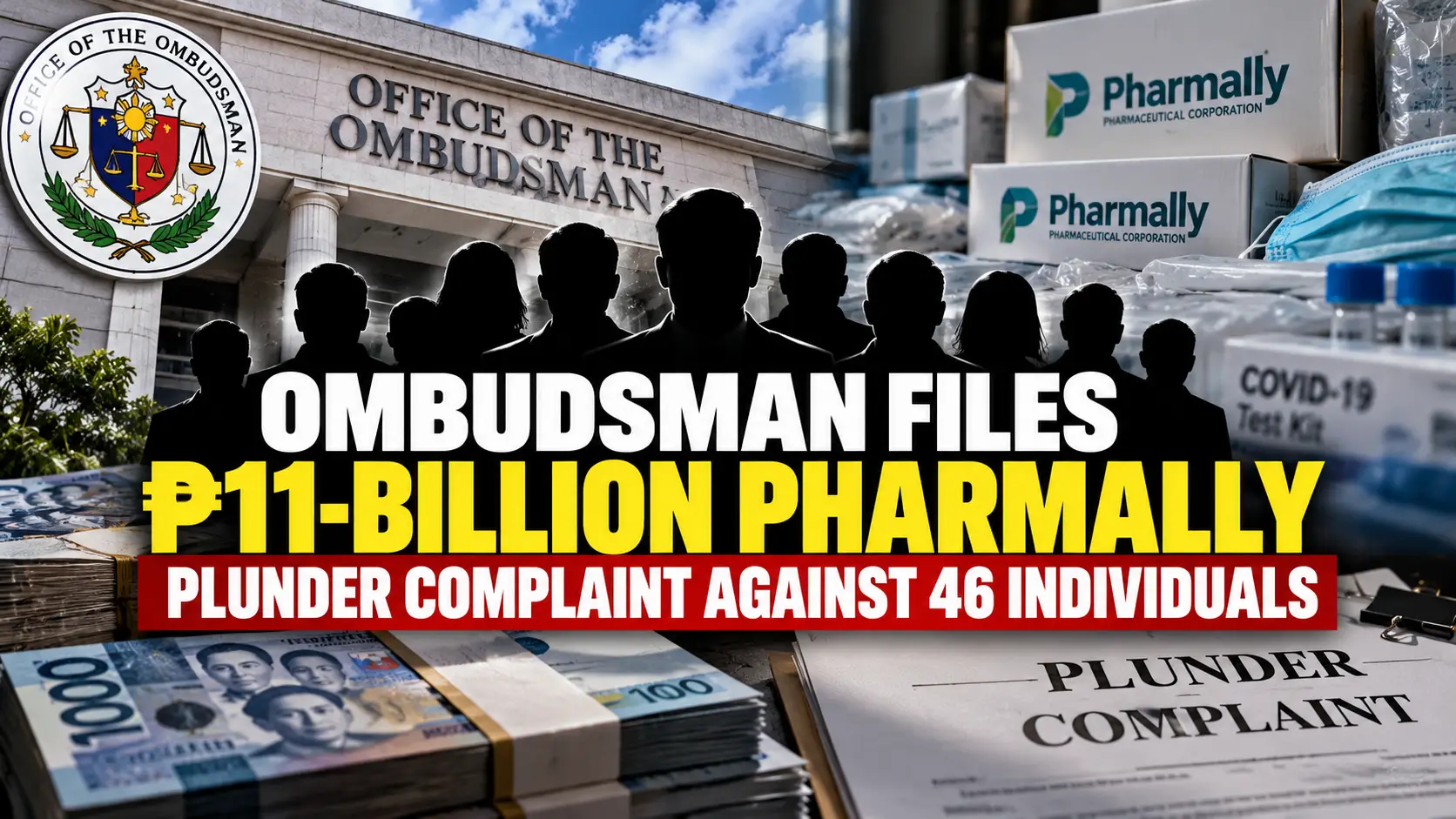
More than five years after the Pharmally controversy erupted during the COVID-19 pandemic, the Office of the Ombudsman has filed a plunder complaint involving approximately ₱11 billion against 46 individuals linked to the government’s controversial procurement of medical supplies.
The announcement, made by Ombudsman Jesus Crispin “Boying” Remulla on October 16, 2026, has revived questions about how billions of pesos in public funds were spent during one of the Philippines’ most serious public health emergencies.
Among the respondents identified by Remulla are former Procurement Service-Department of Budget and Management (PS-DBM) chief Lloyd Christopher Lao and businessman Michael Yang, a former economic adviser to President Rodrigo Duterte.
The Ombudsman also disclosed that 23 of the 46 respondents could not be located at their known addresses, complicating efforts to serve notices and advance the investigation.
The development represents a significant step in the government’s continuing examination of pandemic-era procurement.
However, an important legal distinction remains: filing a plunder complaint is not the same as securing a criminal conviction, and the respondents are presumed innocent unless proven guilty.
Pharmally Plunder Complaint: Key Facts at a Glance
| Detail | Reported information |
|---|---|
| Complaint | Plunder |
| Amount involved | Approximately ₱11 billion |
| Number of respondents | 46 |
| Respondents reportedly unlocated | 23 |
| Announced by | Ombudsman Jesus Crispin Remulla |
| Announcement date | October 16, 2026 |
| Government procurement agency involved | PS-DBM |
| Private company at the center | Pharmally Pharmaceutical Corporation |
| Purchases under scrutiny | PPE, face masks, COVID-19 testing kits and other medical supplies |
| Status | Complaint under investigation; no conviction established by the announcement |
The ₱11-billion figure describes the amount associated with the complaint. It should not automatically be interpreted as ₱11 billion conclusively stolen or lost.
What Happened on October 16, 2026?
During a press briefing, Ombudsman Remulla confirmed that a plunder complaint had been filed involving 46 respondents.
The complaint concerns alleged irregularities in government purchases of pandemic supplies, including personal protective equipment and coronavirus testing kits.
Remulla explained that the number of respondents contributed to the length and complexity of the investigation.
He also raised concerns about difficulties locating individuals whose participation is being examined.
According to the Ombudsman, repeated attempts to find some respondents at their listed addresses had been unsuccessful.
The inability to serve notices creates practical problems for investigators, who must observe procedural requirements while allowing respondents the opportunity to answer allegations.
The Ombudsman’s remarks about possible attempts to evade jurisdiction are his assessment of the situation. They do not establish that all 23 individuals are fugitives or have deliberately gone into hiding.
What Is Pharmally Pharmaceutical Corporation?
Pharmally Pharmaceutical Corporation was registered in the Philippines in September 2019 as a company involved in the distribution and importation of pharmaceutical products and related equipment.
According to earlier reporting and legislative investigations, the company had paid-up capital of only ₱625,000 when it began receiving substantial government supply contracts.
During the COVID-19 pandemic, Pharmally secured contracts worth billions of pesos from the PS-DBM.
Those contracts covered medical supplies needed during the public health emergency.
The company’s rapid expansion into large government transactions became controversial because investigators questioned its financial capacity, procurement qualifications, pricing and supplier relationships.
Why was Pharmally’s capitalization controversial?
Paid-up capital is one indicator of the financial resources invested in a corporation.
A company with limited capitalization is not automatically prohibited from securing large contracts.
However, government procurement rules generally require appropriate due diligence to determine whether suppliers can fulfill contractual obligations.
During the Pharmally hearings, lawmakers questioned how a company with ₱625,000 in paid-up capital could secure contracts worth several billion pesos.
Pharmally representatives explained that the company obtained support from other sources, including supplier arrangements and financing assistance.
The question for investigators was whether the company satisfied applicable procurement requirements and whether public officials properly evaluated those qualifications.
How Much Were Pharmally’s Government Contracts Worth?
Several figures have appeared in Pharmally reporting over the years.
The differences reflect varying periods, transaction scopes and investigative records.
| Figure | Context |
|---|---|
| ₱625,000 | Pharmally’s reported paid-up capital |
| Approximately ₱8.68 billion | Contracts commonly cited during the original 2021 controversy |
| Approximately ₱11 billion | Broader 2020–2021 contract value discussed in later procurement research |
| Approximately ₱11 billion | Amount associated with the October 2026 plunder complaint |
| Approximately ₱4.1 billion–₱4.4 billion | Value reported in coverage of an earlier, separate criminal case involving Lao |
The figures should not be added together.
They may refer to overlapping transactions, different contract groupings or separate legal proceedings.
Likewise, the value of a government contract is not automatically equivalent to an amount of proven overpricing or unlawful enrichment.
The full complaint and supporting financial records would be needed to determine precisely how prosecutors calculate the alleged plunder amount.
Who Are the 46 Respondents?
The Ombudsman has identified individuals associated with Pharmally, government procurement and related business entities.
Two of the most prominent respondents are Lloyd Christopher Lao and Michael Yang.
Lloyd Christopher Lao
Lao previously headed the Procurement Service of the Department of Budget and Management, the agency involved in purchasing medical supplies during the pandemic.
He became a central figure in earlier investigations into the government’s procurement decisions.
In August 2025, Lao pleaded not guilty in a separate case before the Sandiganbayan involving allegedly anomalous Pharmally medical-supply purchases.
That earlier proceeding must be distinguished from the newly announced ₱11-billion plunder complaint.
Lao’s inclusion in the new complaint does not establish that he committed plunder.
Michael Yang
Michael Yang, also known as Yang Hong Ming, served as an economic adviser during the Duterte administration.
His name emerged during the original Pharmally investigation because of his business connections and reported involvement in helping the company establish supplier relationships.
During earlier Senate proceedings, questions were raised about his relationship with Pharmally executives and the company’s financing arrangements.
Yang’s inclusion in the 2026 complaint means investigators are examining his alleged role.
It does not, by itself, prove that he financed an unlawful transaction or participated in plunder.
Pharmally executives and associated individuals
Among those publicly identified in the Ombudsman’s discussion of respondents who could not be located are:
- Huang Tzu Yen — Pharmally chairman.
- Twinkle “Twinkie” Dargani — Pharmally president.
- Mohit Dargani — Corporate secretary and treasurer.
- Linconn Uy Ong — Pharmally director.
- Krizle Grace Mago — Former head of regulatory affairs.
- Lin Wei Xiong — Pharmally financial manager.
- Rose Nono Lin — Pharmally officer.
- Michael Yang — Former presidential economic adviser.
- Yang Hong Jiang, also referred to as Tony or Tany Yang — Michael Yang’s brother.
- Mervin Ian Tanquintic — Former PS-DBM personnel.
Other individuals linked to associated companies and procurement activities were also identified.
The complete official complaint should be consulted before treating any media-published roster as the definitive list of all 46 respondents.
Why Are 23 Respondents Reportedly Unlocated?
One of the most significant developments is the Ombudsman’s difficulty locating half of the respondents.
Remulla said investigators had been unable to serve some individuals at their known addresses.
This creates obstacles because legal proceedings require proper notice and opportunities for respondents to participate.
Does this mean the respondents are fugitives?
Not necessarily.
A person may be unavailable at a registered address for several reasons, including relocation, outdated contact information or residence outside the country.
Deliberately evading legal proceedings is a separate allegation that requires evidence.
The Ombudsman’s statement does not establish that arrest warrants have been issued against all 23 respondents.
What happens if respondents cannot be served?
Investigators may attempt to identify updated addresses and use other legally permitted procedures for service.
The next steps depend on the nature and stage of the proceedings.
Authorities must comply with applicable due-process requirements.
The inability to locate respondents does not automatically establish their guilt.
Why Did the Pharmally Controversy Begin?
The controversy emerged in 2021 as lawmakers examined government spending during the COVID-19 pandemic.
The Department of Health had transferred substantial funds to the PS-DBM for procurement of medical supplies.
The transactions attracted scrutiny after concerns were raised about pricing, documentation, supplier qualifications and contract awards.
The Senate Blue Ribbon Committee conducted extensive hearings into the procurement arrangements.
Several issues became central to those investigations.
1. Supplier qualifications
Lawmakers questioned whether Pharmally possessed the financial and operational capacity to fulfill contracts worth billions of pesos.
2. Pricing of pandemic supplies
Investigators examined whether the government paid appropriate prices for face masks, face shields, PPE and testing kits.
Pandemic-era supply shortages and rapidly changing market prices complicated comparisons.
3. Procurement procedures
Emergency procurement rules allowed government agencies to obtain urgently needed supplies more quickly.
However, accelerated procurement did not eliminate requirements for accountability, documentation and appropriate safeguards.
4. Business relationships
The hearings examined the relationships among company executives, suppliers, intermediaries and government officials.
These inquiries included Michael Yang’s connections to Pharmally.
5. Oversight and accountability
The controversy raised broader questions about whether agencies adequately documented decisions and verified the delivery, quality and pricing of supplies.
What Did the Senate Investigation Find?
The Senate Blue Ribbon Committee’s investigation identified concerns about Pharmally’s qualifications and procurement transactions.
Committee proceedings examined company records, contracts, witness testimony and procurement documents.
The Senate inquiry was an investigation in aid of legislation, not a criminal trial.
Its findings and recommendations therefore did not automatically establish criminal liability.
Importantly, a separate House investigation reached different recommendations regarding some individuals.
In 2022, a House committee recommended syndicated estafa charges against several Pharmally officials but did not recommend charges against Lao and Yang based on the evidence it had reviewed.
These differing conclusions demonstrate why legislative findings, investigative complaints and court judgments must be distinguished.
The Ombudsman’s 2026 complaint represents a later investigative development and should be assessed on its own evidence and legal grounds.
What Is Plunder Under Philippine Law?
Plunder is a serious criminal offense defined under Republic Act No. 7080, as amended.
The law concerns a public officer who, alone or in conspiracy with others, accumulates ill-gotten wealth through a combination or series of specified unlawful acts.
The statutory threshold is at least ₱50 million in alleged ill-gotten wealth.
Potential unlawful acts can include misuse of public funds, kickbacks from government contracts and abuse of official position to obtain financial benefits.
Private individuals may also face liability where their participation in the alleged offense is established under the law.
Does an ₱11-billion procurement controversy automatically qualify as plunder?
No.
The prosecution must establish the required legal elements, including the relevant unlawful acts and accumulation of ill-gotten wealth.
Large procurement amounts alone are insufficient to prove plunder.
The law requires evidence connecting the alleged transactions to unlawful enrichment and the required pattern of conduct.
What penalties can apply?
Plunder carries severe penalties, including lengthy imprisonment and forfeiture of unlawfully acquired assets upon conviction.
The exact penalties and legal consequences depend on the governing statutes, applicable amendments and judicial findings.
No penalty may be imposed on a respondent merely because a complaint has been filed.
Is the New Complaint Already a Sandiganbayan Criminal Case?
This distinction is particularly important.
The October 16 announcement concerns a plunder complaint filed at the Ombudsman.
That does not necessarily mean the Ombudsman has completed preliminary investigation, found probable cause against every respondent or filed a new criminal information in the Sandiganbayan.
A complaint ordinarily triggers further legal evaluation.
The Ombudsman must assess the evidence and determine whether criminal charges should proceed to court.
Only then, where legally warranted, would a criminal information be filed before the appropriate court.
Separate proceedings involving some Pharmally-related transactions have already reached the Sandiganbayan.
Those earlier cases should not be confused with the new complaint.
Timeline: From the Pandemic Contracts to the 2026 Plunder Complaint
| Year | Development |
|---|---|
| 2019 | Pharmally is registered in the Philippines |
| 2020 | The company begins receiving major government medical-supply contracts |
| 2021 | Senate investigations examine pandemic procurement and Pharmally’s qualifications |
| 2022 | Legislative investigations produce findings and recommendations |
| 2023–2024 | Related investigations and legal disputes continue |
| August 2025 | Lao pleads not guilty in a separate Pharmally-related case |
| October 16, 2026 | Ombudsman announces an approximately ₱11-billion plunder complaint involving 46 respondents |
| October 16–19, 2026 | Reports detail difficulties locating 23 respondents |
| October 25, 2026 | No conviction arising from the newly announced complaint has been established in the sources reviewed |
Why the Pharmally Case Still Matters in 2026
The controversy concerns decisions made during an extraordinary national emergency.
At the height of the pandemic, hospitals needed protective equipment, laboratories needed testing supplies and health workers faced significant risks.
Emergency procurement was intended to help the government respond quickly.
But urgency also increased the importance of transparency and oversight.
The Pharmally case raises questions that remain relevant to future public emergencies.
Were public funds properly protected?
Government agencies must be able to demonstrate that emergency spending was necessary, appropriately priced and supported by sufficient documentation.
Were suppliers properly evaluated?
Public agencies must assess whether suppliers can deliver required goods, even when procurement procedures are accelerated.
Were accountability mechanisms effective?
Investigations that continue years after the underlying transactions raise questions about recordkeeping, enforcement capacity and the timely resolution of complaints.
Can the government recover money if wrongdoing is proven?
Where courts establish unlawful acquisition of public funds or assets, recovery and forfeiture may be available under applicable law.
However, the filing of a complaint does not guarantee that money will be recovered.
What lessons should be applied to future emergencies?
Future procurement systems can benefit from stronger supplier verification, public contract disclosures, digital audit trails, price benchmarking and transparent delivery records.
These are governance considerations, not findings that every questioned Pharmally contract was fraudulent.
What Happens Next in the Pharmally Case?
Several developments will determine how the complaint progresses.
Service of notices: The Ombudsman must address the difficulty of locating respondents while complying with legal procedures.
Responses from respondents: Those named should have an opportunity to answer the allegations.
Evaluation of evidence: Investigators must determine whether the available records support the legal elements of the alleged offenses.
Probable-cause determination: The Ombudsman must decide whether criminal prosecution is warranted.
Possible court filing: If the legal requirements are satisfied, an information may be filed in the appropriate court.
Trial and judgment: Criminal liability can be determined only through the applicable judicial process.
No specific timetable for completion of these stages was confirmed in the October 16 announcement.
Frequently Asked Questions
How much money is involved in the Pharmally plunder complaint?
Approximately ₱11 billion, according to the Ombudsman’s October 2026 announcement. This is the amount associated with the complaint, not a judicial finding that the entire sum was stolen.
How many people are named?
The Ombudsman reported 46 respondents.
Who are the prominent respondents?
They include former PS-DBM chief Lloyd Christopher Lao, businessman Michael Yang and several Pharmally executives.
Why are 23 respondents reportedly missing?
The Ombudsman said investigators had been unable to locate them at their known addresses. Their individual reasons for being unavailable have not all been established.
Has Michael Yang been convicted?
No conviction arising from the newly announced plunder complaint has been established in the reports reviewed.
Has Lloyd Christopher Lao been convicted?
The October 2026 complaint does not establish a conviction. Lao previously pleaded not guilty in a separate Pharmally-related case.
Is former President Rodrigo Duterte one of the 46 respondents?
The reviewed October 2026 reports identify Yang as a former Duterte adviser but do not establish that Rodrigo Duterte himself is among the 46 respondents.
What is the difference between graft and plunder?
Graft covers various corrupt practices by public officials under applicable laws. Plunder requires proof of the specific statutory elements involving a combination or series of unlawful acts and at least ₱50 million in ill-gotten wealth.
Is the ₱11-billion amount the same as Pharmally’s original ₱8.68-billion contracts?
Not necessarily. The figures come from different reporting periods and transaction scopes and should not be treated as interchangeable without the underlying records.
What happens if the Ombudsman finds probable cause?
The Ombudsman may pursue the filing of criminal charges before the appropriate court, subject to applicable procedures and legal requirements.
Conclusion: A Major Accountability Test, but Not Yet a Verdict
The Ombudsman’s ₱11-billion Pharmally plunder complaint marks a new stage in a controversy that began during the COVID-19 pandemic.
The involvement of 46 respondents, including former procurement officials and business figures, underscores the scale and complexity of the investigation.
The reported difficulty locating 23 respondents adds another challenge to the legal process.
But the central question remains unresolved: whether prosecutors can establish the evidence required to prove criminal wrongdoing.
For Filipino taxpayers, the case is about more than the individuals named.
It concerns how emergency funds were managed, how government suppliers were selected, how public money was protected and whether accountability mechanisms can deliver timely and fair outcomes.
The outcome must ultimately rest on evidence, due process and judicial findings—not allegations alone.
The Daily Caffeine will continue following the Ombudsman’s investigation, the respondents’ legal responses and any subsequent Sandiganbayan proceedings.
Sources and References
- GMA News — Ombudsman Files ₱11-Billion Plunder Complaint Against Pharmally Officials and Others, October 16, 2026
- The Philippine Star — ₱11-Billion Plunder Complaint Filed in Pharmally Case, October 17, 2026
- News5 — Ombudsman Files ₱11-Billion Complaint Against 46 Respondents, October 17, 2026
- NewsWatch Plus — 23 Respondents Cannot Be Located, October 19, 2026
- VERA Files — Pharmally’s Procurement Contracts and Qualifications
- Philippine Institute for Development Studies — Procurement Controversies and Public Procurement Reform
- Philippine News Agency — House Committee’s Pharmally Investigation Findings
- Office of the Ombudsman — Republic Act No. 7080, Plunder Law
- Supreme Court E-Library — Ong v. Senate of the Philippines, Pharmally-Related Proceedings
Editorial note: This article reports allegations as allegations, distinguishes complaints from court-filed charges and convictions, and does not infer guilt from a respondent’s inclusion in an investigation. Updated October 25, 2026.