
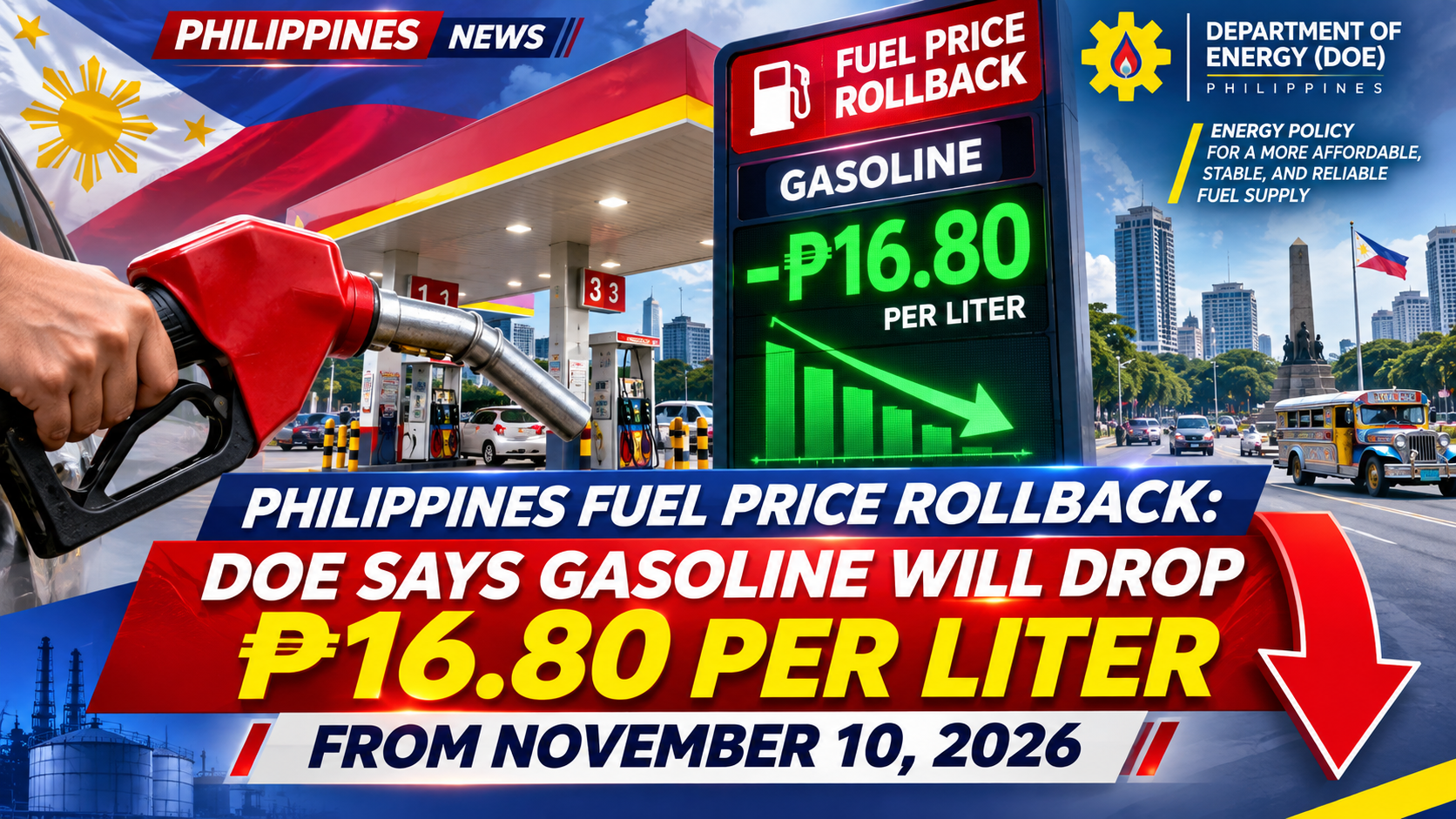
Filipino motorists are set to get rare and immediate relief at the pump after the Department of Energy announced a major rollback in fuel prices for the week of November 10 to 16, 2026.
In an advisory published on November 9, 2026, the Department of Energy said gasoline prices would be cut by ₱16.80 per liter, diesel by ₱4.10 per liter, and kerosene by ₱3.70 per liter. The agency linked the price drop to easing fears of supply disruption in the Middle East, particularly around the Strait of Hormuz, as markets reacted to signs of possible de-escalation in the U.S.-Iran conflict.
The rollback is significant not only for private vehicle owners but also for public transport drivers, delivery operators, and households already dealing with elevated living costs. Fuel costs affect everything from commuting and logistics to food transport and business expenses.
What will change from November 10 to 16
| Fuel product | Price change |
|---|---|
| Gasoline | -₱16.80 per liter |
| Diesel | -₱4.10 per liter |
| Kerosene | -₱3.70 per liter |
These are among the biggest weekly reductions consumers have seen this year, especially for gasoline. For drivers filling up regularly, the change could translate into meaningful short-term savings over the next several days.
Why fuel prices are falling
According to the DOE, oil prices moved lower as concerns eased over a wider disruption in Middle East supply routes. The agency said expectations of more stable shipments through the Strait of Hormuz helped pull global prices down.
That explanation broadly matches market reporting cited in the research brief. Reuters, via a November 2026 market report, said oil prices fell sharply after signals that fresh attacks on Iran were unlikely while talks were progressing, even though regional supply risks had not fully disappeared.
The main point for Philippine consumers is straightforward: local pump prices remain highly sensitive to international oil developments. When conflict fears rise, prices can jump quickly. When those fears ease, pump prices can also fall sharply.
Why this matters to ordinary Filipinos
The direct benefit is clearest for motorists and transport operators, who will pay less for fuel during the November 10 to 16 adjustment window. A lower fuel bill can help drivers manage weekly operating costs, especially after months of volatility.
But the wider impact goes beyond car owners. Fuel costs feed into delivery charges, supply chains, and the cost of moving goods across the country. That matters in a period when inflation has already strained household budgets. The rollback comes only days after October 2026 inflation was reported at 7.8%, with transport, power, and fuel among the major cost pressures, as reported in The Daily Caffeine’s earlier inflation coverage.
That said, one weekly rollback should not automatically be read as a turning point for overall inflation. Lower fuel prices can offer short-term relief, but broader price trends will still depend on what happens next in global oil markets and whether the decline is sustained.
Context: this follows months of fuel pressure
The DOE’s announcement lands after a period in which consumers had already absorbed steep increases in fuel costs. On September 15, 2026, the agency said the one-month average price of Dubai crude had reached the legal threshold for the government to consider suspending or reducing fuel excise taxes.
In that earlier advisory, the DOE said pump prices for September 15 to 21 were set to increase by ₱5.68 per liter for gasoline, ₱4.31 for diesel, and ₱4.62 for kerosene. The agency’s notice, published in September, highlighted how quickly higher global oil prices were feeding into local pump costs.
That background helps explain why the new rollback is likely to draw wide public attention. After weeks of increases and persistent inflation concerns, a gasoline cut of ₱16.80 per liter is large enough to be felt immediately by many consumers.
DOE says supply remains adequate
The DOE also said the Philippines had an estimated 50.33 days of total petroleum supply as of November 6, 2026. That included 51.64 days of gasoline inventory and 53.95 days of diesel inventory.
Those figures do not eliminate market risk, but they suggest the country has a supply cushion even as international tensions continue to influence prices.
What remains uncertain
While the rollback for November 10 to 16 is confirmed, several important questions remain open.
- Will the trend last? The DOE itself pointed to continuing uncertainty in the global oil market. A single weekly rollback does not guarantee lower prices in the following weeks.
- Will commuters see immediate fare relief? Not necessarily. Lower diesel prices may reduce operating costs for some operators, but fare changes typically depend on regulators and separate policy decisions.
- What happens to the fuel tax relief issue? The September threshold certification is important context, but the available research does not confirm any new November government decision on excise tax relief.
There is also a practical implementation question. The research notes that GMA News reported the same rollback figures, while also noting uncertainty in one report about whether reductions would be applied fully at once or in phases. Until company-specific advisories are issued, consumers may still need to check the final announced adjustments of their preferred fuel retailers.
FAQ
When does the fuel price rollback take effect?
The DOE said the rollback applies from November 10 to 16, 2026.
How much will fuel prices go down?
Gasoline will fall by ₱16.80 per liter, diesel by ₱4.10 per liter, and kerosene by ₱3.70 per liter.
Why are prices dropping?
The DOE said global oil prices declined as concerns eased over possible supply disruption linked to the U.S.-Iran conflict and shipping through the Strait of Hormuz.
Will this lower transport fares right away?
Not automatically. Any fare adjustment would depend on separate decisions by regulators and transport operators.
For now, the clearest takeaway is that the DOE’s November 9 announcement offers real but likely temporary relief for consumers after months of fuel-driven cost pressure. Whether that relief lasts will depend less on local policy than on whether tensions in the Middle East continue to cool and global oil markets stay stable.
Sources
- DOE Announces Major Fuel Price Rollback of Up to P16.80 per Liter
- Doe clears key requirement for fuel tax relief amid rising pump prices
- Oil down more than $7 a barrel in post settlement trade as Trump signals restraint on Iran By Reuters
- Mega fuel price rollback set on Tuesday, November 10 | GMA News Online