
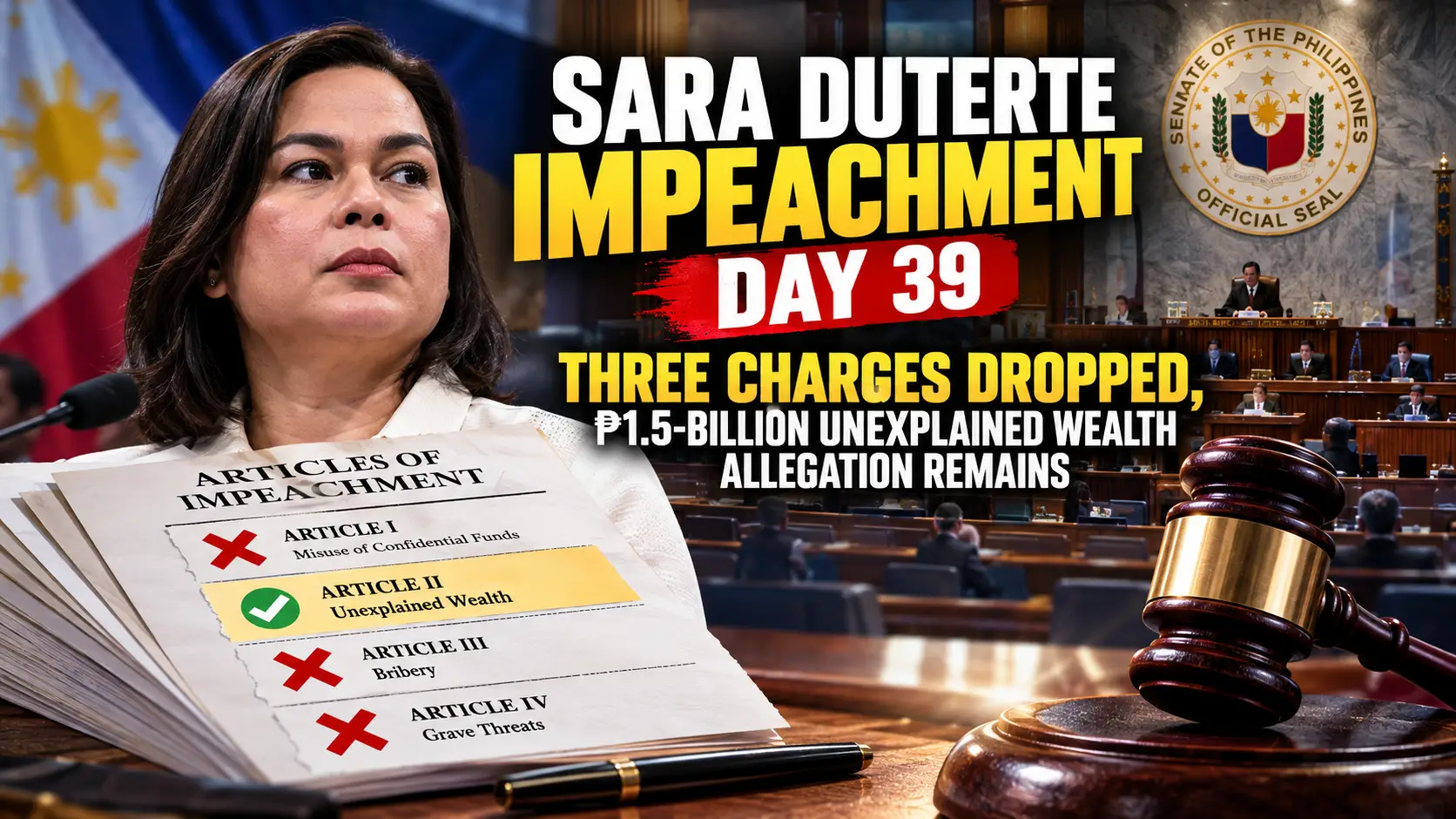
The Sara Duterte impeachment took a major turn on October 13, 2026, when the Senate impeachment court approved the House prosecution’s decision to withdraw three of the four Articles of Impeachment against her.
On Day 39, prosecutors abandoned charges involving the alleged misuse of confidential funds, bribery, and grave threats against President Ferdinand Marcos Jr., First Lady Liza Araneta-Marcos, and former House Speaker Martin Romualdez.
The decision leaves just one charge: Article II, involving allegations of unexplained wealth, inaccurate Statements of Assets, Liabilities and Net Worth (SALNs), and prohibited business interests.
The prosecution maintains that its remaining financial evidence is sufficient to warrant conviction. Duterte’s defense disputes those allegations and argues that withdrawing the other charges after evidence was presented is unfair.
The development substantially changes the scope of the trial, but it does not mean Duterte has been acquitted or found guilty.
What Happened on Day 39?
When the Senate impeachment court convened on October 13, prosecutors were initially expected to seek the withdrawal of Article III, which concerned alleged bribery involving Department of Education officials.
Instead, House lead prosecutor Gerville Luistro announced that the prosecution would withdraw three articles and proceed exclusively with Article II.
The announcement came a day after the prosecution completed the testimony of its final witness, forensic financial analyst Alexander Cabrera.
Luistro told the impeachment court that prosecutors believed they had already presented sufficient evidence to support the unexplained-wealth charge.
The Senate impeachment court, presided over by Senator Francis “Chiz” Escudero, accepted the prosecution’s decision.
The prosecution then formally rested its case.
This means the Senate will no longer decide whether Duterte should be convicted under Articles I, III, and IV. Instead, the eventual verdict will focus on Article II.
Which Impeachment Charges Were Dropped?
The original impeachment case contained four articles.
Article I — Alleged Misuse of Confidential Funds
This concerned allegations involving approximately ₱612.5 million in confidential funds associated with the Office of the Vice President and the Department of Education.
Status: Withdrawn with prejudice.
Article II — Alleged Unexplained Wealth
This concerns allegations of unexplained wealth, inaccurate asset declarations, and prohibited business interests involving Duterte and her husband, lawyer Manases “Mans” Carpio.
Status: Remains for trial.
Article III — Alleged Bribery
This involved accusations of bribery and procurement-related irregularities during Duterte’s tenure as education secretary.
Status: Withdrawn without prejudice.
Article IV — Alleged Grave Threats
This concerned Duterte’s controversial statements involving President Marcos, First Lady Liza Marcos, and former House Speaker Martin Romualdez.
Status: Withdrawn with prejudice.
What Does “With Prejudice” Mean?
The impeachment court made an important distinction between the withdrawn charges.
Articles I and IV were withdrawn with prejudice because prosecutors had already presented evidence concerning those allegations.
Under the court’s ruling, those articles cannot be revived, refiled, or prosecuted again against Duterte during the same constitutional term.
Article III was withdrawn without prejudice because the prosecution had not yet presented its evidence on that charge.
That distinction may have implications for future proceedings, although any new impeachment effort would still need to comply with constitutional requirements.
Importantly, withdrawal is not the same as a Senate acquittal following a full determination of the evidence.
The court did not conclude that the withdrawn allegations were true or false.
Why Did Prosecutors Drop Three Charges?
The House prosecution said its decision was intended to shorten the proceedings and concentrate on evidence it considers sufficient to establish an impeachable offense.
Three factors were particularly important.
1. Prosecutors Believe the Financial Evidence Is Sufficient
The prosecution believes Article II can independently justify Duterte’s removal from office.
Under the 1987 Constitution, an impeachable official does not need to be convicted on several articles for removal.
A conviction on a single article, provided the constitutional voting requirement is satisfied, can be sufficient.
Prosecutors believe the financial documents, government records, and expert testimony presented during the trial support their allegations.
The defense rejects that conclusion.
2. The Withdrawal Eliminates 32 Additional Witnesses
According to the prosecution, abandoning the other articles removes the need to present approximately 32 additional witnesses.
Continuing with all four articles could have required weeks of additional testimony, cross-examination, documentary submissions, and procedural arguments.
The prosecution argued that narrowing the case would save time and public resources.
3. Senate Budget Deliberations Are Approaching
The Senate is also preparing to deliberate on the proposed ₱7.2-trillion national budget for 2027.
That responsibility affects the Senate’s available schedule for impeachment proceedings.
However, some senator-judges have raised concerns about prioritizing speed over the need for a thorough examination of impeachment allegations.
The Constitution does not impose a specific deadline for the Senate to complete an impeachment trial.
Article II: The ₱817.87-Million Unexplained Wealth Allegation
With three charges withdrawn, the prosecution’s case now centers on the financial records of Sara Duterte and Manases Carpio.
Throughout the trial, prosecutors presented documents from banks, financial institutions, insurance companies, government agencies, and the Anti-Money Laundering Council.
These included:
- Bank account records and transaction histories.
- Statements of Assets, Liabilities and Net Worth.
- Income tax returns and other BIR records.
- Corporate ownership and business records.
- Anti-Money Laundering Council reports.
- Financial assessments prepared by prosecution experts.
The prosecution is attempting to determine whether the Vice President’s declared assets and reported income are consistent with the financial information obtained during the investigation.
Financial Expert Estimates ₱817.87 Million
During Day 37 on October 9, forensic financial analyst Alexander Cabrera presented a report estimating approximately ₱817.87 million in allegedly undeclared assets and income involving Duterte and Carpio between 2022 and 2025.
Cabrera, a lawyer and accountant associated with PwC Philippines, said his analysis relied on available financial records and was designed to avoid double-counting transactions.
The prosecution presented his assessment as evidence supporting its allegations of unexplained wealth.
However, the calculation remains contested.
The impeachment court has not established that the amount represents illegally acquired assets or income that Duterte was required to disclose.
Why Did the Alleged Amount Increase to ₱1.5 Billion?
During Day 38 on October 12, Senator Escudero questioned Cabrera about the maximum amount of unexplained wealth his analysis could indicate.
Cabrera responded that the figure could approach ₱1.5 billion under less conservative assumptions.
That figure attracted considerable attention because it was almost twice his original estimate.
However, the distinction between the two amounts is important.
The ₱817.87-million figure was Cabrera’s initial assessment based on his selected methodology.
The approximately ₱1.5-billion figure represented a possible higher estimate calculated using different assumptions.
It was not a newly discovered bank account containing ₱1.5 billion.
Neither estimate has been adopted as a factual finding by the Senate impeachment court.
Can Large Bank Transactions Prove Unexplained Wealth?
Not automatically.
A bank account may record substantial deposits and withdrawals without those transactions representing personal income or net worth.
Transactions may include transfers between accounts, business receipts, loans, repayments, or funds belonging to other individuals or entities.
Consequently, the prosecution must establish how the records relate to assets or income legally attributable to Duterte.
The defense may challenge those findings by providing alternative explanations, documents, and expert testimony.
Defense Challenges the Financial Analysis
During cross-examination on October 12, defense lawyer Kristine Ferrer questioned Cabrera’s qualifications, methodology, and access to financial records.
Cabrera acknowledged that he had not examined financial documents supplied directly by Duterte or Carpio.
He also confirmed that he had not interviewed them or their accountants and auditors.
The defense raised questions about whether his assessment could reliably determine the couple’s actual financial position without incorporating potentially relevant information from those sources.
Cabrera defended his analysis, maintaining that the findings were based on the records available to him.
The disagreement is central to the remaining impeachment case.
The court must eventually determine whether the financial evidence and testimony establish grounds for conviction under Article II.
Defense Objects to the Withdrawal of Three Charges
One of Day 39’s most significant disputes concerned Duterte’s right to answer allegations that prosecutors had already presented.
Lead defense lawyer Sheila Sison argued that the prosecution should not be allowed to introduce accusations and evidence and then withdraw those charges before the defense could formally rebut them.
Her concern was particularly relevant to Articles I and IV because prosecutors had already presented evidence on those matters.
The defense maintained that Duterte should still have an opportunity to challenge the allegations before the impeachment court.
However, presiding officer Escudero ruled that the defense’s formal presentation would be limited to Article II because the three withdrawn articles were no longer pending for adjudication.
The court reasoned that it would no longer vote on the withdrawn charges, making further trial proceedings on their merits unnecessary.
The defense continued to question whether that arrangement adequately protected Duterte’s right to respond.
Senate Lifts Gag Rule on Withdrawn Articles
Day 39 also brought a separate ruling concerning Rule 18 of the impeachment court’s procedures.
Rule 18, commonly known as the sub judice rule, restricts public discussion of the merits of matters pending before the impeachment court.
After approving the withdrawal of Articles I, III, and IV, the court lifted the application of Rule 18 to those allegations.
Escudero explained that because the withdrawn articles were no longer pending for adjudication, the parties could publicly address matters connected with them.
This allows Duterte, her lawyers, prosecutors, and other covered parties to discuss the withdrawn accusations without violating that particular impeachment court restriction.
However, other applicable legal restrictions or separate court orders may still apply.
The ruling therefore gives the defense another avenue to respond to accusations that will no longer be examined in the Senate trial.
Did Sara Duterte Win the Impeachment Case?
No.
Although three charges have been withdrawn, the impeachment case remains active.
The Senate has not acquitted Duterte of the remaining unexplained-wealth charge, nor has it found her guilty.
The distinction matters because the withdrawal of charges is a procedural decision rather than a final judgment on the underlying accusations.
The Senate impeachment court must still examine the evidence under Article II, hear the defense’s presentation, and determine whether the constitutional standard for conviction has been satisfied.
Until that process is completed, the outcome remains unresolved.
Can Sara Duterte Still Be Removed From Office?
Yes.
The Constitution does not require conviction on multiple impeachment articles.
Under Article XI, Section 3(6), conviction requires the concurrence of two-thirds of all members of the Senate.
A conviction on Article II alone could be sufficient to remove Duterte from office.
There is, however, a separate constitutional dispute concerning the calculation of the required number of votes.
The impeachment court’s interpretation of which senators should be included in the calculation has been challenged before the Supreme Court.
That dispute may affect the legal framework for a future conviction vote.
What Happens Next? Updated Impeachment Trial Schedule
Following Day 39, the impeachment court announced the deadlines and hearing dates for the next phase.
October 23, 2026 — Prosecution’s Formal Offer of Evidence
The House prosecution must submit its written formal offer of documentary and object evidence supporting Article II.
This filing will identify the evidence prosecutors want the Senate impeachment court to admit.
Defense Given 10 Days to Object
Duterte’s defense will have 10 days after receiving the formal offer to submit comments and objections.
The court will then determine which evidence may properly be admitted.
Evidence presented during testimony is not automatically the same as evidence formally admitted for consideration.
November 9, 2026 — Defense Presentation Begins
The defense is scheduled to begin presenting its witnesses, documents, and arguments concerning Article II.
The defense presentation is expected to include challenges to the prosecution’s financial calculations and interpretations.
Additional November Trial Dates
The impeachment court has scheduled further hearings on:
- November 10, 2026
- November 11, 2026
- November 12, 2026
- November 13, 2026
- November 19, 2026
- November 20, 2026
- November 23, 2026
Some hearing days will be shortened or divided with regular Senate sessions.
The schedule remains subject to further orders from the impeachment court.
What Does Day 39 Mean for the 2028 Presidential Election?
The impeachment trial carries consequences beyond the current administration.
Duterte is widely discussed as a possible contender in the 2028 presidential election.
Under Article XI of the Constitution, an impeachment conviction can result in removal from office and disqualification from holding public office.
If Duterte is convicted and disqualified, that would have direct consequences for her ability to seek the presidency.
If she is not convicted, this impeachment proceeding would not itself remove her from office or impose an impeachment-based disqualification.
However, no verdict has been issued, and the remaining charge must still be heard.
The political implications should therefore be distinguished from the legal questions being decided by the impeachment court.
Frequently Asked Questions About Day 39
Did the Senate dismiss the entire impeachment case against Sara Duterte?
No. Only three of the four Articles of Impeachment were withdrawn. Article II, concerning alleged unexplained wealth and financial disclosure violations, remains active.
Why did prosecutors drop the confidential-funds charge?
The House prosecution said it wanted to concentrate on the remaining financial allegations, which it believes independently support conviction, while reducing additional witness testimony and trial time.
Were the bribery allegations proven false?
No. Article III was withdrawn without prejudice. The impeachment court did not issue a final factual determination that the allegations were true or false.
Is the ₱1.5-billion unexplained-wealth allegation already proven?
No. The figure came from the prosecution’s financial expert under alternative assumptions. The defense disputes the analysis, and the Senate impeachment court has not adopted it as a finding.
Can Duterte still defend herself?
Yes. The defense is scheduled to present evidence concerning Article II beginning November 9. The court has not permitted separate defense testimony on the merits of the withdrawn articles.
When will the Senate announce its verdict?
No final verdict date has been confirmed. The court must still consider the formal offer of evidence, hear the defense’s presentation, and complete the remaining proceedings.
Conclusion: Day 39 Changes the Direction of the Impeachment Trial
Day 39 marks a significant shift in Vice President Sara Duterte’s impeachment trial.
The prosecution began the case with four separate articles involving confidential funds, unexplained wealth, bribery, and grave threats.
After weeks of hearings and testimony, prosecutors have decided to pursue only the unexplained-wealth allegations.
For the prosecution, the decision reflects its stated belief that the financial evidence is sufficient to establish grounds for removal.
For the defense, it creates an opportunity to focus its arguments on the financial records while raising concerns about accusations presented under the withdrawn charges.
For the Senate impeachment court, the immediate task is now narrower: determine whether the evidence supporting Article II establishes an impeachable offense under the Constitution.
As of October 14, 2026, Sara Duterte remains Vice President of the Philippines. No impeachment verdict has been issued.
The next important development is the prosecution’s October 23 deadline for its formal offer of evidence, followed by the defense presentation scheduled to begin November 9.
The Daily Caffeine will continue covering the Sara Duterte impeachment trial, including major Senate rulings, witness testimony, financial evidence, constitutional issues, and the eventual verdict.
Sources and References
- House of Representatives — Prosecution Drops Three Impeachment Articles, October 13, 2026
- Philippine News Agency — House Prosecution Drops Impeachment Charges Except Unexplained Wealth
- GMA News — Prosecution Drops Three Articles, Retains Article II
- GMA News — Defense Seeks to Present Evidence Despite Withdrawal
- GMA News — Impeachment Court Lifts Sub Judice Rule
- News5 — Senate Court Allows Withdrawal of Three Articles
- GMA News — November Impeachment Trial Schedule
Editorial note: This article distinguishes allegations, witness testimony, legal arguments, and established court rulings. Financial estimates presented by prosecution witnesses should not be interpreted as findings of guilt.