
Philippine inflation jumped to 7.2% in September 2026, but that headline number does not tell the whole story.
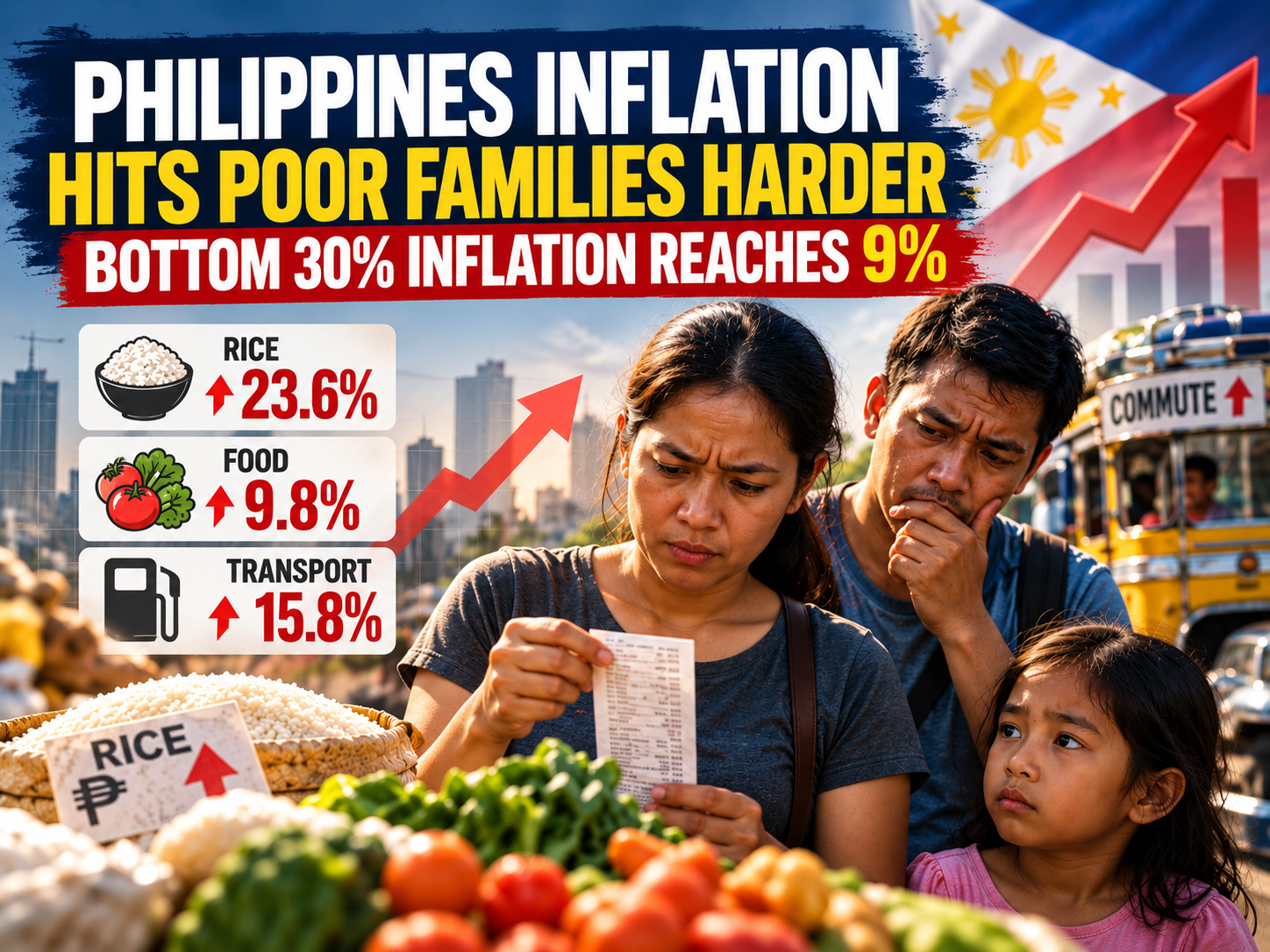
For Filipino households belonging to the bottom 30% income group, inflation reached an even higher 9.0%, according to the latest data from the Philippine Statistics Authority (PSA).
That means many lower-income families are experiencing price increases significantly faster than the national average, with food, rice, transportation, electricity and other basic household expenses putting the greatest pressure on their budgets.
Inflation Reaches 9% for the Bottom 30%
The PSA reported that inflation among the bottom 30% of income households increased from 8.2% in August to 9.0% in September 2026.
The contrast with a year earlier is striking. In September 2025, this group recorded -0.2% inflation, meaning prices in its consumer basket had actually declined slightly compared with the previous year.
Average inflation for the bottom 30% from January through September 2026 now stands at 6.5%.
For comparison, overall Philippine inflation increased from 6.1% in August to 7.2% in September. The national average for the first nine months of 2026 was 5.4%.
September 2026 Inflation at a Glance
| Measure | August 2026 | September 2026 |
|---|---|---|
| Philippines headline inflation | 6.1% | 7.2% |
| Bottom 30% households | 8.2% | 9.0% |
| Bottom 30% food inflation | 8.3% | 9.8% |
| Bottom 30% rice inflation | 22.5% | 23.6% |
| Bottom 30% transport inflation | 15.3% | 15.8% |
The figures show why simply looking at the country’s headline inflation rate can hide how differently rising prices affect Filipino households.
Why Are Lower-Income Families Being Hit Harder?
The answer is largely about where families spend their money.
Lower-income households generally devote a greater portion of their budget to necessities. When food, rice, transportation, electricity and housing become more expensive, there is less room to reduce spending without affecting basic needs.
According to PSA data, three categories accounted for most of the 9% inflation experienced by the bottom 30%:
Food and non-alcoholic beverages contributed 55.7% of overall inflation, equivalent to 5.0 percentage points.
Housing, water, electricity, gas and other fuels contributed 17.5%, or around 1.6 percentage points.
Transportation accounted for another 11.2%, or approximately 1.0 percentage point.
Together, those three categories accounted for more than four-fifths of the inflation experienced by lower-income households.
Food Inflation Reaches 9.8%
Food is the biggest part of the story.
Food inflation for the bottom 30% increased from 8.3% in August to 9.8% in September.
The PSA identified vegetables as one of the main drivers. Inflation for vegetables, tubers, plantains, cooking bananas and pulses accelerated from just 1.2% in August to 9.0% in September.
Fish and seafood inflation reached 8.4%, while fruits and nuts increased by 8.9%.
Weather disruptions affecting agricultural production and distribution have contributed to the broader acceleration in food prices.
Rice Inflation Hits 23.6%
Perhaps the most concerning figure for lower-income households is rice.
Rice inflation for the bottom 30% reached 23.6% in September, up from 22.5% in August.
Rice and other cereals have an especially large impact because they are staple purchases rather than optional expenses.
The PSA found that cereals and cereal products—including rice, corn, flour, bread, pasta and other cereals—accounted for 75.2% of food inflation among bottom-30% households.
For the overall Philippine population, rice inflation was slightly lower but still extremely high at 20.3%, compared with 19.4% in August.
The difference shows that rising rice prices can have an outsized impact on families with smaller household budgets.
Transportation Costs Are Also Rising Fast
Transportation is another major pressure point.
Transport inflation for the bottom 30% increased from 15.3% in August to 15.8% in September.
For the country overall, transport inflation reached 14.6%, up from 13.5%.
This matters beyond commuting expenses.
Higher transportation and fuel costs can eventually work their way into the prices of other goods because businesses also have to pay more to transport food, merchandise and supplies around the country.
Housing, Electricity and Utilities Add More Pressure
Housing, water, electricity, gas and other fuels recorded 10.4% inflation among bottom-30% households in September.
Health costs increased by 6.1%, while restaurant and accommodation services increased by 7.7%.
These increases matter because families are not dealing with just one expensive item.
Higher food prices may be happening at the same time as higher electricity bills, transportation expenses and other household costs.
That combination can make the real effect of inflation feel considerably worse than a single national inflation figure suggests.
Metro Manila vs the Rest of the Philippines
The data also reveal a large geographic difference.
Inflation among bottom-30% households in the National Capital Region reached 5.7% in September.
For lower-income households in areas outside NCR, inflation reached 9.1%.
| Area | August 2026 | September 2026 |
|---|---|---|
| NCR, bottom 30% | 4.3% | 5.7% |
| Outside NCR, bottom 30% | 8.4% | 9.1% |
This suggests that the current cost-of-living problem is particularly severe for lower-income families outside Metro Manila.
The same regional pattern appears in the broader inflation data. Overall inflation was 5.4% in NCR compared with 7.6% outside NCR in September.
What Does 9% Inflation Actually Mean?
A 9% inflation rate does not mean every product became exactly 9% more expensive.
Inflation measures the average change in prices across a basket of goods and services typically purchased by households.
Some products can increase much faster.
Rice inflation among lower-income households, for example, was 23.6%, while transportation inflation was 15.8%.
Other products may increase more slowly or even become cheaper.
The important point is that the overall basket of goods and services used by lower-income households cost substantially more in September 2026 than it did a year earlier.
Why 7.2% Headline Inflation Doesn’t Tell the Whole Story
The national inflation rate remains important because it gives us a broad picture of price movements throughout the economy.
But averages can hide large differences between households.
A family with more disposable income may be able to adjust spending when prices increase—eat out less often, postpone a purchase or switch brands.
A household already spending most of its income on food, rent, electricity and transportation has fewer options.
That is why 9% inflation among the bottom 30% may have a much greater practical effect than the number alone suggests.
And food is particularly important.
More than half of the inflation experienced by these households came from food and non-alcoholic beverages.
Inflation Is Becoming More Widespread
There is another number worth watching.
Core inflation—which removes selected volatile food and energy items—increased from 4.1% in August to 4.7% in September.
That suggests inflationary pressure is not limited to a few products such as rice or fuel.
Nationally, food inflation increased to 6.8%, housing and utilities inflation reached 8.4%, and transportation inflation climbed to 14.6%.
The September headline inflation rate was also the highest since March 2023, matching the 7.2% recorded earlier in April 2026.
What Happens Next?
The next few months will be important.
Food supply conditions, weather disruptions, global oil prices, electricity costs, transportation fares and monetary policy can all affect where inflation goes next.
The September figures also mean policymakers must deal with two different realities: overall inflation is already well above the government’s 2% to 4% target range, while inflation experienced by lower-income households is even higher.
For ordinary Filipinos, however, the immediate concern is simpler.
Will food, transportation and utility prices continue rising faster than household incomes?
That is the number worth watching—not only whether national inflation goes up or down.
The Bottom Line
Philippine inflation reached 7.2% in September 2026, but lower-income households are facing an even tougher situation.
Inflation among the bottom 30% reached 9.0%.
Food inflation reached 9.8%.
Rice inflation reached 23.6%.
Transport inflation reached 15.8%.
And outside Metro Manila, inflation among lower-income households reached 9.1%.
Those figures show why discussions about inflation should go beyond the national headline number.
The impact of rising prices isn’t distributed equally. For families that already spend most of their income on necessities, another increase in rice, electricity, transportation or food can immediately put pressure on the household budget.
The Daily Caffeine will continue tracking the monthly inflation figures and what they mean for Filipino households.