
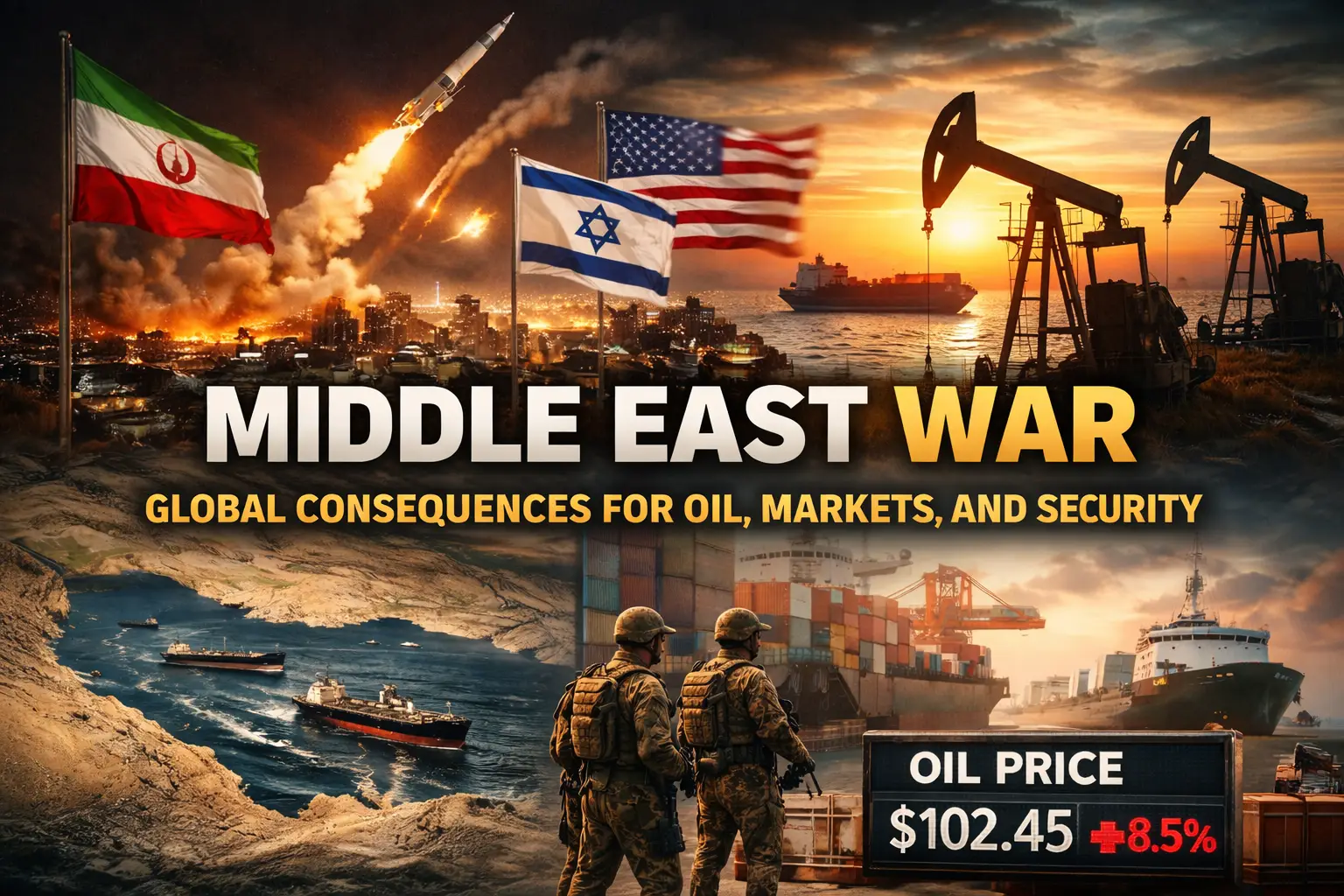
The Middle East is once again at the center of a global crisis. A rapidly escalating conflict involving Iran, the United States, and Israel has triggered missile attacks, disrupted shipping routes, and shaken energy markets worldwide. What began as military strikes and retaliation has quickly expanded into a geopolitical confrontation with consequences that extend far beyond the region.
For decades, the Middle East has been a critical hub for global energy supply, international trade routes, and geopolitical alliances. Now, the latest escalation threatens to reshape regional power dynamics while pushing oil prices higher and placing pressure on global supply chains.
This article examines how the conflict could reshape the Middle East, why oil markets are reacting so strongly, and how disruptions to shipping routes could ripple through the global economy.
The Escalation of a Regional War
The current crisis began with military strikes by the United States and Israel against targets in Iran. Tehran responded with retaliatory missile and drone attacks targeting infrastructure and strategic facilities across the region. The confrontation has rapidly widened, drawing in neighboring states and raising fears of a broader regional war.
Energy infrastructure has already been affected. Oil and gas facilities in several countries have been hit or forced to shut down due to security risks, and attacks on tankers and energy facilities have disrupted exports from the region.
The scale of the conflict has shocked international observers. Military operations have struck thousands of targets within Iran, while Tehran continues to threaten additional retaliation against regional economic centers.
This confrontation represents one of the most dangerous geopolitical flashpoints in recent years. If the fighting continues to escalate, the consequences could extend far beyond the battlefield.
Why the Middle East Matters to the Global Economy
To understand the stakes, it’s important to recognize the Middle East’s role in global energy and trade.
The region produces a large share of the world’s oil and natural gas. Countries such as Saudi Arabia, Iran, Iraq, Qatar, and the United Arab Emirates export energy to Asia, Europe, and North America. These exports travel through key maritime chokepoints that connect the Persian Gulf to global markets.
The most critical of these is the Strait of Hormuz—a narrow waterway between Iran and Oman that serves as one of the world’s most important oil shipping routes. Roughly 20% of global oil and liquefied natural gas shipments pass through this strait.
Any disruption to this route can immediately affect global energy prices and supply chains.
With the current conflict intensifying, this strategic chokepoint has become a major point of concern.
Oil Prices Surge as Energy Markets React
Energy markets respond quickly to geopolitical risk, and the Iran conflict has already pushed oil prices higher.
Global oil prices rose sharply following the military strikes and subsequent retaliation. Brent crude climbed to its highest levels in months, reflecting fears that the conflict could disrupt supplies from the region.
Analysts warn that the situation could worsen if fighting continues. Some forecasts suggest oil prices could exceed $100 per barrel if shipping through the Strait of Hormuz is severely disrupted.
Even before actual supply shortages occur, the fear of disruption is enough to move markets. Traders often price in geopolitical risk, meaning the mere possibility of supply interruptions can cause dramatic price increases.
If the conflict expands, oil prices could rise even further. Iranian officials have warned that prices could reach $200 per barrel if attacks continue against regional infrastructure.
Such a surge would have serious implications for the global economy.
The Inflation Domino Effect
Higher oil prices don’t just affect energy companies—they ripple through the entire global economy.
Oil is a foundational input for transportation, manufacturing, agriculture, and logistics. When oil prices rise, the cost of producing and delivering goods increases.
For consumers, this often translates into higher prices for:
- gasoline and diesel
- airline tickets
- food and agricultural products
- shipping and transportation
- manufactured goods
In many countries, energy costs are a key driver of inflation. If oil prices surge for a prolonged period, central banks may struggle to control rising prices.
Some economists warn that a major Middle East conflict could push inflation higher worldwide while slowing economic growth—a dangerous combination sometimes referred to as stagflation.
Even countries far removed from the conflict could feel the impact in their everyday cost of living.
The Strait of Hormuz: A Global Energy Lifeline
The Strait of Hormuz has long been considered one of the most vulnerable points in global energy security.
The waterway is extremely narrow—only about 33 kilometers wide at its narrowest point. Yet it carries a huge portion of global oil exports from the Persian Gulf to international markets.
In recent days, military tensions have severely disrupted traffic through the strait. Missile strikes, tanker attacks, and security concerns have caused ships to halt operations or reroute away from the area.
At one point, dozens of oil tankers were reported waiting in the Gulf, unable to safely navigate the waterway.
This disruption alone is enough to send shockwaves through global energy markets.
If the strait were fully closed—even temporarily—the consequences would be enormous.
Global Shipping Routes Are Under Pressure
Energy is not the only sector affected by the conflict. The war is also disrupting global shipping and logistics.
Thousands of ships have been delayed in the Persian Gulf due to the crisis, with hundreds waiting offshore or unable to leave ports.
This includes cargo carrying:
- pharmaceuticals from India
- semiconductors and electronics from Asia
- petrochemical products
- plastics and fertilizers
- consumer goods
With traditional routes becoming dangerous or inaccessible, shipping companies have begun rerouting vessels around Africa’s Cape of Good Hope—a much longer journey that increases travel time and fuel costs.
Air cargo has also been affected, as regional airspace closures and airport shutdowns have disrupted flights and cargo shipments.
These logistical disruptions could create shortages of certain goods while pushing up transportation costs.
Global Supply Chains at Risk
Modern supply chains are highly interconnected. A disruption in one region can quickly cascade through global manufacturing networks.
The Middle East plays a major role in producing oil-derived products such as plastics, chemicals, and fertilizers. If production or transport of these materials is interrupted, industries worldwide may feel the effects.
For example:
- Agriculture depends on fertilizers made from petrochemicals.
- Electronics manufacturing relies on complex global supply chains.
- The shipping industry depends heavily on fuel derived from oil.
When energy supply becomes unstable, entire industrial systems can be affected.
Supply chain experts warn that prolonged disruptions could lead to higher prices, delayed shipments, and shortages across multiple sectors.
Financial Markets React to Geopolitical Shock
Financial markets are also responding to the uncertainty.
Historically, wars and geopolitical crises create volatility in global markets. Investors often move money away from riskier assets and into safe havens such as gold or government bonds.
During the current conflict:
- global stock markets have experienced sharp swings
- energy stocks have surged
- safe-haven assets have gained popularity
Oil market volatility is especially sensitive to geopolitical risk. Even rumors of escalation can cause price spikes.
Markets are essentially trying to answer one question: Will the conflict expand or be contained?
The answer will determine how severe the economic consequences become.
A New Balance of Power in the Middle East
Beyond economic consequences, the conflict could reshape the political landscape of the Middle East.
The region already contains multiple overlapping rivalries involving Iran, Israel, Saudi Arabia, and various allied groups.
If the war expands, it could:
- redraw regional alliances
- weaken existing governments
- increase military spending
- deepen sectarian divisions
Countries in the Gulf region may strengthen security partnerships with Western powers, while Iran could deepen ties with geopolitical rivals such as Russia or China.
The result may be a more polarized and militarized Middle East.
The Risk of a Wider Global Conflict
One of the biggest fears surrounding the crisis is that it could draw in additional global powers.
The United States already has a significant military presence in the region. Meanwhile, countries such as Russia and China have strategic interests tied to energy markets and regional stability.
China, for example, relies heavily on Middle Eastern energy imports and has called for the protection of shipping routes through the Strait of Hormuz.
If the conflict expands or threatens international shipping lanes, outside powers may feel compelled to intervene diplomatically—or even militarily.
Such a scenario would dramatically increase the stakes of the conflict.
Could the Crisis Accelerate the Energy Transition?
Ironically, rising oil prices and supply disruptions could accelerate the global transition toward renewable energy.
High fossil fuel prices often make alternatives such as solar, wind, and electric vehicles more economically attractive.
Governments may respond to the crisis by:
- investing more heavily in renewable energy
- expanding energy storage technologies
- diversifying energy supply sources
- strengthening strategic oil reserves
Energy security has long been a major driver of technological change. A prolonged Middle East conflict could push many countries to reduce their dependence on imported oil.
The Uncertain Road Ahead
At the moment, the future of the conflict remains unclear.
Several scenarios are possible:
- Limited conflict – fighting remains localized and eventually de-escalates.
- Prolonged regional war – continued attacks disrupt energy markets and trade routes.
- Major escalation – additional countries or global powers become directly involved.
Each scenario carries different consequences for global markets and security.
What is clear, however, is that the world is closely watching the Middle East once again.
Conclusion
The escalating conflict involving Iran, the United States, and Israel has quickly become a global issue rather than a regional one.
Oil prices are rising, shipping routes are being disrupted, and supply chains are under pressure. With a critical energy corridor like the Strait of Hormuz at risk, the entire world economy is exposed to the consequences of instability in the Middle East.
The situation highlights how deeply interconnected the modern global system has become. A missile strike in the Persian Gulf can influence fuel prices in Europe, shipping delays in Asia, and inflation in developing countries.
Whether the conflict escalates or eventually de-escalates, its effects will likely linger. Energy markets, international trade, and geopolitical alliances may all be reshaped by what is unfolding today.
In a world dependent on global supply chains and energy security, the stakes of the Middle East conflict extend far beyond the region itself.
Sources and References
- Oil prices rise sharply after US‑Israeli attacks on Iran
Oil markets surged following strikes on Iran as investors feared disruptions to energy supplies and shipping routes in the Persian Gulf. - Shutdown of Strait of Hormuz raises fears of soaring oil prices
The escalation of the war threatens one of the world’s most important energy chokepoints and could disrupt a large portion of global oil shipments. - Global oil and gas prices soar as Iran crisis disrupts shipping and production
Missile attacks and infrastructure damage in the Gulf have delayed tanker shipments and pushed energy prices higher worldwide. - Middle East crisis pushes up oil prices – and could drive inflation rises too
Analysts warn that prolonged conflict could increase global inflation and slow economic growth due to rising fuel costs. - China calls for protection of vessels in the Strait of Hormuz amid soaring shipping costs
Shipping traffic has dropped sharply and freight rates have surged as the conflict threatens maritime security in the Gulf. - US‑Iran war widens across the region as attacks spread to Lebanon
The military confrontation has expanded beyond Iran, raising fears of a broader regional conflict. - US‑Iran war pushes oil prices higher as Strait of Hormuz shipping disrupted
Oil prices jumped after the escalation raised concerns about supply disruptions in the Persian Gulf.
Background and Data Sources
2026 Strait of Hormuz crisis overview
The crisis began after U.S.–Israeli strikes on Iran and retaliatory missile attacks, which halted shipping traffic through the strategic waterway.
Strait of Hormuz ship traffic slows to a crawl amid Iran war
The strategic waterway handles roughly one-fifth of global oil shipments, making it one of the most critical energy corridors in the world.
The global chokepoint in the Strait of Hormuz (Reuters graphics)
Around 20 million barrels of oil per day pass through the strait, highlighting its importance to global energy markets.
Economic impact of the 2026 Iran conflict
The conflict has caused oil price surges, financial market volatility, airspace closures, and supply chain disruptions worldwide.